







Question: Measuring Performance Four performance factors can be measured for any healthcare activity: structure, process, outcome and patient experience. Imagine you are a leader at the
Measuring Performance Four performance factors can be measured for any healthcare activity: structure, process, outcome and patient experience. Imagine you are a leader at the fictional Metro Health Clinic and have been assigned to determine what data will be used to measure the rate of issues identified in the case study. Carefully read the case study and tutorial, then complete the assignment. Case Scenario Metro-Health Family Practice Clinic is in the center of the city, off the
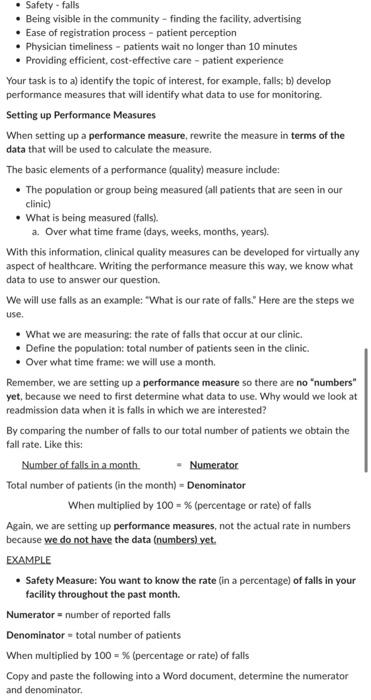
- Safety - falls - Being visible in the community - finding the facility, advertising - Ease of registration process - patient perception - Physician timeliness - patients wait no longer than 10 minutes - Providing efficient, cost-effective care - patient experience Your task is to a) identify the topic of interest, for example, falls; b) develop performance measures that will identify what data to use for monitoring. Setting up Performance Measures When setting up a performance measure, rewrite the measure in terms of the data that will be used to calculate the measure. The basic elements of a performance (quality) measure include: - The population or group being measured (all patients that are seen in our clinic) - What is being measured (falls). a. Over what time frame (days, weeks, months, years). With this information, clinical quality measures can be developed for virtually any aspect of healthcare. Writing the performance measure this way, we know what data to use to answer our question. We will use falls as an example: "What is our rate of falls." Here are the steps we use. - What we are measuring: the rate of falls that occur at our clinic. - Define the population: total number of patients seen in the clinic. - Over what time frame: we will use a month. Remember, we are setting up a performance measure so there are no "numbers" yet, because we need to first determine what data to use. Why would we look at readmission data when it is falls in which we are interested? By comparing the number of falls to our total number of patients we obtain the fall rate. Like this: Number of falls in a month. = Numerator. Total number of patients (in the month) = Denominator When multiplied by 100=% (percentage or rate) of falls Again, we are setting up performance measures, not the actual rate in numbers because we do not have the data (numbers) yet. EXAMPLE - Safety Measure: You want to know the rate (in a percentage) of falls in your facility throughout the past month. Numerator = number of reported falls Denominator = total number of patients When multiplied by 100=% (percentage or rate) of falls Copy and paste the following into a Word document, determine the numerator and denominator. - Safety - falls - Being visible in the community - finding the facility, advertising - Ease of registration process - patient perception - Physician timeliness - patients wait no longer than 10 minutes - Providing efficient, cost-effective care - patient experience Your task is to a) identify the topic of interest, for example, falls; b) develop performance measures that will identify what data to use for monitoring. Setting up Performance Measures When setting up a performance measure, rewrite the measure in terms of the data that will be used to calculate the measure. The basic elements of a performance (quality) measure include: - The population or group being measured (all patients that are seen in our clinic) - What is being measured (falls). a. Over what time frame (days, weeks, months, years). With this information, clinical quality measures can be developed for virtually any aspect of healthcare. Writing the performance measure this way, we know what data to use to answer our question. We will use falls as an example: "What is our rate of falls." Here are the steps we use. - What we are measuring: the rate of falls that occur at our clinic. - Define the population: total number of patients seen in the clinic. - Over what time frame: we will use a month. Remember, we are setting up a performance measure so there are no "numbers" yet, because we need to first determine what data to use. Why would we look at readmission data when it is falls in which we are interested? By comparing the number of falls to our total number of patients we obtain the fall rate. Like this: Number of falls in a month. = Numerator. Total number of patients (in the month) = Denominator When multiplied by 100=% (percentage or rate) of falls Again, we are setting up performance measures, not the actual rate in numbers because we do not have the data (numbers) yet. EXAMPLE - Safety Measure: You want to know the rate (in a percentage) of falls in your facility throughout the past month. Numerator = number of reported falls Denominator = total number of patients When multiplied by 100=% (percentage or rate) of falls Copy and paste the following into a Word document, determine the numerator and denominator
Step by Step Solution
There are 3 Steps involved in it

Get step-by-step solutions from verified subject matter experts
 Study Help