Question: Merchants Under the UCC Case Submitting a text entry box or a file upload Due Sunday by 11:59pm Points 20 Available until Jul 5 at
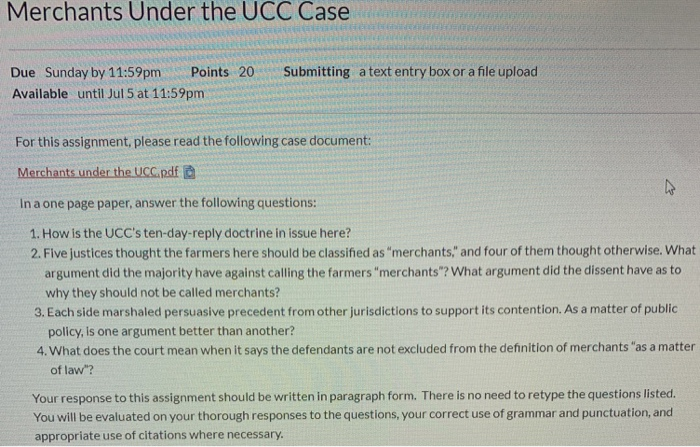
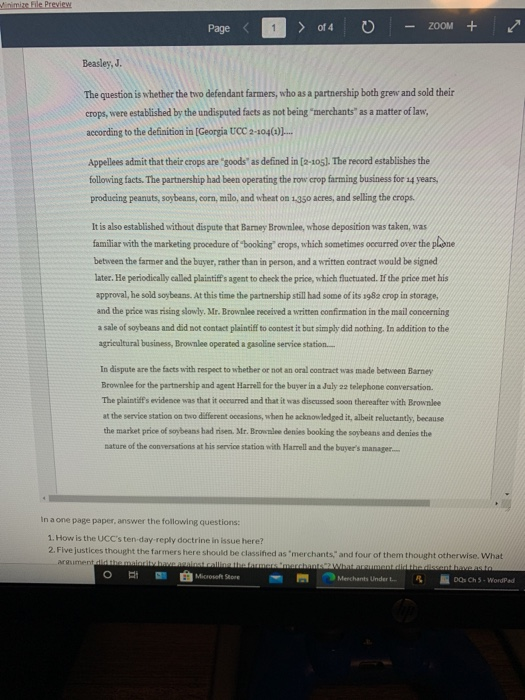
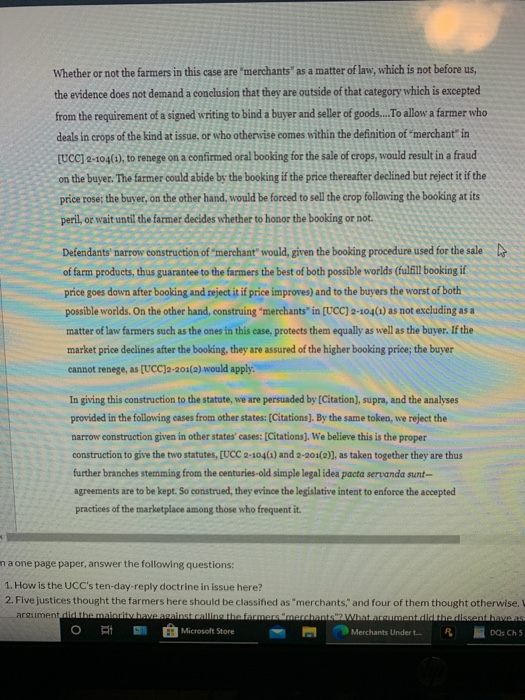
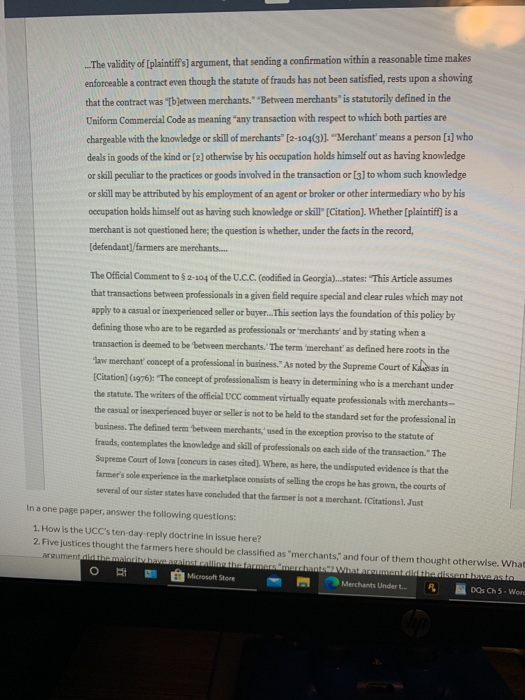
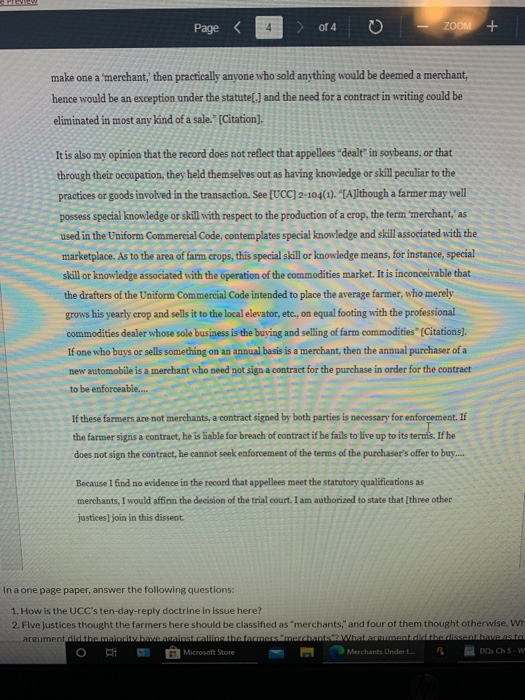
Merchants Under the UCC Case Submitting a text entry box or a file upload Due Sunday by 11:59pm Points 20 Available until Jul 5 at 11:59pm For this assignment, please read the following case document: Merchants under the UCC.pdf In a one page paper, answer the following questions: 1. How is the UCC's ten-day-reply doctrine in issue here? 2. Five justices thought the farmers here should be classified as "merchants," and four of them thought otherwise. What argument did the majority have against calling the farmers "merchants"? What argument did the dissent have as to why they should not be called merchants? 3. Each side marshaled persuasive precedent from other jurisdictions to support its contention. As a matter of public policy, is one argument better than another? 4. What does the court mean when it says the defendants are not excluded from the definition of merchants "as a matter of law"? Your response to this assignment should be written in paragraph form. There is no need to retype the questions listed. You will be evaluated on your thorough responses to the questions, your correct use of grammar and punctuation, and appropriate use of citations where necessary. Vinimize File Preview Page > of 4 o ZOOM + Beasley, J. The question is whether the two defendant farmers, who as a partnership both grew and sold their crops, were established by the undisputed facts as not being merchants" as a matter of law, according to the definition in Georgia UCC 2-104(1).... Appellees admit that their crops are "goods" as defined in [2-105). The record establishes the following facts. The partnership had been operating the row crop farming business for 14 years, producing peanuts, soybeans, corn, milo, and wheat on 1.350 acres, and selling the crops. It is also established without dispute that Barney Brownlee, whose deposition was taken, was familiar with the marketing procedure of booking crops, which sometimes occurred over the plane between the farmer and the buyer, rather than in person, and a written contract would be signed later. He periodically called plaintiff's agent to check the price, which fluctuated. If the price met his approval, he sold soybeans. At this time the partnership still had some of its 1982 crop in storage and the price was rising slowly. Mr. Brownlee received a written confirmation in the mail concerning a sale of soybeans and did not contact plaintiff to contest it but simply did nothing. In addition to the agricultural business, Brownlee operated a gasoline service station... In dispute are the facts with respect to whether or not an oral contract was made between Barney Brownlee for the partnership and agent Harrell for the buyer in a July 22 telephone conversation. The plaintiff's evidence was that it occurred and that it was discussed soon thereafter with Brownlee at the service station on two different occasions, when he acknowledged it, albeit reluctantly, because the market price of soybeans had risen. Mr. Brownlee denies booking the soybeans and denies the nature of the conversations at his service station with Harrell and the buyer's manager.... In a one page paper, answer the following questions: 1. How is the UCC's ten-day reply doctrine in issue here? 2. Five justices thought the farmers here should be classified as "merchants," and four of them thought otherwise. What argumenthemalediwalimhammarchantment did the decontato Microsoft Store Merchants Under DOCH S-WordPad o Whether or not the farmers in this case are "merchants' as a matter of law, which is not before us, the evidence does not demand a conclusion that they are outside of that category which is excepted from the requirement of a signed writing to bind a buyer and seller of goods....To allow a farmer who deals in crops of the kind at issue, or who otherwise comes within the definition of "merchant" in [UCC] 2-104(1), to renege on a confirmed oral booking for the sale of crops, would result in a fraud on the buyer. The farmer could abide by the booking if the price thereafter declined but reject it if the price rose; the buyer, on the other hand, would be forced to sell the crop following the booking at its peril, or wait until the farmer decides whether to honor the booking or not. Defendants' narrow construction of merchant" would, given the booking procedure used for the sale of farm products, thus guarantee to the farmers the best of both possible worlds (fulfill booking if price goes down after booking and reject it if price improves) and to the buyers the worst of both possible worlds. On the other hand, construing "merchants" in (UCC) 2-104(1) as not excluding as a matter of law farmers such as the ones in this case, protects them equally as well as the buyer. If the market price declines after the booking, they are assured of the higher booking price; the buyer cannot renege, as (UCC)2-201(2) would apply. In giving this construction to the statute, we are persuaded by [Citation), supra, and the analyses provided in the following cases from other states: [Citations). By the same token, we reject the narrow construction given in other states cases: [Citations). We believe this is the proper construction to give the two statutes, (UCC 2-104(1) and 2-201(2)), as taken together they are thus further branches stemming from the centuries-old simple legal idea pacta servanda sunt- agreements are to be kept. So construed, they evince the legislative intent to enforce the accepted practices of the marketplace among those who frequent it. ma one page paper, answer the following questions: 1. How is the UCC's ten-day-reply doctrine in issue here? 2. Five justices thought the farmers here should be classified as "merchants," and four of them thought otherwise argumentide malaltwave against calling the former merchants What asument.didithe discenti havas Microsoft Store Merchants Under Dah o The validity of (plaintiff's] argument, that sending a confirmation within a reasonable time makes enforceable a contract even though the statute of frauds has not been satisfied, rests upon a showing that the contract was "Ibjetween merchants." "Between merchants" is statutorily defined in the Uniform Commercial Code as meaning "any transaction with respect to which both parties are chargeable with the knowledge or skill of merchants" [2-104(3)). "Merchant means a person [1] who deals in goods of the kind or [2] otherwise by his occupation holds himself out as having knowledge or skill peculiar to the practices or goods involved in the transaction or [3] to whom such knowledge or skill may be attributed by his employment of an agent or broker or other intermediary who by his occupation holds himself out as having such knowledge or skill" (Citation). Whether (plaintiff) is a merchant is not questioned here; the question is whether, under the facts in the record, (defendant]/farmers are merchants.... The Official Comment to $ 2-104 of the U.C.C. (codified in Georgia)...states: This Article assumes that transactions between professionals in a given field require special and clear rules which may not apply to a casual or inexperienced seller or buyer... This section lays the foundation of this policy by defining those who are to be regarded as professionals or 'merchants' and by stating when a transaction is deemed to be between merchants. The term 'merchant' as defined here roots in the law merchant concept of a professional in business." As noted by the Supreme Court of Klaas in [Citation) (1976): "The concept of professionalism is heavy in determining who is a merchant under the statute. The writers of the official UCC comment virtually equate professionals with merchants- the casual or inexperienced buyer or seller is not to be held to the standard set for the professional in business. The defined term between merchants,' used in the exception proviso to the statute of frauds, contemplates the knowledge and skill of professionals on each side of the transaction. The Supreme Court of lowa (concurs in cases cited]. Where, as here, the undisputed evidence is that the farmer's sole experience in the marketplace consists of selling the crops he has grown, the courts of several of our sister states have concluded that the farmer is not a merchant. Citations L. Just In a one page paper, answer the following questions: 1. How is the UCC'sten-day-reply doctrine in issue here? 2. Five justices thought the farmers here should be classified as "merchants," and four of them thought otherwise. What arsumented thematisch aanhemmandant Whatsaumont did the discontista Microsoft Store Merchants Undert R DOCH 5 - Were o BA Page of 4 o ZOOM + Beasley, J. The question is whether the two defendant farmers, who as a partnership both grew and sold their crops, were established by the undisputed facts as not being merchants" as a matter of law, according to the definition in Georgia UCC 2-104(1).... Appellees admit that their crops are "goods" as defined in [2-105). The record establishes the following facts. The partnership had been operating the row crop farming business for 14 years, producing peanuts, soybeans, corn, milo, and wheat on 1.350 acres, and selling the crops. It is also established without dispute that Barney Brownlee, whose deposition was taken, was familiar with the marketing procedure of booking crops, which sometimes occurred over the plane between the farmer and the buyer, rather than in person, and a written contract would be signed later. He periodically called plaintiff's agent to check the price, which fluctuated. If the price met his approval, he sold soybeans. At this time the partnership still had some of its 1982 crop in storage and the price was rising slowly. Mr. Brownlee received a written confirmation in the mail concerning a sale of soybeans and did not contact plaintiff to contest it but simply did nothing. In addition to the agricultural business, Brownlee operated a gasoline service station... In dispute are the facts with respect to whether or not an oral contract was made between Barney Brownlee for the partnership and agent Harrell for the buyer in a July 22 telephone conversation. The plaintiff's evidence was that it occurred and that it was discussed soon thereafter with Brownlee at the service station on two different occasions, when he acknowledged it, albeit reluctantly, because the market price of soybeans had risen. Mr. Brownlee denies booking the soybeans and denies the nature of the conversations at his service station with Harrell and the buyer's manager.... In a one page paper, answer the following questions: 1. How is the UCC's ten-day reply doctrine in issue here? 2. Five justices thought the farmers here should be classified as "merchants," and four of them thought otherwise. What argumenthemalediwalimhammarchantment did the decontato Microsoft Store Merchants Under DOCH S-WordPad o Whether or not the farmers in this case are "merchants' as a matter of law, which is not before us, the evidence does not demand a conclusion that they are outside of that category which is excepted from the requirement of a signed writing to bind a buyer and seller of goods....To allow a farmer who deals in crops of the kind at issue, or who otherwise comes within the definition of "merchant" in [UCC] 2-104(1), to renege on a confirmed oral booking for the sale of crops, would result in a fraud on the buyer. The farmer could abide by the booking if the price thereafter declined but reject it if the price rose; the buyer, on the other hand, would be forced to sell the crop following the booking at its peril, or wait until the farmer decides whether to honor the booking or not. Defendants' narrow construction of merchant" would, given the booking procedure used for the sale of farm products, thus guarantee to the farmers the best of both possible worlds (fulfill booking if price goes down after booking and reject it if price improves) and to the buyers the worst of both possible worlds. On the other hand, construing "merchants" in (UCC) 2-104(1) as not excluding as a matter of law farmers such as the ones in this case, protects them equally as well as the buyer. If the market price declines after the booking, they are assured of the higher booking price; the buyer cannot renege, as (UCC)2-201(2) would apply. In giving this construction to the statute, we are persuaded by [Citation), supra, and the analyses provided in the following cases from other states: [Citations). By the same token, we reject the narrow construction given in other states cases: [Citations). We believe this is the proper construction to give the two statutes, (UCC 2-104(1) and 2-201(2)), as taken together they are thus further branches stemming from the centuries-old simple legal idea pacta servanda sunt- agreements are to be kept. So construed, they evince the legislative intent to enforce the accepted practices of the marketplace among those who frequent it. ma one page paper, answer the following questions: 1. How is the UCC's ten-day-reply doctrine in issue here? 2. Five justices thought the farmers here should be classified as "merchants," and four of them thought otherwise argumentide malaltwave against calling the former merchants What asument.didithe discenti havas Microsoft Store Merchants Under Dah o The validity of (plaintiff's] argument, that sending a confirmation within a reasonable time makes enforceable a contract even though the statute of frauds has not been satisfied, rests upon a showing that the contract was "Ibjetween merchants." "Between merchants" is statutorily defined in the Uniform Commercial Code as meaning "any transaction with respect to which both parties are chargeable with the knowledge or skill of merchants" [2-104(3)). "Merchant means a person [1] who deals in goods of the kind or [2] otherwise by his occupation holds himself out as having knowledge or skill peculiar to the practices or goods involved in the transaction or [3] to whom such knowledge or skill may be attributed by his employment of an agent or broker or other intermediary who by his occupation holds himself out as having such knowledge or skill" (Citation). Whether (plaintiff) is a merchant is not questioned here; the question is whether, under the facts in the record, (defendant]/farmers are merchants.... The Official Comment to $ 2-104 of the U.C.C. (codified in Georgia)...states: This Article assumes that transactions between professionals in a given field require special and clear rules which may not apply to a casual or inexperienced seller or buyer... This section lays the foundation of this policy by defining those who are to be regarded as professionals or 'merchants' and by stating when a transaction is deemed to be between merchants. The term 'merchant' as defined here roots in the law merchant concept of a professional in business." As noted by the Supreme Court of Klaas in [Citation) (1976): "The concept of professionalism is heavy in determining who is a merchant under the statute. The writers of the official UCC comment virtually equate professionals with merchants- the casual or inexperienced buyer or seller is not to be held to the standard set for the professional in business. The defined term between merchants,' used in the exception proviso to the statute of frauds, contemplates the knowledge and skill of professionals on each side of the transaction. The Supreme Court of lowa (concurs in cases cited]. Where, as here, the undisputed evidence is that the farmer's sole experience in the marketplace consists of selling the crops he has grown, the courts of several of our sister states have concluded that the farmer is not a merchant. Citations L. Just In a one page paper, answer the following questions: 1. How is the UCC'sten-day-reply doctrine in issue here? 2. Five justices thought the farmers here should be classified as "merchants," and four of them thought otherwise. What arsumented thematisch aanhemmandant Whatsaumont did the discontista Microsoft Store Merchants Undert R DOCH 5 - Were o BA Page









 Study Help