







Question: Method 1: Thinning Method As the value is changing over time, it can be difficult to simulate the process directly. Thinning method is based on
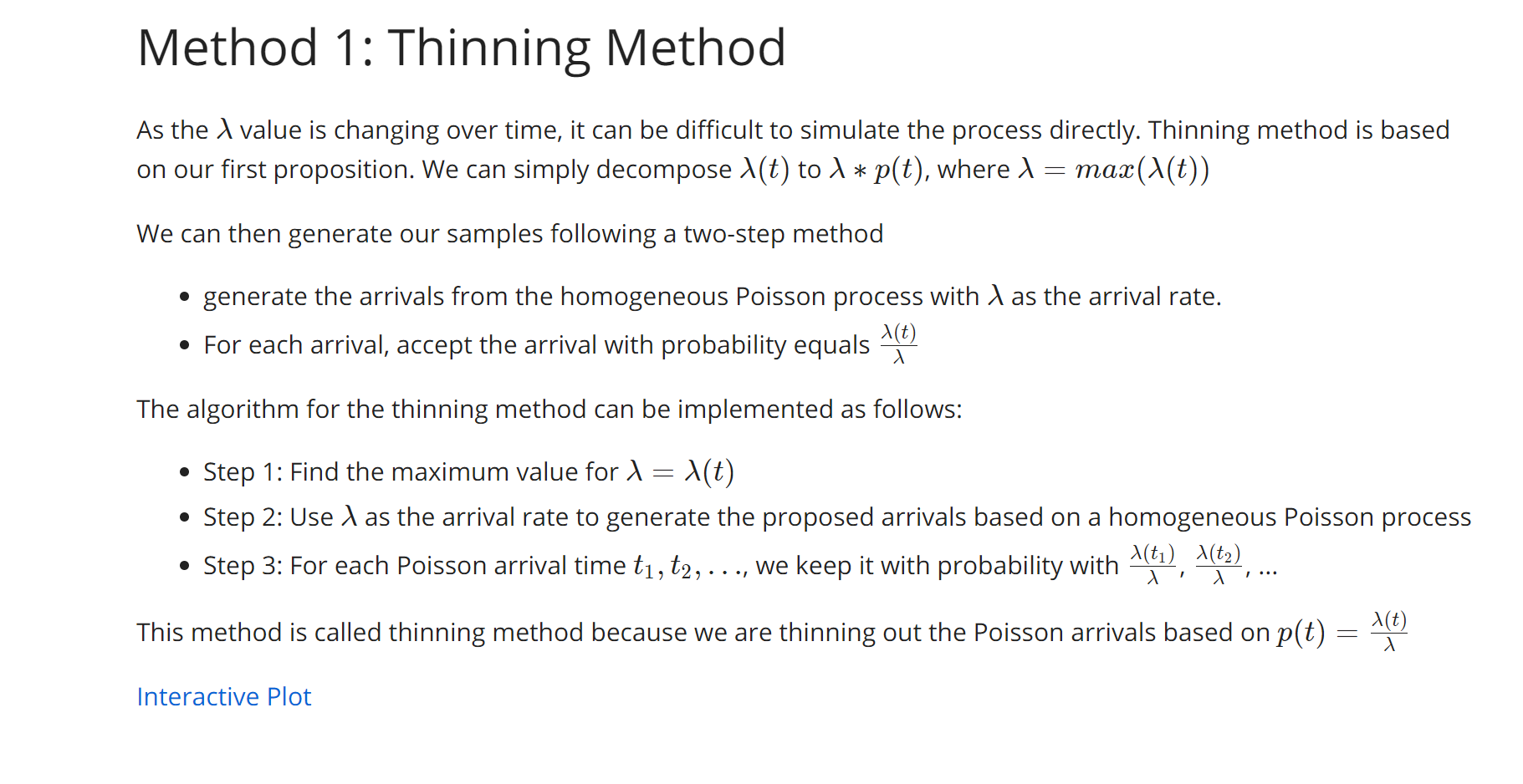
Method 1: Thinning Method As the value is changing over time, it can be difficult to simulate the process directly. Thinning method is based on our first proposition. We can simply decompose \(t) to .* p(t), where l = max(\(t)) We can then generate our samples following a two-step method generate the arrivals from the homogeneous Poisson process with l as the arrival rate. 1(t) For each arrival, accept the arrival with probability equals The algorithm for the thinning method can be implemented as follows: Step 1: Find the maximum value for 1 = \(t) Step 2: Use l as the arrival rate to generate the proposed arrivals based on a homogeneous Poisson process Step 3: For each Poisson arrival time t, t2, ..., we keep it with probability with 1(ti), 1(t2) This method is called thinning method because we are thinning out the Poisson arrivals based on p(t) - "(t) 2 Interactive Plot Method 1: Thinning Method As the value is changing over time, it can be difficult to simulate the process directly. Thinning method is based on our first proposition. We can simply decompose \(t) to .* p(t), where l = max(\(t)) We can then generate our samples following a two-step method generate the arrivals from the homogeneous Poisson process with l as the arrival rate. 1(t) For each arrival, accept the arrival with probability equals The algorithm for the thinning method can be implemented as follows: Step 1: Find the maximum value for 1 = \(t) Step 2: Use l as the arrival rate to generate the proposed arrivals based on a homogeneous Poisson process Step 3: For each Poisson arrival time t, t2, ..., we keep it with probability with 1(ti), 1(t2) This method is called thinning method because we are thinning out the Poisson arrivals based on p(t) - "(t) 2 Interactive Plot
Step by Step Solution
There are 3 Steps involved in it

Get step-by-step solutions from verified subject matter experts
 Study Help