



Question: & MICRO& Question E [24'] points} lEonsider the following economy. Time is discrete and runs forever, t = ,1,2,... The emnomy is populated by two
& MICRO&
![& MICRO& Question E [24'] points} lEonsider the following economy. Time is](https://s3.amazonaws.com/si.experts.images/answers/2024/07/66890283657d8_107668902834655e.jpg)
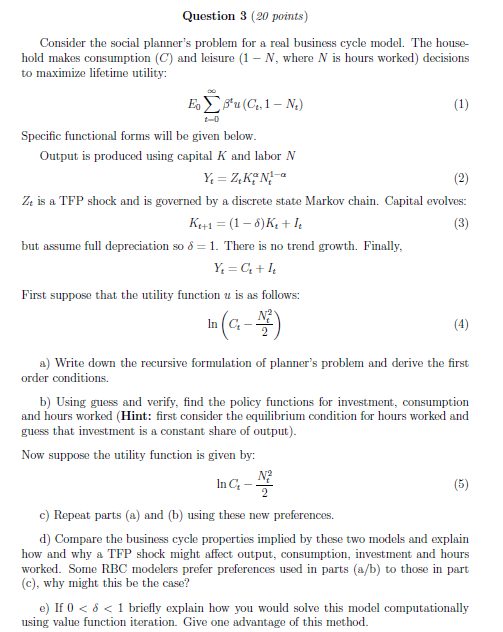
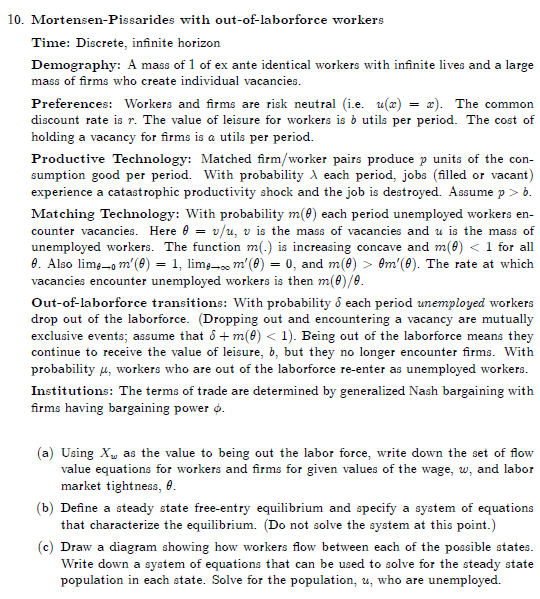
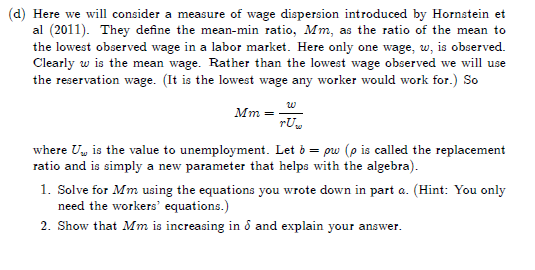
Question E [24'] points} lEonsider the following economy. Time is discrete and runs forever, t = ,1,2,... The emnomy is populated by two types of agents [a measure one of each}: farmers and workers. Earmess own a piece of land that pays a stochastic income 1;. every period. We assume that y: is i_i_d_ across Earmers and time, and that y, m NEE-ca}. Farmers use all their time working their land. Their preferences are given by m} = J'EPlT'Tcl [21) Iior some 1' :n- D. For simplicity, we assume that consumption of farmers can be negative, that is c E R. Moreover, farmers can save {or borrow if negative} in a non-state contingent and non-defaultahle asset c, which has a rate of return 1'. Farmers [ace the thllowing \"No-Fonsi\" condition on assets } a [22) Moreover, farmers can produce and hold capital, k, which is rented to the representative rm in competitive markets [1 unit of nal consumption good produces 1 unit of capital}. Let 1"\" be the rental rate of capital and .5 the depreciation rate. Unlike Earmers, workers don't own land, and they use their available time to work in the representative firm. Assume each worker is endowed with one unit of time. They cannot trade the asset a, but they can produce and hold capital, it [with the same tedinology as farmers]. Their per-period utility is given by u[c], with tr'l[c}| :3- D, tn"{c] a: ll, limu u'{c] = cc, limhm u't'c} = D. Finally1 there is a representative rm that combines capital and labor to pro duce nal good according to liL}, where K is the capital they operate, and L the hoursfworkers they hire. Assume -JI satises the standard Inada conditions. Thus, the only nancial market available in this economy is the market [or assets c, where only farmers can trade. l'vlorvecver1 there is a market for k. where all agents can trade. Both type of agents have the same discount factor ,3 E {11,1}. a} Given a constant path [or r and r\Question 3 [21'] points} lConsider the social plamler's problem for a real business cycle model. The house hold makes consumption [Cl and leisure [l N, where N is hours worked] decisions to maximise lifetime utility: oZ'u (0.,1 N=} (1:: [-0 Specic functional forms will be given below. Output is produced using capital K and labor N t = see\" [231 Z; is e. TFP shock end is governed by ediscrete stole Markov chain. Capital evolves: Kf+1:{l_':lri+ft [3] but assume full depreciation so a = 1. There is no trend growth. Finally, H=Q+t First suppose thst the utility function u is as follows: In (it g) [4) a} 1ll'll'rrite don] the recursive forrmllation of planner's problem and derive the rst order conditions b] Using guess and verify, nd the policy functions for investment, consumption and hours worked (Hint: rst consider the equilibrium condition for hours worked and guess that investment is a cornstant shore of output}. Now suppose the utility function is given by: hillg to c} Repeat parts {s} and Eb} using these new preferences. d] lCompare the business cycle properties implied by these two models end explain how and 1Ivl'ry a TFP she-ck might affect output, consumption, investment and hours worked. Some REC modelers prefer preferences used in ports {sub} to those in port [c], why might this be the case? e} If U -:: :5 c I briey explain how you 1would solve this model oomputstionally using value function iteration. Give one advantage of this method. 10. Mortensen-Pissarides with out-of-laborforce workers Time: Discrete, infinite horizon Demography: A mass of 1 of ex ante identical workers with infinite lives and a large mass of firms who create individual vacancies. Preferences: Workers and firms are risk neutral (i.e. u(x) = x). The common discount rate is r. The value of leisure for workers is b utils per period. The cost of holding a vacancy for firms is a utils per period. Productive Technology: Matched firm/ worker pairs produce p units of the con- sumption good per period. With probability A each period, jobs (filled or vacant) experience a catastrophic productivity shock and the job is destroyed. Assume p > b. Matching Technology: With probability m() each period unemployed workers en- counter vacancies. Here # = v/u, v is the mass of vacancies and u is the mass of unemployed workers. The function m(.) is increasing concave and m() 0m'(0). The rate at which vacancies encounter unemployed workers is then m(0)/e. Out-of-laborforce transitions: With probability o each period unemployed workers drop out of the laborforce. (Dropping out and encountering a vacancy are mutually exclusive events; assume that o + m()
Step by Step Solution
There are 3 Steps involved in it

Get step-by-step solutions from verified subject matter experts