







Question: microwaves. Microwave heating is different from the conventional heating in many aspects. This problem focuses on one of those aspects. Consider two identical solid slabs
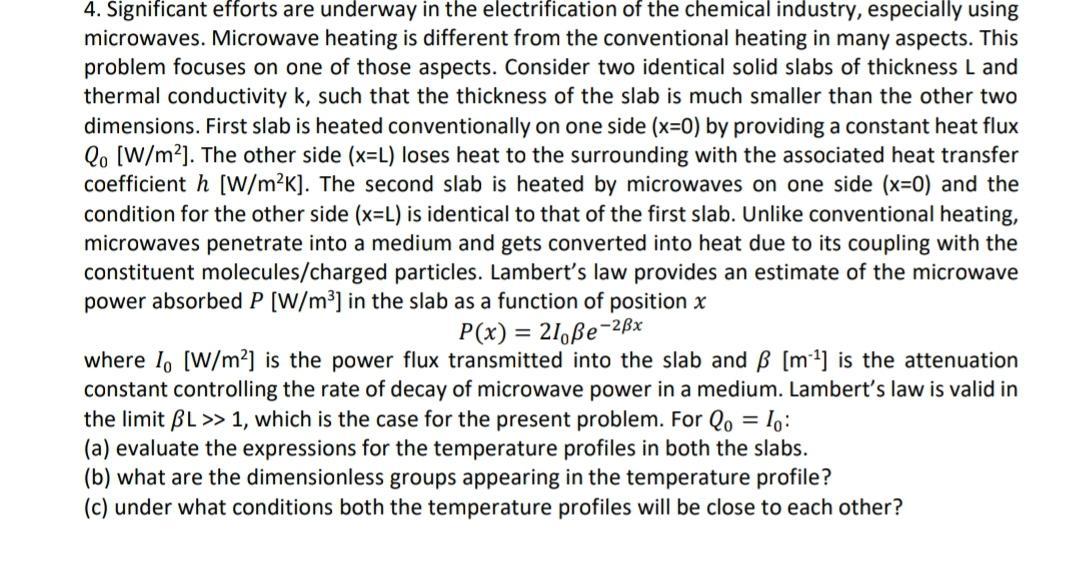
microwaves. Microwave heating is different from the conventional heating in many aspects. This problem focuses on one of those aspects. Consider two identical solid slabs of thickness L and thermal conductivity k, such that the thickness of the slab is much smaller than the other two dimensions. First slab is heated conventionally on one side (x=0) by providing a constant heat flux Q0[W/m2]. The other side (x=L) loses heat to the surrounding with the associated heat transfer coefficient h[W/m2K]. The second slab is heated by microwaves on one side (x=0) and the condition for the other side (x=L) is identical to that of the first slab. Unlike conventional heating, microwaves penetrate into a medium and gets converted into heat due to its coupling with the constituent molecules/charged particles. Lambert's law provides an estimate of the microwave power absorbed P[W/m3] in the slab as a function of position x P(x)=2I0e2x where I0[W/m2] is the power flux transmitted into the slab and [m1] is the attenuation constant controlling the rate of decay of microwave power in a medium. Lambert's law is valid in the limit L>, which is the case for the present problem. For Q0=I0 : (a) evaluate the expressions for the temperature profiles in both the slabs. (b) what are the dimensionless groups appearing in the temperature profile? (c) under what conditions both the temperature profiles will be close to each other
Step by Step Solution
There are 3 Steps involved in it

Get step-by-step solutions from verified subject matter experts
 Study Help