



Question: Mikes Brewery is a small local brewery whose ale and beer are always in demand but whose production is limited by certain raw materials that
Mikes Brewery is a small local brewery whose ale and beer are always in demand but whose production is limited by certain raw materials that are in short supply. (Ale is a type of alcoholic beverage, similar to but heavier than beer.) The scarce materials are corn, hops, and barley malt (all of special high quality). A barrel of ale calls for different amounts of ingredients from a barrel of beer as follows:
RAW MATERIAL REQUIREMENTS
Raw material Ale (per barrel) Beer (per barrel)
Corn 6 pounds 14 pounds
Hops 5 ounces 4 ounces
Malt 35 pounds 20 pounds
For each day in the near future, Mikes Brewery will have the following quantities of raw materials available to them: 580 pounds of corn, 275 ounces of hops, and 1,390 pounds of malt. They also estimate that the contribution to earnings is $15 per barrel of ale and $25 per barrel of beer. Mikes Brewery believes that it can sell all the beverages it produces.
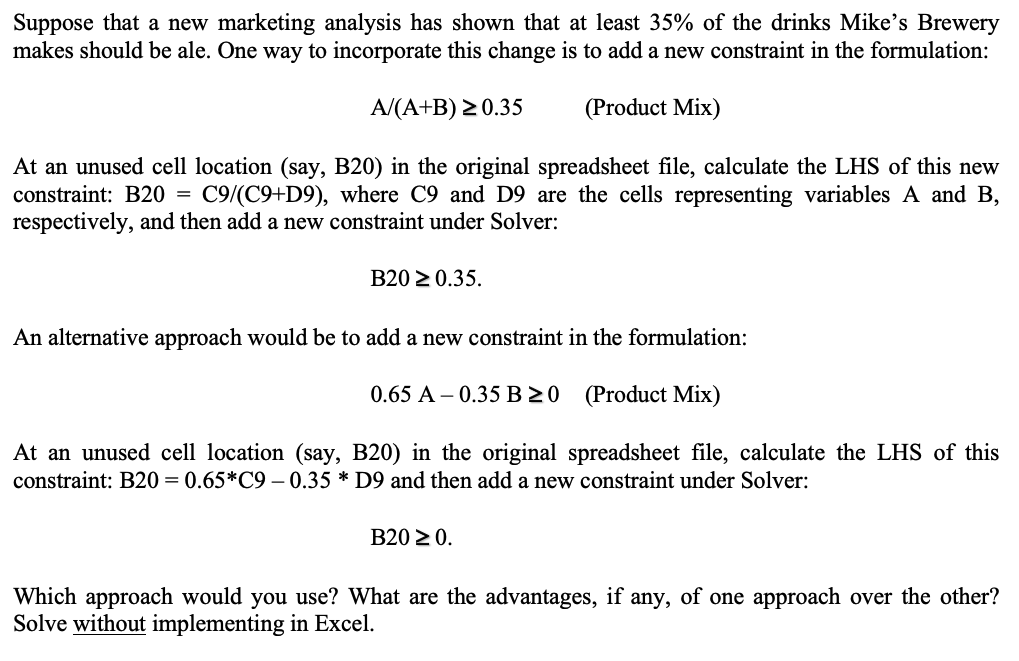
Let A and B be the daily production level of ale and beer (in barrels) at Mikes Brewery. Partial barrel production is allowed (e.g., A=10.25 is acceptable). Mike wants to use a linear programming model to solve this problem. The following linear optimization model will determine the best production plan:
Max 15 A + 25 B (contribution to earnings)
Subject to: 6 A + 14 B 580 (Corn Resource)
5 A + 4 B 275 (Hops Resource)
35A + 20 B 1,390 (Malt Resource)
A, B >= 0 (Nonnegativity)
Step by Step Solution
There are 3 Steps involved in it

Get step-by-step solutions from verified subject matter experts