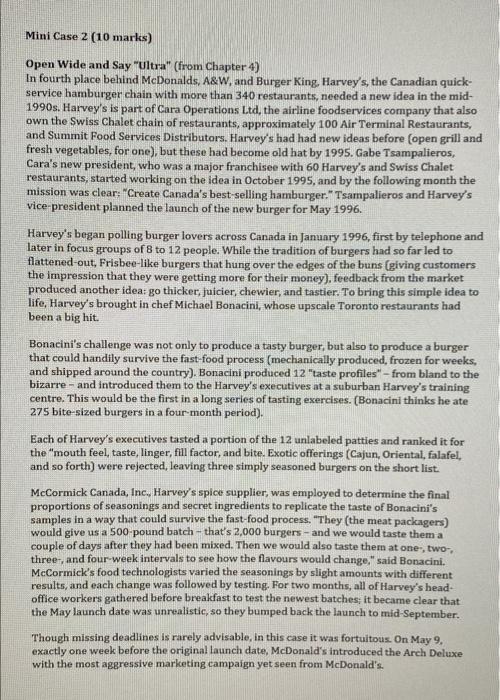
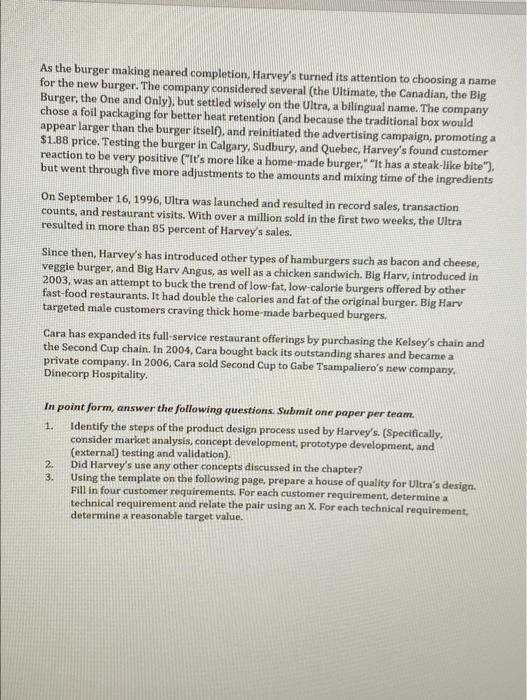
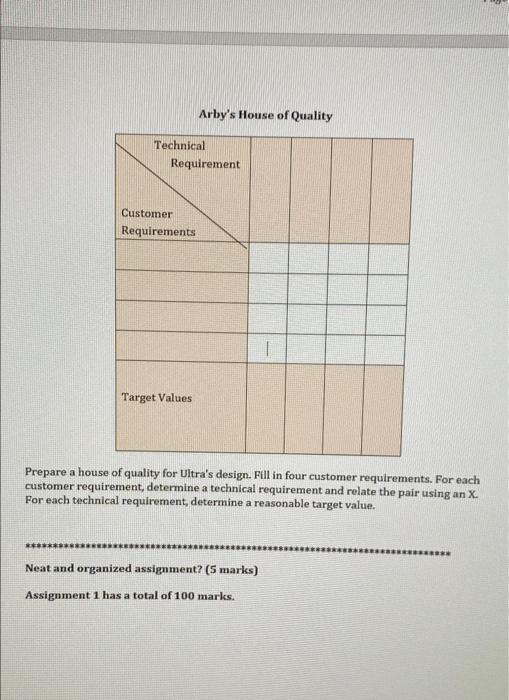
Mini Case 2 (10 marks) Open Wide and Say "Ultra" (from Chapter 4) In fourth place behind McDonalds, A&W, and Burger King, Harvey's, the Canadian quick- service hamburger chain with more than 340 restaurants, needed a new idea in the mid- 1990s. Harvey's is part of Cara Operations Ltd, the airline foodservices company that also own the Swiss Chalet chain of restaurants, approximately 100 Air Terminal Restaurants, and Summit Food Services Distributors. Harvey's had had new ideas before (open grill and fresh vegetables, for one), but these had become old hat by 1995. Gabe Tsampalieros, Cara's new president, who was a major franchisee with 60 Harvey's and Swiss Chalet restaurants, started working on the idea in October 1995, and by the following month the mission was clear: "Create Canada's best-selling hamburger." Tsampalieros and Harvey's vice-president planned the launch of the new burger for May 1996. Harvey's began polling burger lovers across Canada in January 1996, first by telephone and later in focus groups of 8 to 12 people. While the tradition of burgers had so far led to flattened-out, Frisbee-like burgers that hung over the edges of the buns (giving customers the impression that they were getting more for their money), feedback from the market produced another idea: go thicker, juicier, chewier, and tastier. To bring this simple idea to life, Harvey's brought in chef Michael Bonacini, whose upscale Toronto restaurants had been a big hit. Bonacini's challenge was not only to produce a tasty burger, but also to produce a burger that could handily survive the fast-food process (mechanically produced, frozen for weeks, and shipped around the country). Bonacini produced 12 "taste profiles" - from bland to the bizarre- and introduced them to the Harvey's executives at a suburban Harvey's training centre. This would be the first in a long series of tasting exercises. (Bonacini thinks he ate 275 bite-sized burgers in a four-month period). Each of Harvey's executives tasted a portion of the 12 unlabeled patties and ranked it for the "mouth feel, taste, linger, fill factor, and bite. Exotic offerings (Cajun, Oriental, falafel, and so forth) were rejected, leaving three simply seasoned burgers on the short list. McCormick Canada, Inc., Harvey's spice supplier, was employed to determine the final proportions of seasonings and secret ingredients to replicate the taste of Bonacini's samples in a way that could survive the fast-food process. "They (the meat packagers) would give us a 500-pound batch - that's 2,000 burgers - and we would taste them a couple of days after they had been mixed. Then we would also taste them at one, two-, three-, and four-week intervals to see how the flavours would change," said Bonacini. McCormick's food technologists varied the seasonings by slight amounts with different results, and each change was followed by testing. For two months, all of Harvey's head- office workers gathered before breakfast to test the newest batches; it became clear that the May launch date was unrealistic, so they bumped back the launch to mid-September. Though missing deadlines is rarely advisable, in this case it was fortuitous. On May 9, exactly one week before the original launch date, McDonald's introduced the Arch Deluxe with the most aggressive marketing campaign yet seen from McDonald's. As the burger making neared completion, Harvey's turned its attention to choosing a name for the new burger. The company considered several (the Ultimate, the Canadian, the Big Burger, the One and Only), but settled wisely on the Ultra, a bilingual name. The company chose a foil packaging for better heat retention (and because the traditional box would appear larger than the burger itself), and reinitiated the advertising campaign, promoting a $1.88 price. Testing the burger in Calgary, Sudbury, and Quebec, Harvey's found customer reaction to be very positive ("It's more like a home-made burger," "It has a steak-like bite"). but went through five more adjustments to the amounts and mixing time of the ingredients On September 16, 1996, Ultra was launched and resulted in record sales, transaction counts, and restaurant visits. With over a million sold in the first two weeks, the Ultra resulted in more than 85 percent of Harvey's sales. Since then, Harvey's has introduced other types of hamburgers such as bacon and cheese, veggie burger, and Big Harv Angus, as well as a chicken sandwich. Big Harv, introduced in 2003, was an attempt to buck the trend of low-fat, low-calorie burgers offered by other fast-food restaurants. It had double the calories and fat of the original burger. Big Harv targeted male customers craving thick home-made barbequed burgers. Cara has expanded its full-service restaurant offerings by purchasing the Kelsey's chain and the Second Cup chain. In 2004, Cara bought back its outstanding shares and became a private company. In 2006, Cara sold Second Cup to Gabe Tsampaliero's new company. Dinecorp Hospitality. In point form, answer the following questions. Submit one paper per team. 1. Identify the steps of the product design process used by Harvey's. (Specifically, consider market analysis, concept development, prototype development, and (external) testing and validation). 2. Did Harvey's use any other concepts discussed in the chapter? 3. Using the template on the following page, prepare a house of quality for Ultra's design. Fill in four customer requirements. For each customer requirement, determine a technical requirement and relate the pair using an X. For each technical requirement, determine a reasonable target value. Arby's House of Quality Technical Requirement Customer Requirements | Target Values. Prepare a house of quality for Ultra's design. Fill in four customer requirements. For each customer requirement, determine a technical requirement and relate the pair using an X. For each technical requirement, determine a reasonable target value. **** **** Neat and organized assignment? (5 marks) Assignment 1 has a total of 100 marks