







Question: MIPS please explain thoroughly how to do this, as i'm very confused 4.(Chapter 3.3) Using a table similar to that shown in Figure 3.6, calculate

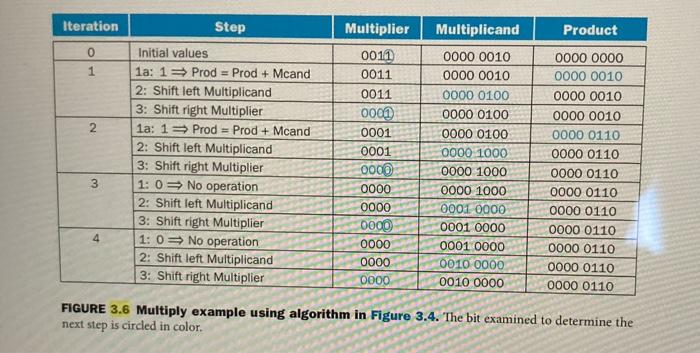
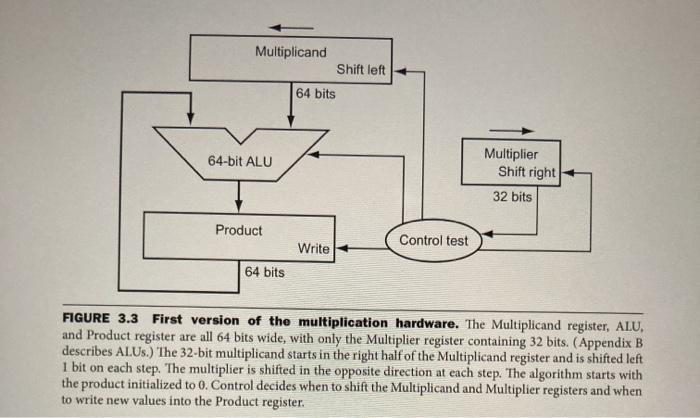
4.(Chapter 3.3) Using a table similar to that shown in Figure 3.6, calculate the product of the octal unsigned 6-bit integer 718 and 358 using the hardware described in Figure 3.3. You should show the contents of each register on each step. (8 points) Iteration Step Multiplicand Product Ol 1 2 Initial values 1a: 1 Prod = Prod + Mcand 2: Shift left Multiplicand 3: Shift right Multiplier 1a: 1 ProdProd + Mcand 2: Shift left Multiplicand 3: Shift right Multiplier 1:0 = No operation 2: Shift left Multiplicand 3: Shift right Multiplier 1:0= No operation 2: Shift left Multiplicand 3: Shift right Multiplier Multiplier 0011 0011 0011 0001 0001 0001 0000 0000 0000 0000 0000 0000 0000 0000 0010 0000 0010 0000 0100 0000 0100 0000 0100 0000 1000 0000 1000 0000 1000 0001 0000 0001 0000 0001 0000 0010 0000 0010 0000 0000 0000 0000 0010 0000 0010 0000 0010 0000 0110 0000 0110 0000 0110 0000 0110 0000 0110 0000 0110 0000 0110 0000 0110 0000 0110 3 FIGURE 3.6 Multiply example using algorithm in Figure 3.4. The bit examined to determine the next step is circled in color. Multiplicand Shift left 64 bits 64-bit ALU Multiplier Shift right 32 bits Product Control test Write 64 bits FIGURE 3.3 First version of the multiplication hardware. The Multiplicand register, ALU, and Product register are all 64 bits wide, with only the Multiplier register containing 32 bits. (Appendix B describes ALUs.) The 32-bit multiplicand starts in the right half of the Multiplicand register and is shifted left 1 bit on each step. The multiplier is shifted in the opposite direction at each step. The algorithm starts with the product initialized to 0. Control decides when to shift the Multiplicand and Multiplier registers and when to write new values into the Product register
Step by Step Solution
There are 3 Steps involved in it

Get step-by-step solutions from verified subject matter experts
 Study Help