







Question: MIPS using qtspim The code for file io.s is: # io.s .data prompt: .asciiz SPIM IO Test. Please type 6 input lines: nl: .asciiz
MIPS using qtspim
The code for file "io.s" is:
# io.s .data prompt: .asciiz "SPIM IO Test. Please type 6 input lines: " nl: .asciiz " " .text .globl main main: li $v0, 4 la $a0, prompt syscall # Register usage: # # s0 loop counter # t0 address of the recv_ctrl # t1 address of the recv_buffer # t2 address of the trans_ctrl # t3 address of the trans_buffer # t4, t5 temporaries # t6 char read from input # t7 1 => char in t6 li $s0 3 # loop counter li $t0 0xffff0000 li $t1 0xffff0004 li $t2 0xffff0008 li $t3 0xffff000c # First, read and echo 3 lines of input by polling the IO registers, not through interrupts: mtc0 $0,$12 # Clear IE bit in Status reg to disable interrupts l1: lw $t4, 0($t0) # Wait for receiver ready and $t4,$t4,1 beq $t4,0,l1 lw $t6,0($t1) # Read character l2: lw $t4,0($t2) # Wait for transmitter ready and $t4,$t4,1 beq $t4,0,l2 sw $t6,0($t3) # Write character beq $t6,0xa,decr # new line (nl) bne $t6,0xd,l1 # Carriage return (cr) decr: add $s0,$s0,-1 # Decrement line counter bne $s0,0,l1 # If not zero, get another line # Second, read and echo 3 lines of input by through interrupts: mfc0 $t4,$13 li $t5,0xffff00ff and $t4,$t4,$t5 # Clear IP bits in Cause register mtc0 $t4,$13 li $s0,3 # loop counter li $t4,0x2 # Enable device interrupts sw $t4,0($t0) sw $t4,0($t2) mfc0 $t4,$12 # Enable interrupts and mask in Status register ori $t4,$t4,0xff01 mtc0 $t4,$12 l3: j l3 # Loop waiting for interrupts # Interrupt handler. Replaces the standard SPIM handler. .ktext 0x80000180 mfc0 $t4,$13 # Get ExcCode field from Cause reg srl $t5,$t4,2 and $t5,$t5,0x1f # ExcCode field bne $t5,0,exception # Not interrupt, it is exception # An interrupt: and $t5,$t4,0x800 # Check for IP3 beq $t5,0,check_trans # Receiver interrupt: lw $t5,0($t0) # Check receiver ready and $t5,$t5,1 beq $t5,0,no_recv_ready # Error if receiver is not ready lw $t6,0($t1) # Read character li $t7,1 # Set a flag beq $t6, 0xa decr2 # new line (nl) bne $t6, 0xd next # Carriage return (cr) decr2: add $s0 $s0 -1 # Decrement line counter next: mfc0 $t4 $13 # Get Cause register li $t5,0xfffff7ff and $t4,$t4,$t5 # Clear IP3 bit in Cause register mtc0 $t4,$13 check_trans: beq $t7 0 ret_handler # No char to write yet and $t5 $t4 0x400 # Check for IP2 beq $t5 0 check_loop # Transmitter interrupt: lw $t5, 0($t2) # Check transmitter ready and $t5 $t5 1 beq $t5 0 no_trans_ready sw $t6 0($t3) # Write character li $t7 0 mfc0 $t4 $13 # Get Cause register and $t4, 0xfffffbff # Clear IP2 bit mtc0 $t4 $13 check_loop: bne $s0 0 ret_handler # If line counter not zero, get another line # Done echoing, so terminate program. li $v0 10 syscall # Return from handler. ret_handler: mfc0 $t4, $12 # Enable interrupts and mask in Status register ori $t4, $t4 0xff01 mtc0 $t4, $12 eret # return to interrupted instruction exception: li $v0, 4 # Non-interrupt exception la $a0, other_str # Print message and ignore syscall j ret_handler no_recv_ready: li $v0, 4 # Receiver was not ready after interrupt la $a0 no_recv_str # Print message and ignore syscall j ret_handler bad_int: li $v0, 4 # Interrupt was not from recv or trans la $a0, bad_int_str # Print message and ignore syscall j ret_handler no_trans_ready: li $v0, 4 # Transmitter was not ready after interrupt la $a0 no_trans_str # Print message and ignore syscall j ret_handler .data other_str: .asciiz "Non-interrupt exception " no_recv_str: .asciiz "Receiver not ready " no_trans_str: .asciiz "Transmitter not ready " bad_int_str: .asciiz "Unknown interrupt "
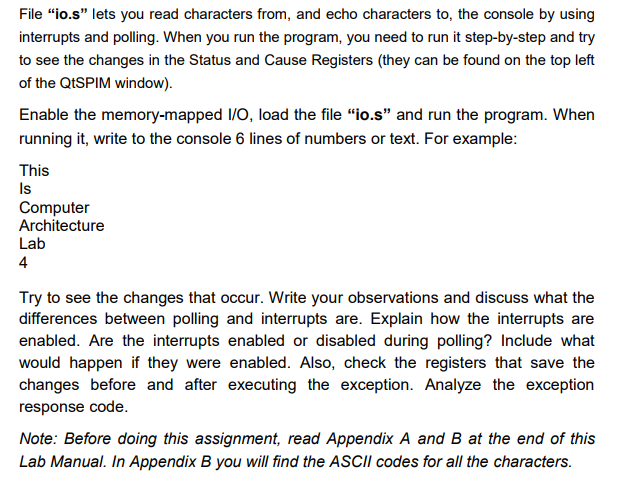
File "io.s" lets you read characters from, and echo characters to, the console by using interrupts and polling. When you run the program, you need to run it step-by-step and try to see the changes in the Status and Cause Registers (they can be found on the top left of the QtSPIM window). Enable the memory-mapped lVO, load the file "io.s" and run the program. When running it, write to the console 6 lines of numbers or text. For example: This Is Architecture Lab 4 Try to see the changes that occur. Write your observations and discuss what the differences between polling and interrupts are. Explain how the interrupts are enabled. Are the interrupts enabled or disabled during polling? Include what would happen if they were enabled. Also, check the registers that save the changes before and after executing the exception. Analyze the exception response code. Note: Before doing this assignment, read Appendix A and B at the end of this Lab Manual. In Appendix B you will find the ASCII codes for all the characters. File "io.s" lets you read characters from, and echo characters to, the console by using interrupts and polling. When you run the program, you need to run it step-by-step and try to see the changes in the Status and Cause Registers (they can be found on the top left of the QtSPIM window). Enable the memory-mapped lVO, load the file "io.s" and run the program. When running it, write to the console 6 lines of numbers or text. For example: This Is Architecture Lab 4 Try to see the changes that occur. Write your observations and discuss what the differences between polling and interrupts are. Explain how the interrupts are enabled. Are the interrupts enabled or disabled during polling? Include what would happen if they were enabled. Also, check the registers that save the changes before and after executing the exception. Analyze the exception response code. Note: Before doing this assignment, read Appendix A and B at the end of this Lab Manual. In Appendix B you will find the ASCII codes for all the characters
Step by Step Solution
There are 3 Steps involved in it

Get step-by-step solutions from verified subject matter experts
 Study Help