







Question: Mirror Inc. has developed a powerful efficient Golf Cart that is significantly less polluting than existing golf carts currently on the market. The company spent
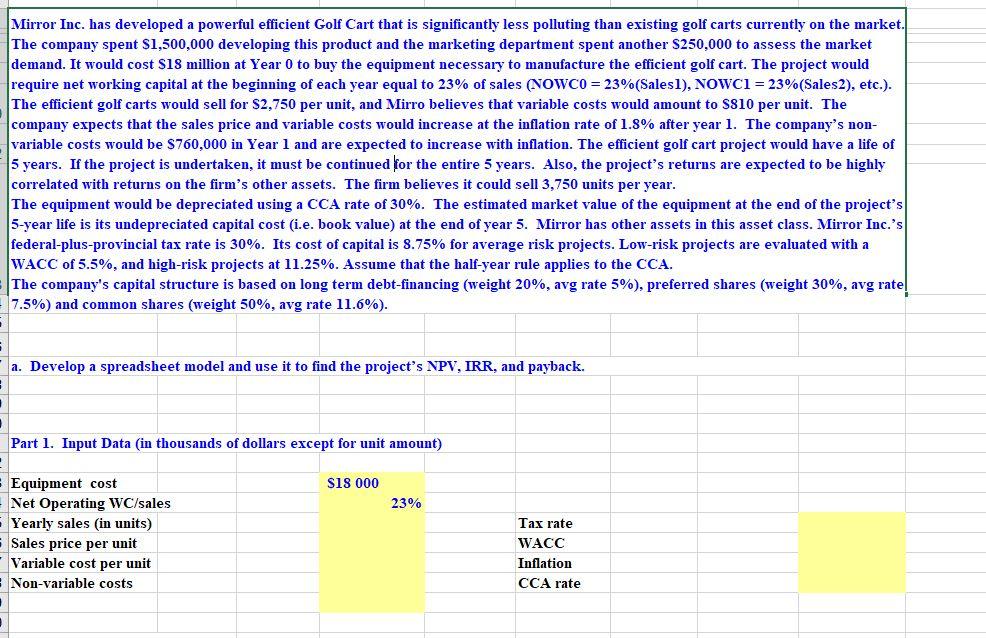
Mirror Inc. has developed a powerful efficient Golf Cart that is significantly less polluting than existing golf carts currently on the market. The company spent $1,500,000 developing this product and the marketing department spent another S250,000 to assess the market demand. It would cost $18 million at Year 0 to buy the equipment necessary to manufacture the efficient golf cart. The project would require net working capital at the beginning of each year equal to 23% of sales (NOWCO = 23%(Salesl), NOWC1 = 23%(Sales2), etc.). The efficient golf carts would sell for $2,750 per unit, and Mirro believes that variable costs would amount to $810 per unit. The company expects that the sales price and variable costs would increase at the inflation rate of 1.8% after year 1. The company's non- variable costs would be $760,000 in Year 1 and are expected to increase with inflation. The efficient golf cart project would have a life of 5 years. If the project is undertaken, it must be continued for the entire 5 years. Also, the project's returns are expected to be highly correlated with returns on the firm's other assets. The firm believes it could sell 3,750 units per year. The equipment would be depreciated using a CCA rate of 30%. The estimated market value of the equipment at the end of the project's 5-year life is its undepreciated capital cost (i.e. book value) at the end of year 5. Mirror has other assets in this asset class. Mirror Inc.'s federal-plus-provincial tax rate is 30%. Its cost of capital is 8.75% for average risk projects. Low-risk projects are evaluated with a WACC of 5.5%, and high-risk projects at 11.25%. Assume that the half-year rule applies to the CCA. The company's capital structure is based on long term debt-financing (weight 20%, avg rate 5%), preferred shares (weight 30%, avg rate 17.5%) and common shares (weight 50%, avg rate 11.6%). a. Develop a spreadsheet model and use it to find the project's NPV, IRR, and payback. Part 1. Input Data (in thousands of dollars except for unit amount) S18 000 23% Tax rate Equipment cost Net Operating WC/sales Yearly sales (in units) Sales price per unit Variable cost per unit Non-variable costs WACC Inflation CCA rate
Step by Step Solution
There are 3 Steps involved in it

Get step-by-step solutions from verified subject matter experts
 Study Help