Question: MIS 245 PAPER/COURSE PROJECT Course learning outcomes connected to this student deliverable include: Describe the use and function of management information systems (MIS) in global
MIS 245 PAPER/COURSE PROJECT
Course learning outcomes connected to this student deliverable include:
Describe the use and function of management information systems (MIS) in global business today.
Identify the major components of a computer-based information system, including hardware, software, operating systems, and operating environments.
Distinguish the components of wired and wireless telecommunications networks that support Internet, Intranet and Extranet systems which are integral to the successful operations of the modern firm.
Compare, evaluate, and select the most efficient and effective computer-based information systems from a management perspective.
Explain the interdependence and functionality of the hardware and software components of information systems and apply this knowledge to be able to advise and assist MIS staff about technical decisions.
Analyze how information technology can be used to synthesize complex data to enhance sound business decisions.
Examine the ethical and social issues associated with information systems confronting today's technology managers and the organizations for which they work.
Formulate processes and systems, in conjunction with technology personnel, to best leverage MIS for competitive advantage, including knowledge management, business intelligence, and customer intimacy.
Apply the knowledge obtained in this course in order to evaluate and mitigate security threats to the hardware and software systems of an organization.
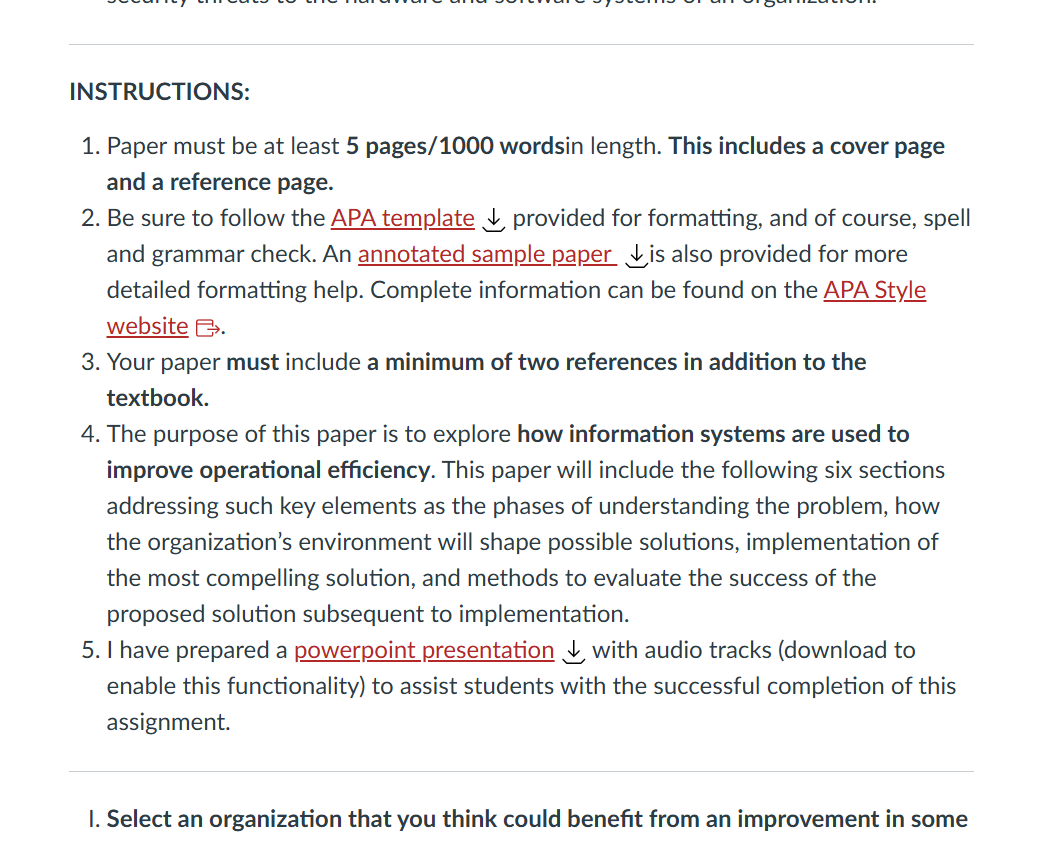
INSTRUCTIONS:
Paper must be at least5 pages/1000 wordsin length.This includes a cover page and a reference page.
Be sure to follow theAPA template provided for formatting, and of course, spell and grammar check.Anannotated sample paper is also provided for more detailed formatting help. Complete information can be found on theAPA Style websiteLinks to an external site..
Your papermustincludea minimum of two references in addition to the textbook.
The purpose of this paper is to explorehow information systems are used to improve operational efficiency. This paper will include the following six sections addressing such key elements as the phases of understanding the problem, how the organization's environment will shape possible solutions, implementation of the most compelling solution, and methods to evaluate the success of the proposed solution subsequent to implementation.
I have prepared apowerpoint presentation with audio tracks (download to enable this functionality) to assist students with the successful completion of this assignment.
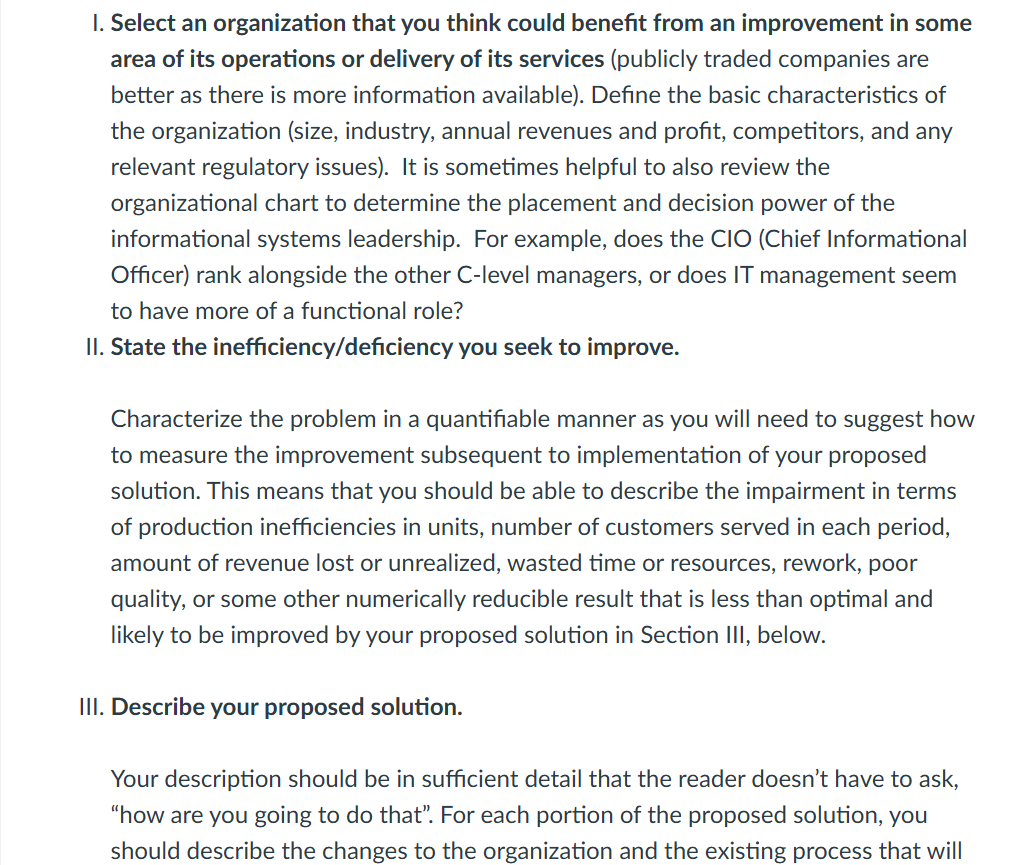
Select an organization that you think could benefit from an improvement in some area of its operations or delivery of its services(publicly traded companies are better as there is more information available).Define the basic characteristics of the organization (size, industry, annual revenues and profit, competitors, and any relevant regulatory issues).It is sometimes helpful to also review the organizational chart to determine the placement and decision power of the informational systems leadership.For example, does the CIO (Chief Informational Officer) rank alongside the other C-level managers, or does IT management seem to have more of a functional role?
State the inefficiency/deficiency you seek to improve. Characterize the problem in a quantifiable manner as you will need to suggest how to measure the improvement subsequent to implementation of your proposed solution. This means that you should be able to describe the impairment in terms of production inefficiencies in units, number of customers served in each period, amount of revenue lost or unrealized, wasted time or resources, rework, poor quality, or some other numerically reducible result that is less than optimal and likely to be improved by your proposed solution in Section III, below.
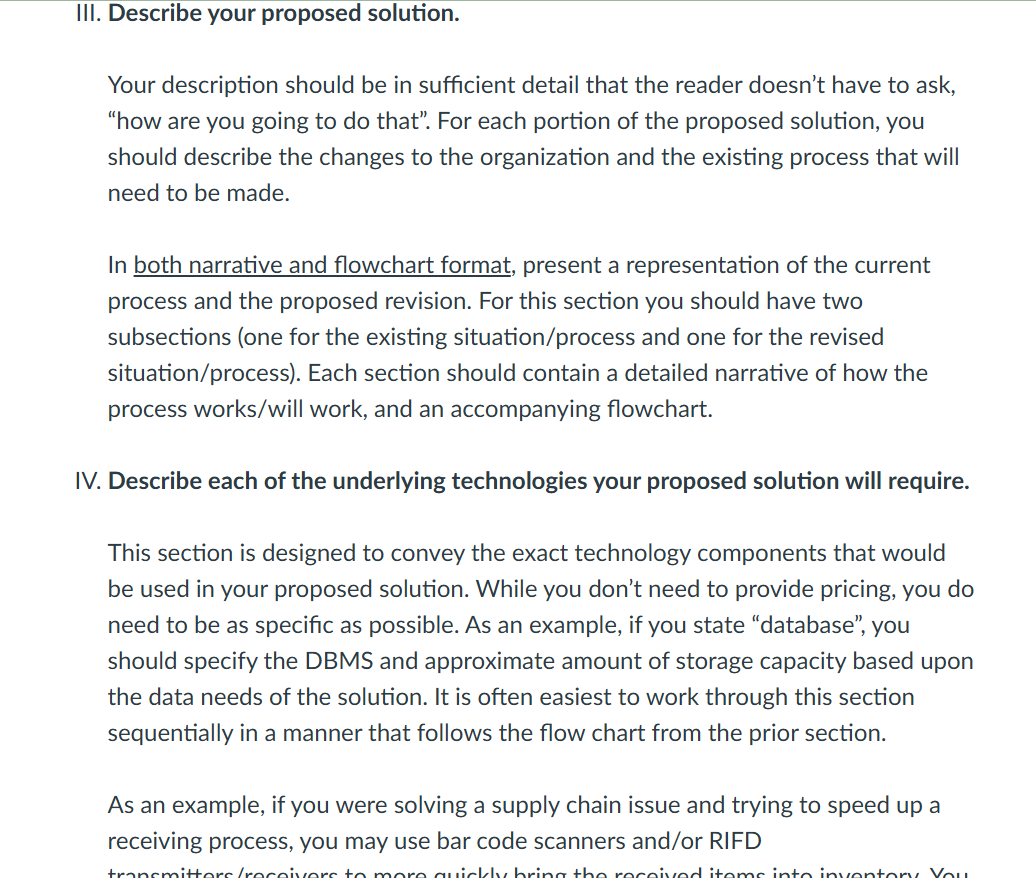
Describe your proposed solution. Your description should be in sufficient detail that the reader doesn't have to ask, "how are you going to do that". For each portion of the proposed solution, you should describe the changes to the organization and the existing process that will need to be made. Inboth narrative and flowchart format, present a representation of the current process and the proposed revision. For this section you should have two subsections (one for the existing situation/process and one for the revised situation/process). Each section should contain a detailed narrative of how the process works/will work, and an accompanying flowchart.
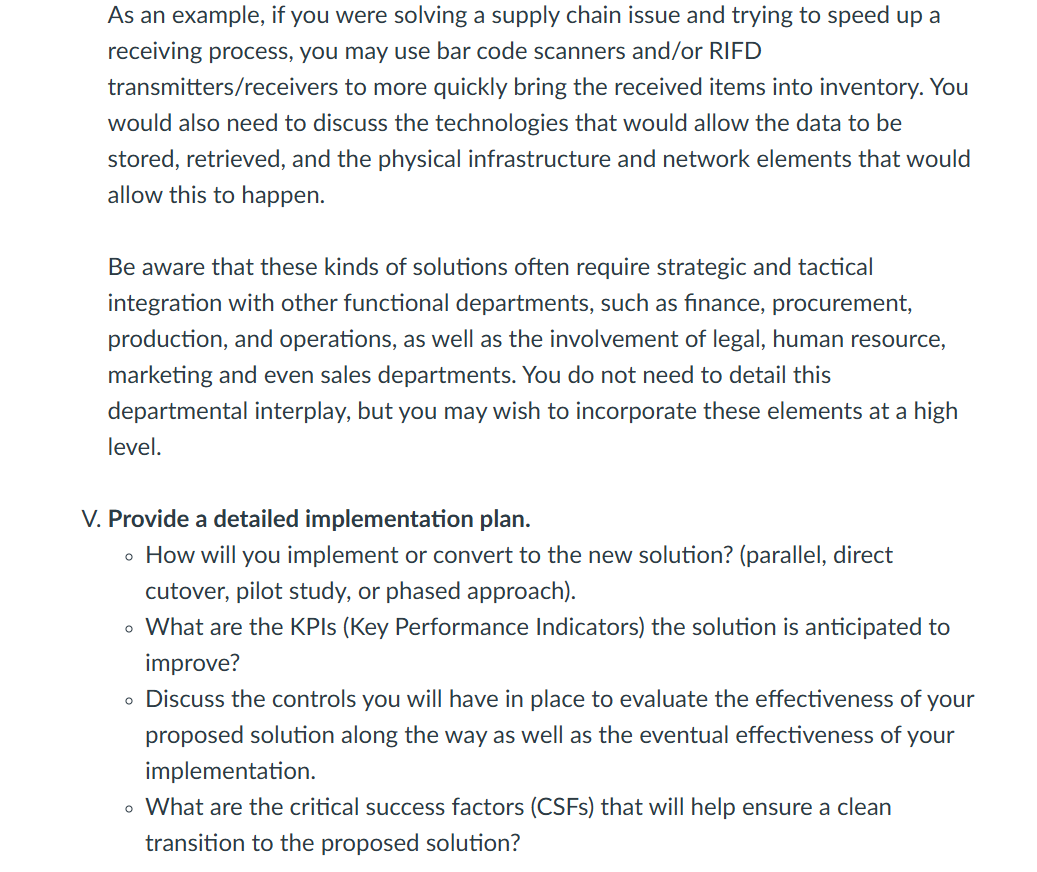
Describe each of the underlying technologies your proposed solution will require. This section is designed to convey the exact technology components that would be used in your proposed solution. While you don't need to provide pricing, you do need to be as specific as possible. As an example, if you state "database", you should specify the DBMS and approximate amount of storage capacity based upon the data needs of the solution. It is often easiest to work through this section sequentially in a manner that follows the flow chart from the prior section. As an example, if you were solving a supply chain issue and trying to speed up a receiving process, you may use bar code scanners and/or RIFD transmitters/receivers to more quickly bring the received items into inventory. You would also need to discuss the technologies that would allow the data to be stored, retrieved, and the physical infrastructure and network elements that would allow this to happen. Be aware that these kinds of solutions often require strategic and tactical integration with other functional departments, such as finance, procurement, production, and operations, as well as the involvement of legal, human resource, marketing and even sales departments.You do not need to detail this departmental interplay, but you may wish to incorporate these elements at a high level.
Provide a detailed implementation plan.
How will you implement or convert to the new solution? (parallel, direct cutover, pilot study, or phased approach).
What are the KPIs (Key Performance Indicators) the solution is anticipated to improve?
Discuss the controls you will have in place to evaluate the effectiveness of your proposed solution along the way as well as the eventual effectiveness of your implementation.
What are the critical success factors (CSFs) that will help ensure a clean transition to the proposed solution?
Provide a conclusion that summarizes the previous sections.The conclusion should recap the company, problem, and the proposed solution ending with a quantifiable benefit as the result of the proposed solution. This benefit should be in terms of not only production/service metrics, but also extrapolated into a revenue/profit increase, if applicable. As an example, if your solution reduced supply receiving time by "X" percent, that percentage would be deducted from the total human hours needed in a shift/day. Those human hours multiplied by the prevailing rate for that labor would give you an hourly savings, which would then be multiplied by however many units of the selected time measurement occur in a year.
MIS 245 PAPER/COURSE PROJECT Course learning outcomes connected to this student deliverable include: Describe the use and function of management information systems (MIS) in global business today. |dentify the major components of a computer-based information system, including hardware, software, operating systems, and operating environments. s trm e ma ot e e s e s e s ms s mr e e amma sy s em s e e e mam e e f e moms e |+ mam g we s g e business today. Identify the major components of a computer-based information system, including hardware, software, operating systems, and operating environments. Distinguish the components of wired and wireless telecommunications networks that support Internet, Intranet and Extranet systems which are integral to the successful operations of the modern firm. Compare, evaluate, and select the most efficient and effective computer-based information systems from a management perspective. Explain the interdependence and functionality of the hardware and software components of information systems and apply this knowledge to be able to advise and assist MIS staff about technical decisions. Analyze how information technology can be used to synthesize complex data to enhance sound business decisions. Examine the ethical and social issues associated with information systems confronting today's technology managers and the organizations for which they work. Formulate processes and systems, in conjunction with technology personnel, to best leverage MIS for competitive advantage, including knowledge management, business intelligence, and customer intimacy. Apply the knowledge obtained in this course in order to evaluate and mitigate security threats to the hardware and software systems of an organization. INSTRUCTIONS: e L e L e LI I L T e T INSTRUCTIONS: 1. Paper must be at least 5 pages/1000 wordsin length. This includes a cover page and a reference page. . Be sure to follow the APA template . provided for formatting, and of course, spell and grammar check. An annotated sample paper { is also provided for more detailed formatting help. Complete information can be found on the APA Style website . . Your paper must include a minimum of two references in addition to the textbook. . The purpose of this paper is to explore how information systems are used to improve operational efficiency. This paper will include the following six sections addressing such key elements as the phases of understanding the problem, how the organization's environment will shape possible solutions, implementation of the most compelling solution, and methods to evaluate the success of the proposed solution subsequent to implementation. . | have prepared a powerpoint presentation 4 with audio tracks (download to enable this functionality) to assist students with the successful completion of this assignment. . Select an organization that you think could benefit from an improvement in some Select an organization that you think could benefit from an improvement in some area of its operations or delivery of its services (publicly traded companies are better as there is more information available). Define the basic characteristics of the organization (size, industry, annual revenues and profit, competitors, and any relevant regulatory issues). It is sometimes helpful to also review the organizational chart to determine the placement and decision power of the informational systems leadership. For example, does the CIO (Chief Informational Officer) rank alongside the other C-level managers, or does IT management seem to have more of a functional role? . State the inefficiency/deficiency you seek to improve. Characterize the problem in a quantifiable manner as you will need to suggest how to measure the improvement subsequent to implementation of your proposed solution. This means that you should be able to describe the impairment in terms of production inefficiencies in units, number of customers served in each period, amount of revenue lost or unrealized, wasted time or resources, rework, poor quality, or some other numerically reducible result that is less than optimal and likely to be improved by your proposed solution in Section lll, below. Describe your proposed solution. Your description should be in sufficient detail that the reader doesn't have to ask, \"how are you going to do that\". For each portion of the proposed solution, you should describe the changes to the organization and the existing process that will Ill. Describe your proposed solution. Your description should be in sufficient detail that the reader doesn't have to ask, "how are you going to do that". For each portion of the proposed solution, you should describe the changes to the organization and the existing process that will need to be made. In both narrative and flowchart format, present a representation of the current process and the proposed revision. For this section you should have two subsections (one for the existing situation/process and one for the revised situation/process). Each section should contain a detailed narrative of how the process works/will work, and an accompanying flowchart. IV. Describe each of the underlying technologies your proposed solution will require. This section is designed to convey the exact technology components that would be used in your proposed solution. While you don't need to provide pricing, you do need to be as specific as possible. As an example, if you state "database", you should specify the DBMS and approximate amount of storage capacity based upon the data needs of the solution. It is often easiest to work through this section sequentially in a manner that follows the flow chart from the prior section. As an example, if you were solving a supply chain issue and trying to speed up a receiving process, you may use bar code scanners and/or RIFDAs an example, if you were solving a supply chain issue and trying to speed up a receiving process, you may use bar code scanners and/or RIFD transmitters/receivers to more quickly bring the received items into inventory. You would also need to discuss the technologies that would allow the data to be stored, retrieved, and the physical infrastructure and network elements that would allow this to happen. Be aware that these kinds of solutions often require strategic and tactical integration with other functional departments, such as finance, procurement, production, and operations, as well as the involvement of legal, human resource, marketing and even sales departments. You do not need to detail this departmental interplay, but you may wish to incorporate these elements at a high level. V. Provide a detailed implementation plan. o How will you implement or convert to the new solution? (parallel, direct cutover, pilot study, or phased approach). o What are the KPIs (Key Performance Indicators) the solution is anticipated to improve? o Discuss the controls you will have in place to evaluate the effectiveness of your proposed solution along the way as well as the eventual effectiveness of your implementation. o What are the critical success factors (CSFs) that will help ensure a clean transition to the proposed solution? V1. Provide a conclusion that summarizes the previous sections. The conclusion should recap the company, problem, and the proposed solution ending with a guantifiable benefit as the result of the proposed solution. This benefit should be in terms of not only production/service metrics, but also extrapolated into a revenue/profit increase, if applicable. As an example, if your solution reduced supply receiving time by \"X\" percent, that percentage would be deducted from the total human hours needed in a shift/day. Those human hours multiplied by the prevailing rate for that labor would give you an hourly savings, which would then be multiplied by however many units of the selected time measurement occur in a year. DUE AT THE END OF WEEK 14! If you miss the deadline | can not accept any emailed submissions as they do not process via Turnitin and do not archive in the LMS system. Course Paper/Project Rubric Criteria Ratings Pts Content and Conceptualization 80 pts 68 pts 60 pts 48 pts 0 pts Key elements of assignments Excellent Good Satisfactory Poor Not covered This section This section This section This section evident Content is of the of the of the of the This effort
Step by Step Solution
There are 3 Steps involved in it
1 Expert Approved Answer
Step: 1 Unlock

Question Has Been Solved by an Expert!
Get step-by-step solutions from verified subject matter experts
Step: 2 Unlock
Step: 3 Unlock

Students Have Also Explored These Related Law Questions!