





Question: MIS 445 - Caselet-2 Enterprise Systems In this case-let we have considered several aspects of enterprise systems and their role in managing business processes. Enterprise
MIS 445 - Caselet-2 Enterprise Systems In this
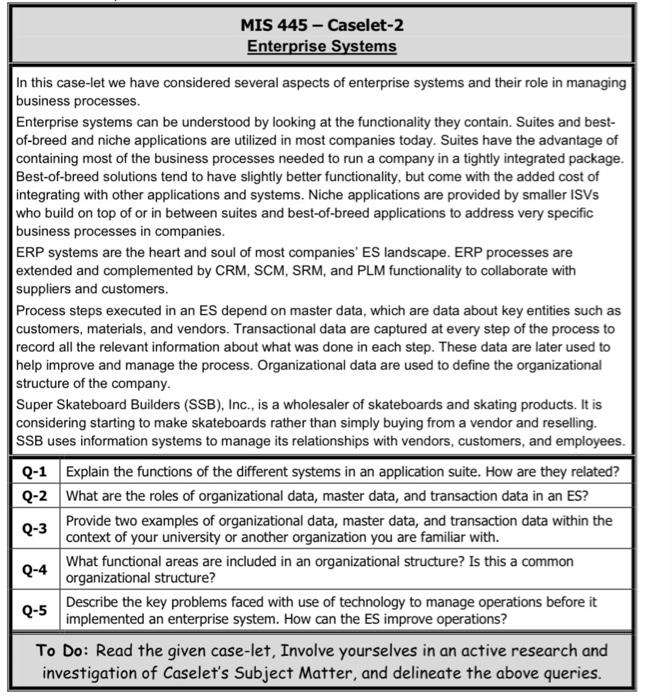
MIS 445 - Caselet-2 Enterprise Systems In this case-let we have considered several aspects of enterprise systems and their role in managing business processes. Enterprise systems can be understood by looking at the functionality they contain. Suites and best- of-breed and niche applications are utilized in most companies today. Suites have the advantage of containing most of the business processes needed to run a company in a tightly integrated package. Best-of-breed solutions tend to have slightly better functionality, but come with the added cost of integrating with other applications and systems. Niche applications are provided by smaller ISVS who build on top of or in between suites and best-of-breed applications to address very specific business processes in companies. ERP systems are the heart and soul of most companies' ES landscape. ERP processes are extended and complemented by CRM, SCM, SRM, and PLM functionality to collaborate with suppliers and customers. Process steps executed in an ES depend on master data, which are data about key entities such as customers, materials, and vendors. Transactional data are captured at every step of the process to record all the relevant information about what was done in each step. These data are later used to help improve and manage the process. Organizational data are used to define the organizational structure of the company. Super Skateboard Builders (SSB), Inc., is a wholesaler of skateboards and skating products. It is considering starting to make skateboards rather than simply buying from a vendor and reselling. SSB uses information systems to manage its relationships with vendors, customers, and employees. Q-1 Explain the functions of the different systems in an application suite. How are they related? Q-2 What are the roles of organizational data, master data, and transaction data in an ES? Q-3 Provide two examples of organizational data, master data, and transaction data within the context of your university or another organization you are familiar with. Q-4 What functional areas are included in an organizational structure? Is this a common organizational structure? Q-5 Describe the key problems faced with use of technology to manage operations before it implemented an enterprise system. How can the ES improve operations? To Do: Read the given case-let, Involve yourselves in an active research and investigation of Caselet's Subject Matter, and delineate the above queries

Step by Step Solution

There are 3 Steps involved in it

1 Expert Approved Answer
Step: 1 Unlock blur-text-image

Question Has Been Solved by an Expert!

Get step-by-step solutions from verified subject matter experts

Step: 2 Unlock
Step: 3 Unlock

Students Have Also Explored These Related General Management Questions!