Question: Module 4: Performance Management 4.1: APPROACH TO PERFORMANCE MEASUREMENT Identify THREE key result areas (KRAs) for your role. These should be closely aligned with your
Module 4: Performance Management
4.1: APPROACH TO PERFORMANCE MEASUREMENT
Identify THREE key result areas (KRAs) for your role. These should be closely aligned with your job description in Module 1. For each KRA you should discuss whether the use of a subjective (focus on behaviour and personal characteristics) or objective (focus on outcomes and results) or combination approach to performance measurement would be most appropriate. You should argue the merits of your choice individually for each of the KRAs. You should do this using the theory in your textbook (Fig 8.2 on pages 306 or 348 in old textbook should be very helpful in understanding the differences) as well as the context provided by your case study.
NB: WORD LIMIT 1000 WORDS
PLEASE FOLLOW CRITERIA AND CASE STUDY
Module 1 Info:
Images attached are the Case Study :
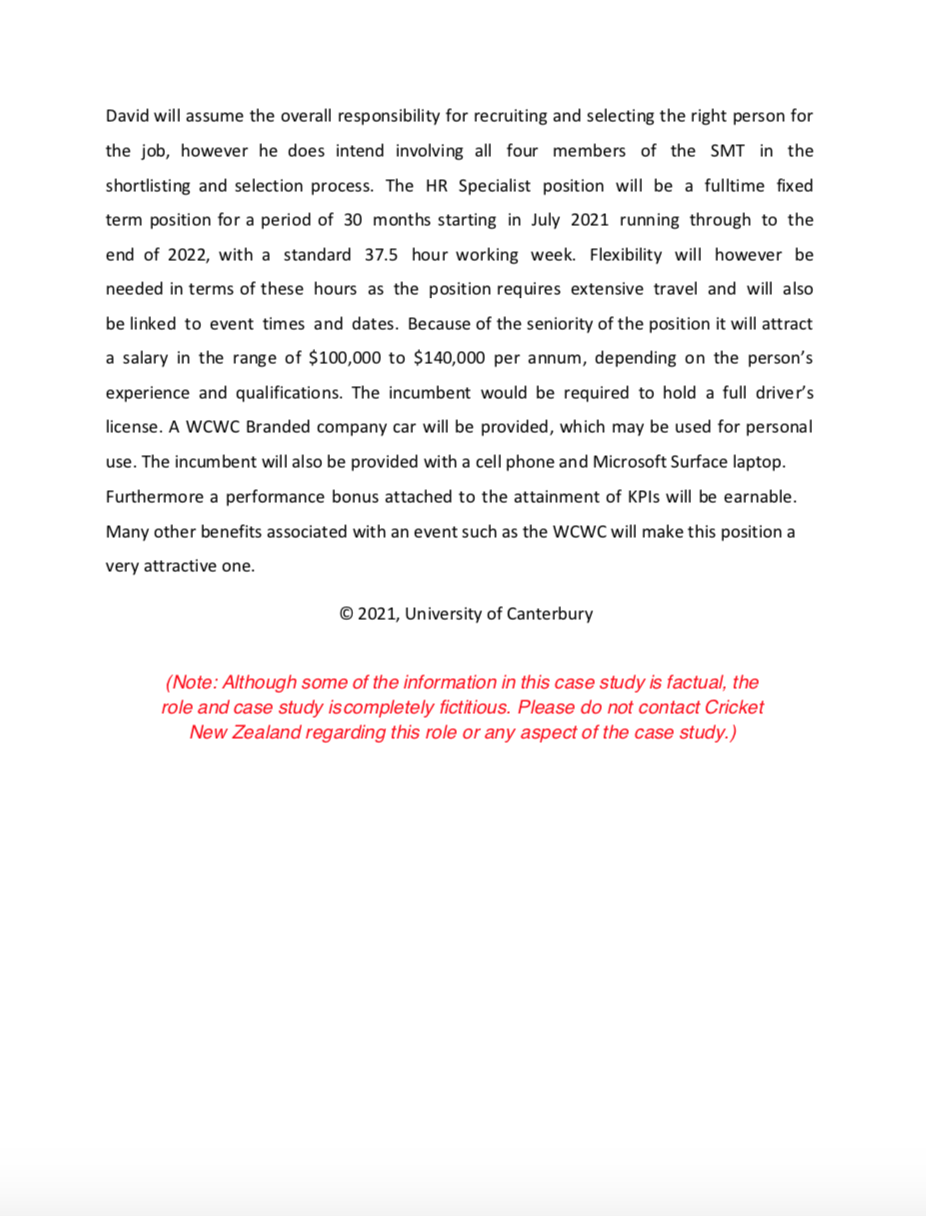
Image below is the criteria to help answer Q4.1 as read at the top ^:
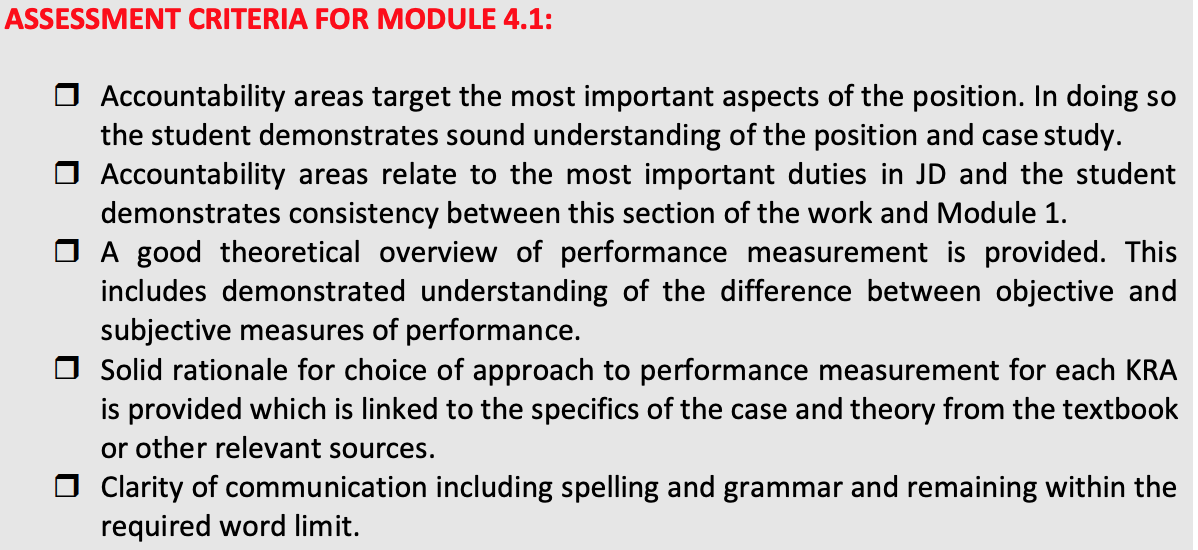
1.1 Team: Community Engagement Volunteer Reporting to: LOC Community Engagement Manager Time Commitment: Depending on location, this role requires a minimum number of 8 shifts between 25 February 2022 and 03 April 2022. The shifts will be primarily on Match Days, with attendance at rehearsals where required. You may also be required on team training days to assist with coaching clinics. Shift schedules will be released closer to the Tournament. Where you fit: During the innings breaks you will support the community lead activations which includes chaperoning children, supporting the Community Engagement Manager and helping to run the coaching clinics on training days. Specifically, in this role you'll: Chaperon the kids from the time they arrive at the stadium, manage the walk-out with players and mid-innings kids cricket; Assist the Community Engagement Manager to run the kids coaching clinics with participating teams during one/two of their training sessions; Need to have cricket knowledge; Able to deliver soft skill cricket drills. You'll love this role if: You are positive and have a 'team focused' attitude; You have strong communication skills; You are approachable, personable and friendly; You strive to go above and beyond expectations. You'll need to: Be at least 17 years old at the time of application; Be available prior to the Tournament; Read and consent to the ICC Women's World Cup 2022 Volunteer Programme Terms and Conditions and Privacy Policy; Consent to undertake and successfully complete Security Background Check(s); Have confirmed accommodation and ability to get to/from venues in your Host City; Be available to attend a volunteer interview in your selected Host City (times/dates will be confirmed closer to the time); Agree to complete scheduled training commitments (times/dates will be confirmed closer to the time); Be able to commit to attending uniform and accreditation collection early 2022 in your Host City). WOMEN'S WORLD CUP NatWest INDI Women's Cricket World Cup Background Although the pandemic and the border restrictions have complicated the organization of sporting events locally and internationally, NZ Cricket still believes that between 6 May and 7 June 2022, New Zealand will be able to host the 12th edition of the ICCC Women's Cricket (WCWC) World Cup. With this in mind, preparations are on the way. To most of the New Zealand public success will be defined by how well the White Ferns perform on the field. For New Zealand Cricket (NZC), CEO David Black, and the WCWC Senior Management Team (SMT), the fate of the White Ferns is important, but their bigger concern is the smooth running of the event. They need to deliver a flawless event and showcase to an estimated 8,000 international visitors, as well as audiences watching online from all around the world, everything that makes New Zealand great. And they need to do this on a limited tournament budget. To be able to make this happen, the involvement of volunteers is crucial. Early estimates suggest that over 700 volunteers will be needed across the country. Volunteers will work in a wide range of roles, but most will have some element of interaction with the public and will therefore be acting as a representative of the tournament organisation. Obviously the volunteers will not be paid employees of the WCWC, but they will still need to be recruited, selected, trained and managed, and all within a short space of time. None of the WCWC Organising Committee or WCWC Board have any specific Human Resource (HR) experience, so David knows that he needs to appoint someone with the right knowledge, skills and abilities to oversee what is essentially a major 'HR projec. David views every WCWC volunteer as an ambassador for New Zealand and a vital part of the success of the event. As such the recruitment and selection of volunteers has to be top class, ensuring that volunteers' skills and abilities are aligned with the requirements of the varied roles available. Vetting of age, licensing, and security requirements will also be an important part of the volunteer selection process. Because people are volunteering their own time and energy David is also realistic about the fact that most volunteers will not necessarily have all of the knowledge and skills they need to perform their roles. Therefore a comprehensive volunteer training programme will have to be put in developed and implemented, and the effectiveness of this training carefully monitored. David also needs to ensure that all legislative aspects are covered in terms of the volunteers, all"i"s must be dotted and all t's crossed, especially from a health and safety perspective. The last thing David and his team want to get stuck with is 700 disgruntled volunteers and even worse, 8 000+ disappointed cricket fans. The New Position To make sure this does not happen the WCWC management team have decided to create a fixed term "Human Resource Specialist" position. With a finite time period and a tournament start date of 6 May 2022, David needs to make an appointment as soon as possible. The incumbent will be responsible for three key deliverables, namely (1) human resource planning, (2) recruitment and selection and (3) training. While this might sound like a fairly standard human resource role, David knows that it won't be. Literally staffing an organisation from 0 to 700 employees' in a matter of months is one thing, but doing it across a large geographical area and for a multitude of different roles will prove to be highly challenging. In order to accurately determine the volunteer requirements for the event the incumbent will need to work closely with the Chief Operations Officer, Richard Rakete, and other members of the organising committee. Richard will be able to provide key information regarding the type and number of volunteers required for each of the different roles, regions and events. Once the human resource requirements have been accurately assessed and documented, a national recruitment drive will need to be initiated, with focusing on each major city in New Zealand as well as some of the larger regional towns. David has indicated that he would prefer the bulk of the recruitment and application activities to be carried out online through the WCWC website. To date however this functionality is not available on the website and the HR Specialist will play a major role in the design and development of the wcwc volunteer website and other HR related pages of the website, thus some background or experience with web development would be beneficial, although not essential, as David has a great web development team. Early estimates from Richard suggest that upwards of 3,500 people are likely to apply for the 700 volunteer positions available. All of these applications will need to be screened, reviewed and shortlisted. Following this process, interviews will need to take place with the shortlisted candidates. David knows that one person will not be able to do all of the recruitment, shortlisting, background checks and selection activities, particularly as these will need to take place across the country. As such the HR Specialist will need to appoint and manage a team of contract HR Advisors that will travel around the regions carrying out interviews. Similarly the Human Resource Specialist will need to put together a team of trainers that will deliver the various training programmes to volunteers. The role will therefore involve a large amount of travel around New Zealand. As volunteers will not be paid in any way or form, the HR Specialist will not be required to manage the remuneration and reward activities normally associated with this type of role. The position does however come with a significant budget of $1,250,000 per annum which the incumbent must use to fund all recruitment and selection, training and operational expenses as well as the salaries of the team of contract HR Advisors and Trainers. David wants a person that can hit the ground running but knows that finding the right person for the job is not going to be easy. He needs someone with a solid HR background, preferably with a degree and some form of professional accreditation from the HR profession. Additionally, senior level experience working in a very large organisation would be highly beneficial given the number of volunteers needed for the event and the complexity involved in an event such as the WCWC. The ideal candidate would also have project management experience at a relatively senior level, experience with large events or working with volunteers would also be advantageous but is not essential for the role. Communication skills are vital for success in the role and the incumbent would need to be comfortable working with and communicating with people at all levels in the organisation, from semi-literate volunteers right up to the WCWC Minister, Grant Ronson. Over and above this HR specific background, the incumbent would require a range of skills and abilities such as analytical skills, the ability to work in a team environment, reporting writing skills and high levels of energy and enthusiasm as the role will require extensive travel and long working hours. An ability to work under considerable pressure will also be very important as the project has several non-negotiable deadlines. David will assume the overall responsibility for recruiting and selecting the right person for the job, however he does intend involving all four members of the SMT in the shortlisting and selection process. The HR Specialist position will be a fulltime fixed term position for a period of 30 months starting in July 2021 running through to the end of 2022, with a standard 37.5 hour working week. Flexibility will however be needed in terms of these hours as the position requires extensive travel and will also be linked to event times and dates. Because of the seniority of the position it will attract a salary in the range of $100,000 to $140,000 per annum, depending on the person's experience and qualifications. The incumbent would be required to hold a full driver's license. A WCWC Branded company car will be provided, which may be used for personal use. The incumbent will also be ovided with a cell and Microsoft Surface laptop. Furthermore a performance bonus attached to the attainment of KPIs will be earnable. Many other benefits associated with an event such as the WCWC will make this position a very attractive one. 2021, University of Canterbury (Note: Although some of the information in this case study is factual, the role and case study is completely fictitious. Please do not contact Cricket New Zealand regarding this role or any aspect of the case study.) ASSESSMENT CRITERIA FOR MODULE 4.1: Accountability areas target the most important aspects of the position. In doing so the student demonstrates sound understanding of the position and case study. Accountability areas relate to the most important duties in JD and the student demonstrates consistency between this section of the work and Module 1. O A good theoretical overview of performance measurement is provided. This includes demonstrated understanding of the difference between objective and subjective measures of performance. O Solid rationale for choice of approach to performance measurement for each KRA is provided which is linked to the specifics of the case and theory from the textbook or other relevant sources. O Clarity of communication including spelling and grammar and remaining within the required word limit









 Study Help