







Question: Molecular Dynamics Simulations Diblock Copolymer Morphology Block copolymers provide simple, well-characterized, and easily controlled materials for the systematic study of self-assembly. Each molecule consists of
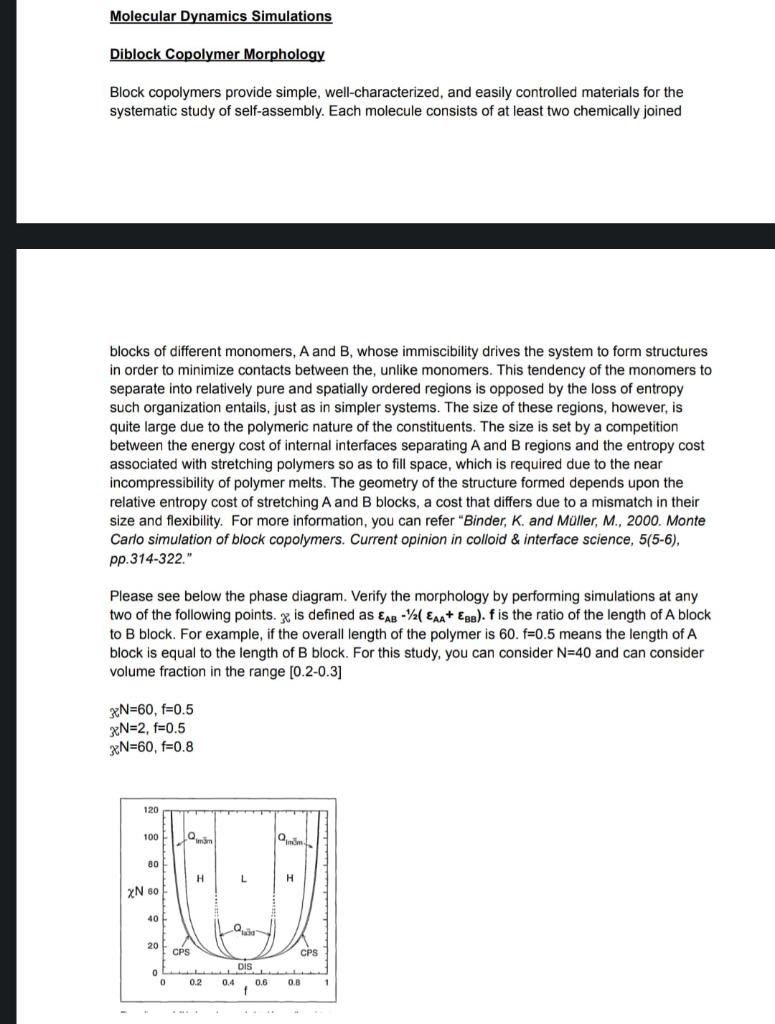
Molecular Dynamics Simulations Diblock Copolymer Morphology Block copolymers provide simple, well-characterized, and easily controlled materials for the systematic study of self-assembly. Each molecule consists of at least two chemically joined blocks of different monomers, A and B, whose immiscibility drives the system to form structures in order to minimize contacts between the, unlike monomers. This tendency of the monomers to separate into relatively pure and spatially ordered regions is opposed by the loss of entropy such organization entails, just as in simpler systems. The size of these regions, however, is quite large due to the polymeric nature of the constituents. The size is set by competition between the energy cost of internal interfaces separating A and B regions and the entropy cost associated with stretching polymers so as to fill space, which is required due to the near incompressibility of polymer melts. The geometry of the structure formed depends upon the relative entropy cost of stretching A and B blocks, a cost that differs due to a mismatch in their size and flexibility. For more information, you can refer "Binder, K. and Mller, M., 2000. Monte Carlo simulation of block copolymers. Current opinion in colloid \& interface science, 5(5-6), pp.314-322." Please see below the phase diagram. Verify the morphology by performing simulations at any two of the following points. is defined as AB1/2(AA+BB). f is the ratio of the length of A block to B block. For example, if the overall length of the polymer is 60.f=0.5 means the length of A block is equal to the length of B block. For this study, you can consider N=40 and can consider volume fraction in the range [0.20.3] 3N=60,f=0.53N=2,f=0.53N=60,f=0.8 Molecular Dynamics Simulations Diblock Copolymer Morphology Block copolymers provide simple, well-characterized, and easily controlled materials for the systematic study of self-assembly. Each molecule consists of at least two chemically joined blocks of different monomers, A and B, whose immiscibility drives the system to form structures in order to minimize contacts between the, unlike monomers. This tendency of the monomers to separate into relatively pure and spatially ordered regions is opposed by the loss of entropy such organization entails, just as in simpler systems. The size of these regions, however, is quite large due to the polymeric nature of the constituents. The size is set by competition between the energy cost of internal interfaces separating A and B regions and the entropy cost associated with stretching polymers so as to fill space, which is required due to the near incompressibility of polymer melts. The geometry of the structure formed depends upon the relative entropy cost of stretching A and B blocks, a cost that differs due to a mismatch in their size and flexibility. For more information, you can refer "Binder, K. and Mller, M., 2000. Monte Carlo simulation of block copolymers. Current opinion in colloid \& interface science, 5(5-6), pp.314-322." Please see below the phase diagram. Verify the morphology by performing simulations at any two of the following points. is defined as AB1/2(AA+BB). f is the ratio of the length of A block to B block. For example, if the overall length of the polymer is 60.f=0.5 means the length of A block is equal to the length of B block. For this study, you can consider N=40 and can consider volume fraction in the range [0.20.3] 3N=60,f=0.53N=2,f=0.53N=60,f=0.8
Step by Step Solution
There are 3 Steps involved in it

Get step-by-step solutions from verified subject matter experts
 Study Help