


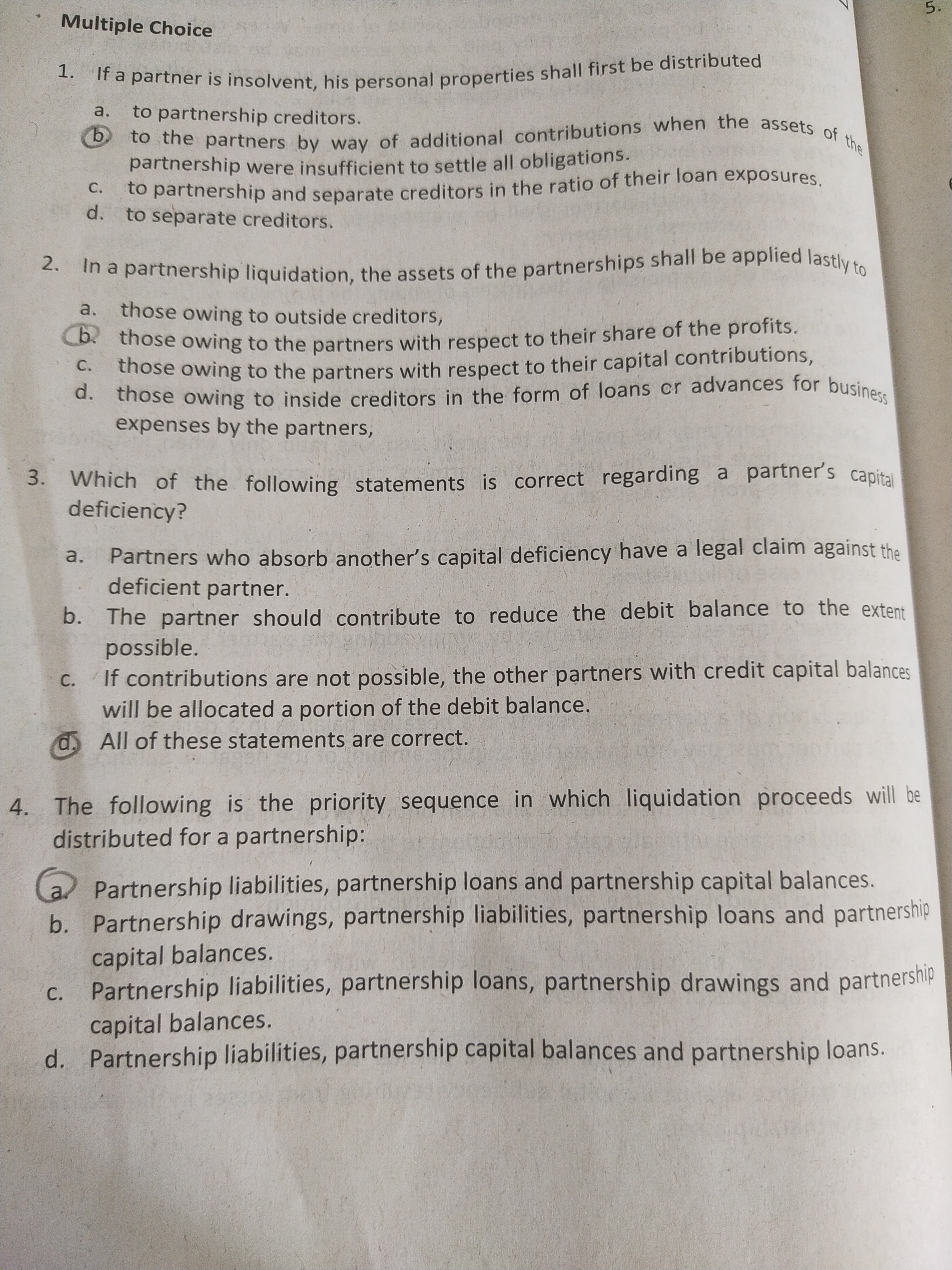
Question: Multiple Choice 1. If a partner is insolvent, his personal properties shall first be distributed a. to partnership creditors. b to the partners by way
Multiple Choice 1. If a partner is insolvent, hisMultiple Choice 1. If a partner is insolvent, hisMultiple Choice 1. If a partner is insolvent, his
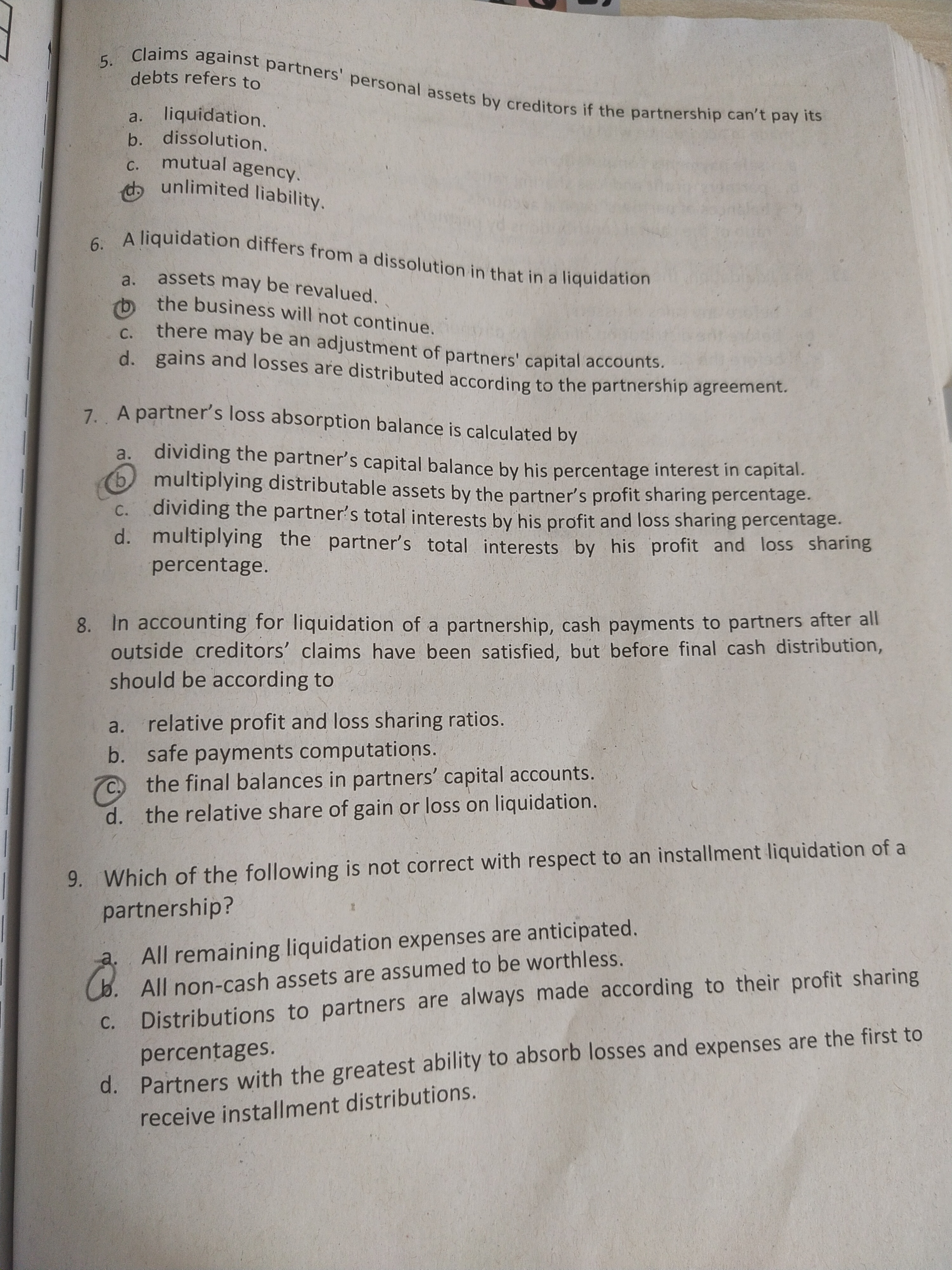
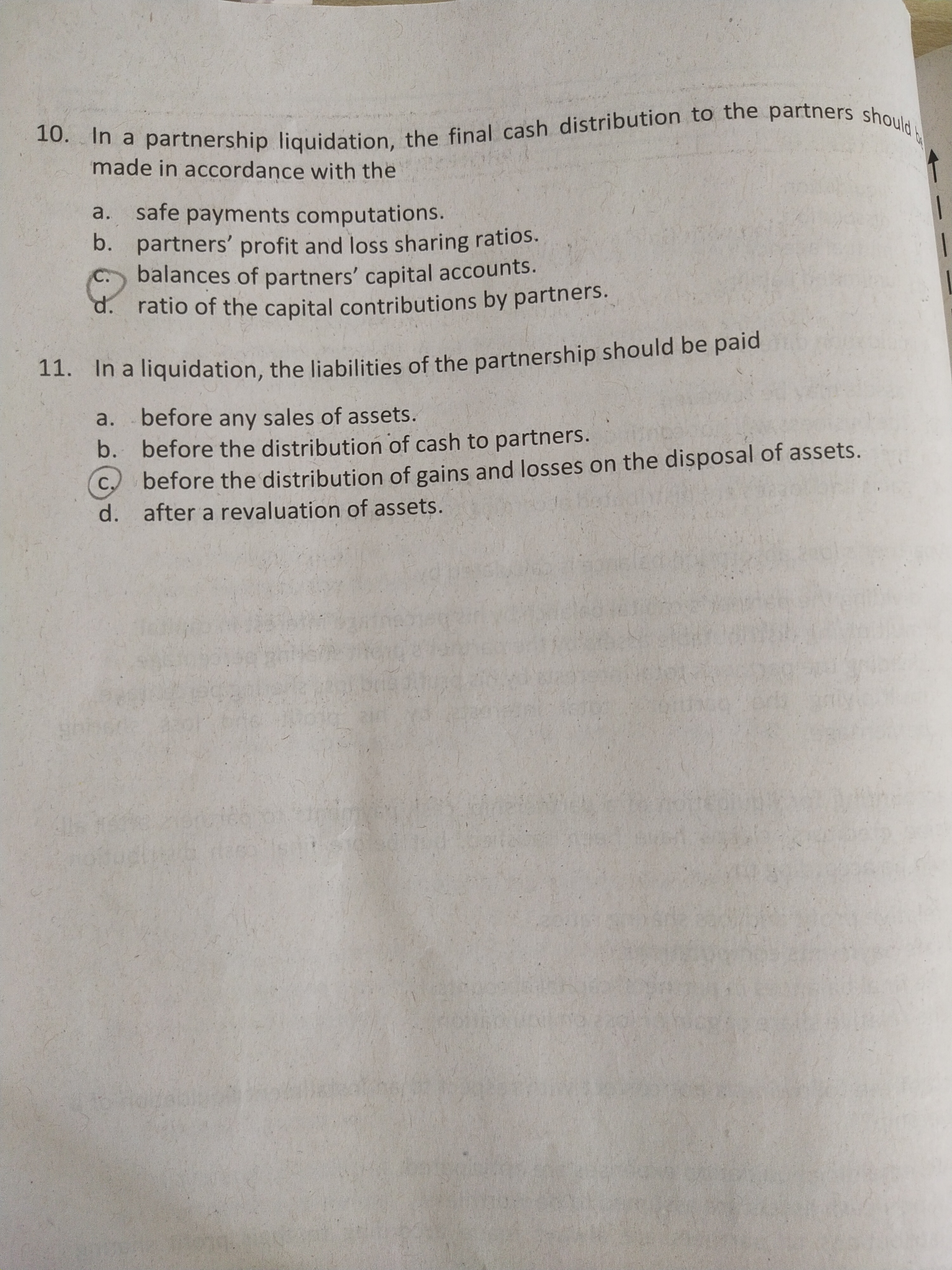
Multiple Choice 1. If a partner is insolvent, his personal properties shall first be distributed a. to partnership creditors. b to the partners by way of additional contributions when the assets of partnership were insufficient to settle all obligations. . to partnership and separate creditors in the ratio of their loan exposures. d. to separate creditors. 2. In a partnership liquidation, the assets of the partnerships shall be applied lastly to a. those owing to outside creditors, Cb? those owing to the partners with respect to their share of the profits. C . those owing to the partners with respect to their capital contributions, d. those owing to inside creditors in the form of loans or advances for business expenses by the partners, 3. Which of the following statements is correct regarding a partner's capital deficiency? a. Partners who absorb another's capital deficiency have a legal claim against the deficient partner. b. The partner should contribute to reduce the debit balance to the extent possible. c. If contributions are not possible, the other partners with credit capital balances will be allocated a portion of the debit balance. d. All of these statements are correct. . The following is the priority sequence in which liquidation proceeds will be distributed for a partnership: Ca) Partnership liabilities, partnership loans and partnership capital balances. b. Partnership drawings, partnership liabilities, partnership loans and partnership capital balances. c. Partnership liabilities, partnership loans, partnership drawings and partnership capital balances. d. Partnership liabilities, partnership capital balances and partnership loans.5 . debts refers to Claims against partners' personal assets by creditors if the partnership can't pay its a . liquidation. b . dissolution. C . mutual agency. unlimited liability. 6. A liquidation differs from a dissolution in that in a liquidation a . assets may be revalued. the business will not continue. c. there may be an adjustment of partners' capital accounts. d. gains and losses are distributed according to the partnership agreement. 7. A partner's loss absorption balance is calculated by a. dividing the partner's capital balance by his percentage interest in capital. b multiplying distributable assets by the partner's profit sharing percentage. C . dividing the partner's total interests by his profit and loss sharing percentage. d. multiplying the partner's total interests by his profit and loss sharing percentage. 8. In accounting for liquidation of a partnership, cash payments to partners after all outside creditors' claims have been satisfied, but before final cash distribution, should be according to a. relative profit and loss sharing ratios. b. safe payments computations. the final balances in partners' capital accounts. d. the relative share of gain or loss on liquidation. 9. Which of the following is not correct with respect to an installment liquidation of a partnership? . All remaining liquidation expenses are anticipated. B . All non-cash assets are assumed to be worthless. C. Distributions to partners are always made according to their profit sharing percentages. d. Partners with the greatest ability to absorb losses and expenses are the first to receive installment distributions.10. In a partnership liquidation, the final cash distribution to the partners should made in accordance with the a. safe payments computations. b. partners' profit and loss sharing ratios. balances of partners' capital accounts. ratio of the capital contributions by partners. 11. In a liquidation, the liabilities of the partnership should be paid a. before any sales of assets. b. before the distribution of cash to partners. c, before the distribution of gains and losses on the disposal of assets. d. after a revaluation of assets
Step by Step Solution

There are 3 Steps involved in it

1 Expert Approved Answer
Step: 1 Unlock blur-text-image

Question Has Been Solved by an Expert!

Get step-by-step solutions from verified subject matter experts

Step: 2 Unlock
Step: 3 Unlock

Students Have Also Explored These Related Accounting Questions!