







Question: MULTIPLE CHOICE: 8-16 Thank you so much, automatic thumbs up! B. Profit is: 9. A. The difference between totalt and variable COSE B. The difference
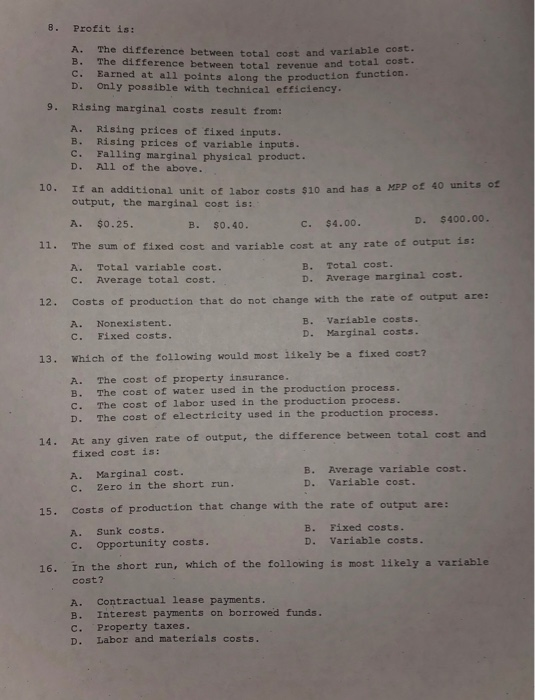
B. Profit is: 9. A. The difference between totalt and variable COSE B. The difference between total revenue and total COST C. Earned at all points along the production function. D. Only possible with technical efficiency. Rising marginal costs result from: A. Rising prices of fixed inputs. B. Rising prices of variable inputs. c. Falling marginal physical product. D. All of the above. If an 40 units 01 - an additional unit of labor costs $10 and has a MPP o output, the marginal cost is: A. $0.25. B. $0.40. C. $4.00. D. $400.00. 10. The sum of fixed cost and variable cont at any rate of output A. Total variable cost. B. Total cost. c. Average total cost. D. Average marginal cost. Costs of production that do not change with the rate of output are: A. Nonexistent. B. Variable costs. c. Fixed costs. D. Marginal costs. 12. 13. Which of the following would most likely be a fixed cost? A. The cost of property insurance. B. The cost of water used in the production process. c. The cost of labor used in the production process. D. The cost of electricity used in the production process. 14. At any given rate of output, the difference between total cost and fixed cost is: A. Marginal cost. B. Average variable cost. c. Zero in the short run. D. Variable cost. 15. Costs of production that change with the rate of output are A. Sunk costs. B. Fixed costs. c. Opportunity costs. D. Variable costs. 16. In the short run, which of the following is most likely a variable cost? A. B. c. D. Contractual lease payments. Interest payments on borrowed funds. Property taxes. Labor and materials costs
Step by Step Solution
There are 3 Steps involved in it

Get step-by-step solutions from verified subject matter experts
 Study Help