





Question: Multiple Server System Simulation You are an engineering manager in charge of a service center where customers arrive to the center with an arrival rate
Multiple Server System Simulation You are anMultiple Server System Simulation You are an

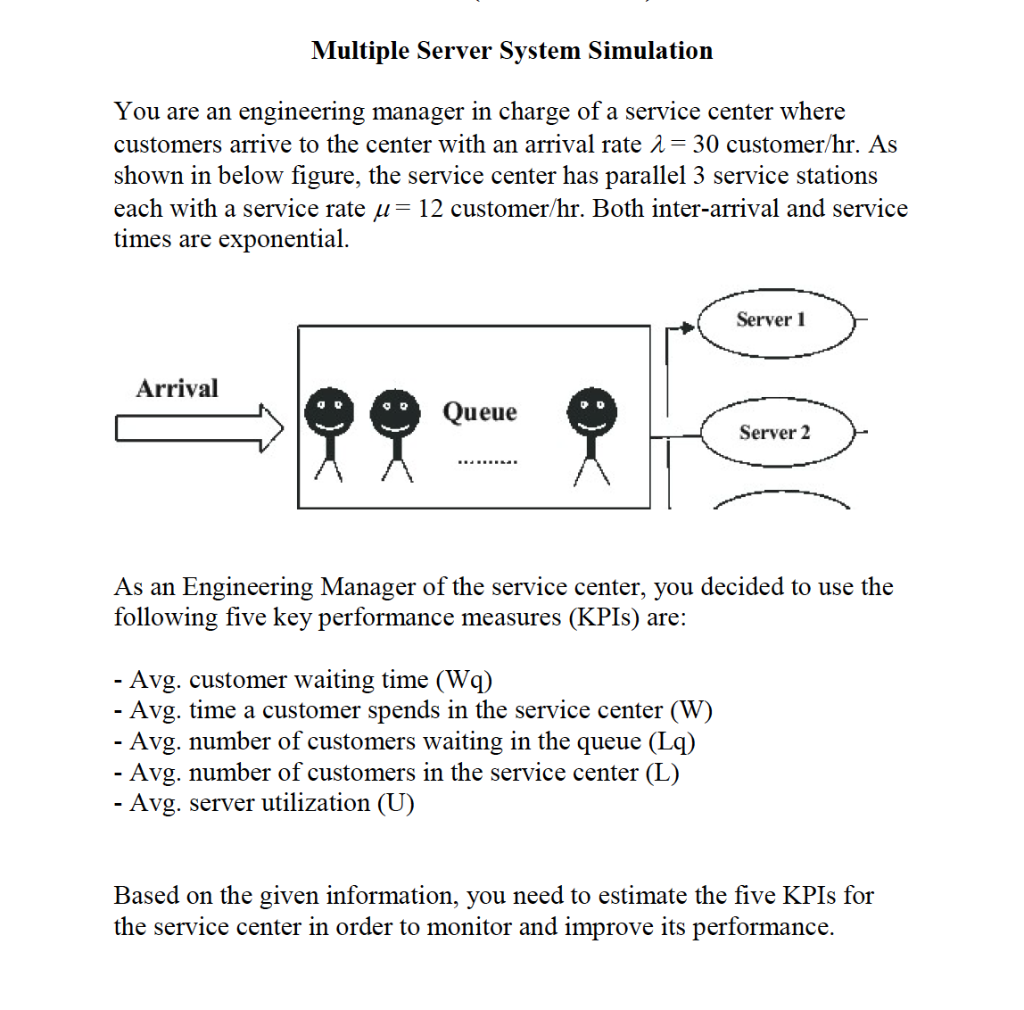
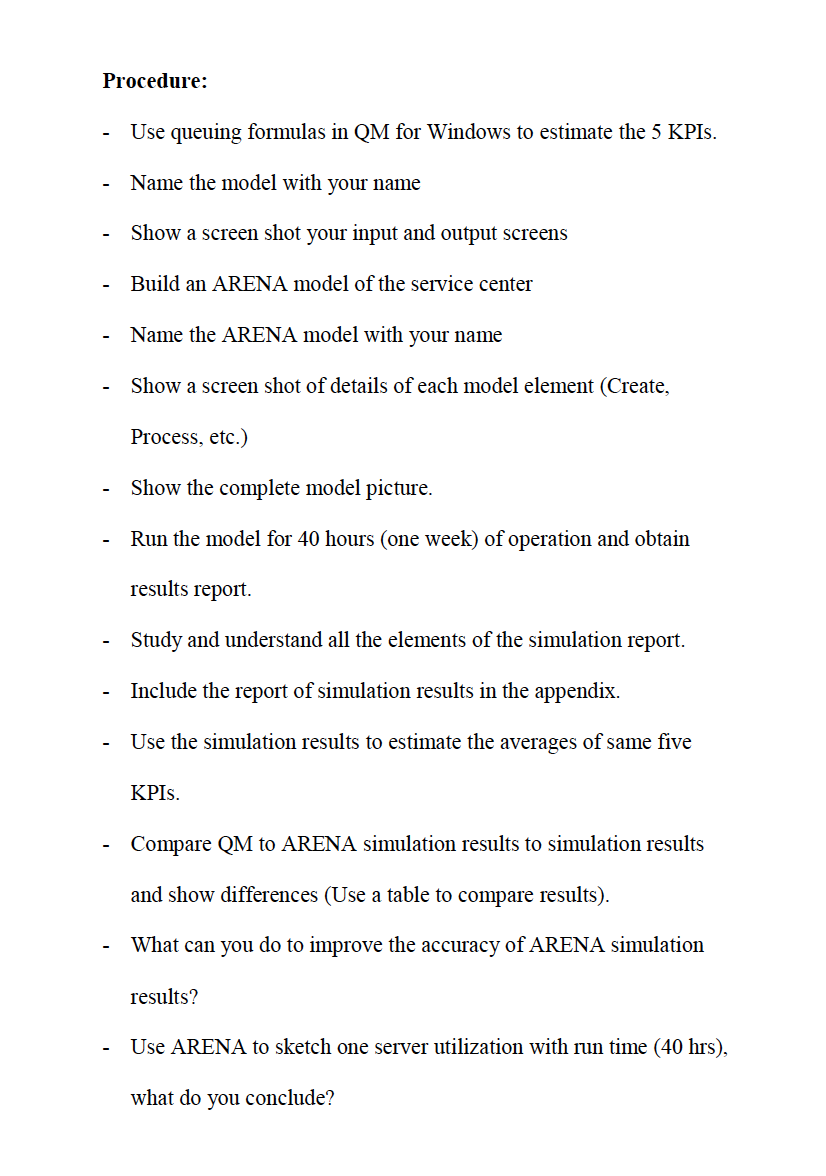
Multiple Server System Simulation You are an engineering manager in charge of a service center where customers arrive to the center with an arrival rate 2 = 30 customer/hr. As shown in below figure, the service center has parallel 3 service stations each with a service rate u= 12 customer/hr. Both inter-arrival and service times are exponential. Server 1 Arrival Queue Server 2 ..... As an Engineering Manager of the service center, you decided to use the following five key performance measures (KPIs) are: - Avg. customer waiting time (Wq) - Avg. time a customer spends in the service center (W) - Avg. number of customers waiting in the queue (Lq) - Avg. number of customers in the service center (L) - Avg. server utilization (U) Based on the given information, you need to estimate the five KPIs for the service center in order to monitor and improve its performance. Procedure: Use queuing formulas in QM for Windows to estimate the 5 KPIs. Name the model with your name Show a screen shot your input and output screens Build an ARENA model of the service center Name the ARENA model with your name Show a screen shot of details of each model element (Create, Process, etc.) Show the complete model picture. Run the model for 40 hours (one week) of operation and obtain results report. Study and understand all the elements of the simulation report. - Include the report of simulation results in the appendix. Use the simulation results to estimate the averages of same five KPIS. Compare QM to ARENA simulation results to simulation results and show differences (Use a table to compare results). What can you do to improve the accuracy of ARENA simulation results? Use ARENA to sketch one server utilization with run time (40 hrs), what do you conclude? Multiple Server System Simulation You are an engineering manager in charge of a service center where customers arrive to the center with an arrival rate 2 = 30 customer/hr. As shown in below figure, the service center has parallel 3 service stations each with a service rate u= 12 customer/hr. Both inter-arrival and service times are exponential. Server 1 Arrival Queue Server 2 ..... As an Engineering Manager of the service center, you decided to use the following five key performance measures (KPIs) are: - Avg. customer waiting time (Wq) - Avg. time a customer spends in the service center (W) - Avg. number of customers waiting in the queue (Lq) - Avg. number of customers in the service center (L) - Avg. server utilization (U) Based on the given information, you need to estimate the five KPIs for the service center in order to monitor and improve its performance. Procedure: Use queuing formulas in QM for Windows to estimate the 5 KPIs. Name the model with your name Show a screen shot your input and output screens Build an ARENA model of the service center Name the ARENA model with your name Show a screen shot of details of each model element (Create, Process, etc.) Show the complete model picture. Run the model for 40 hours (one week) of operation and obtain results report. Study and understand all the elements of the simulation report. - Include the report of simulation results in the appendix. Use the simulation results to estimate the averages of same five KPIS. Compare QM to ARENA simulation results to simulation results and show differences (Use a table to compare results). What can you do to improve the accuracy of ARENA simulation results? Use ARENA to sketch one server utilization with run time (40 hrs), what do you conclude

Step by Step Solution

There are 3 Steps involved in it

1 Expert Approved Answer
Step: 1 Unlock blur-text-image

Question Has Been Solved by an Expert!

Get step-by-step solutions from verified subject matter experts

Step: 2 Unlock
Step: 3 Unlock

Students Have Also Explored These Related General Management Questions!