







Question: MUST show work. You can do in an EXCEL document and post the link if needed. THANK YOU!! CASE 5 During mid-September 2015, the top
MUST show work. You can do in an EXCEL document and post the link if needed. THANK YOU!!
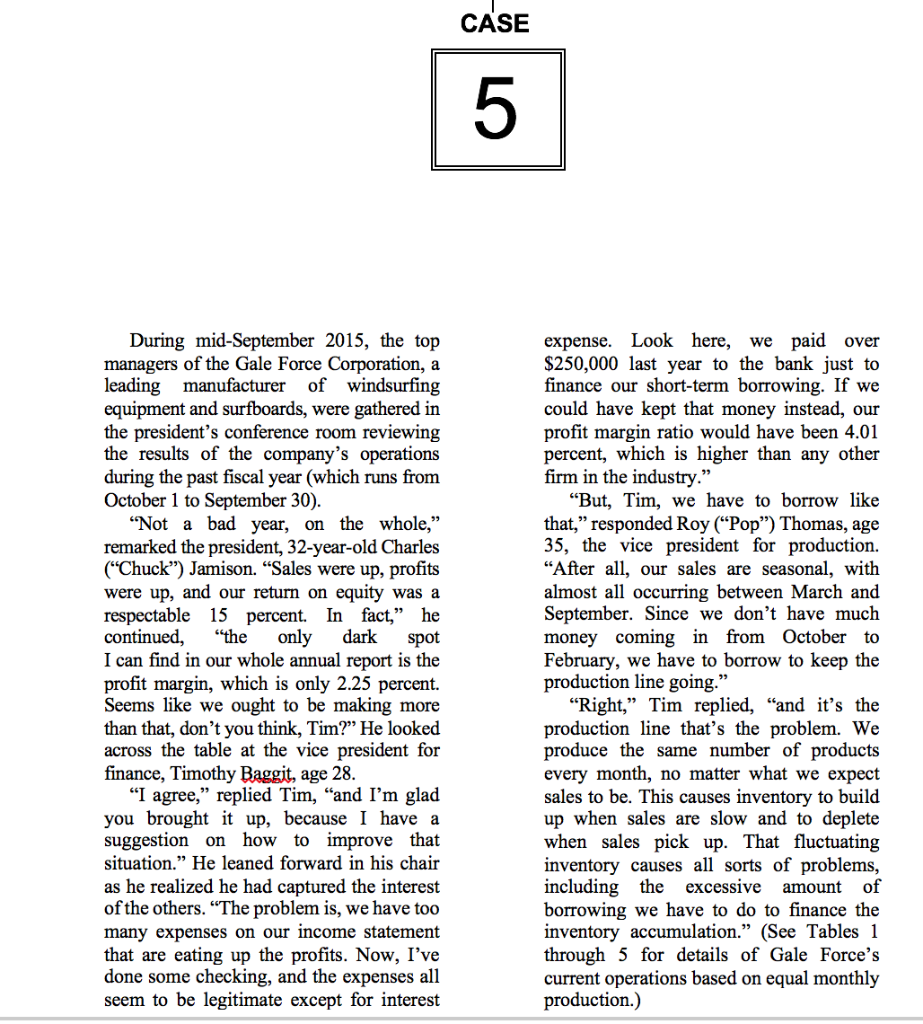
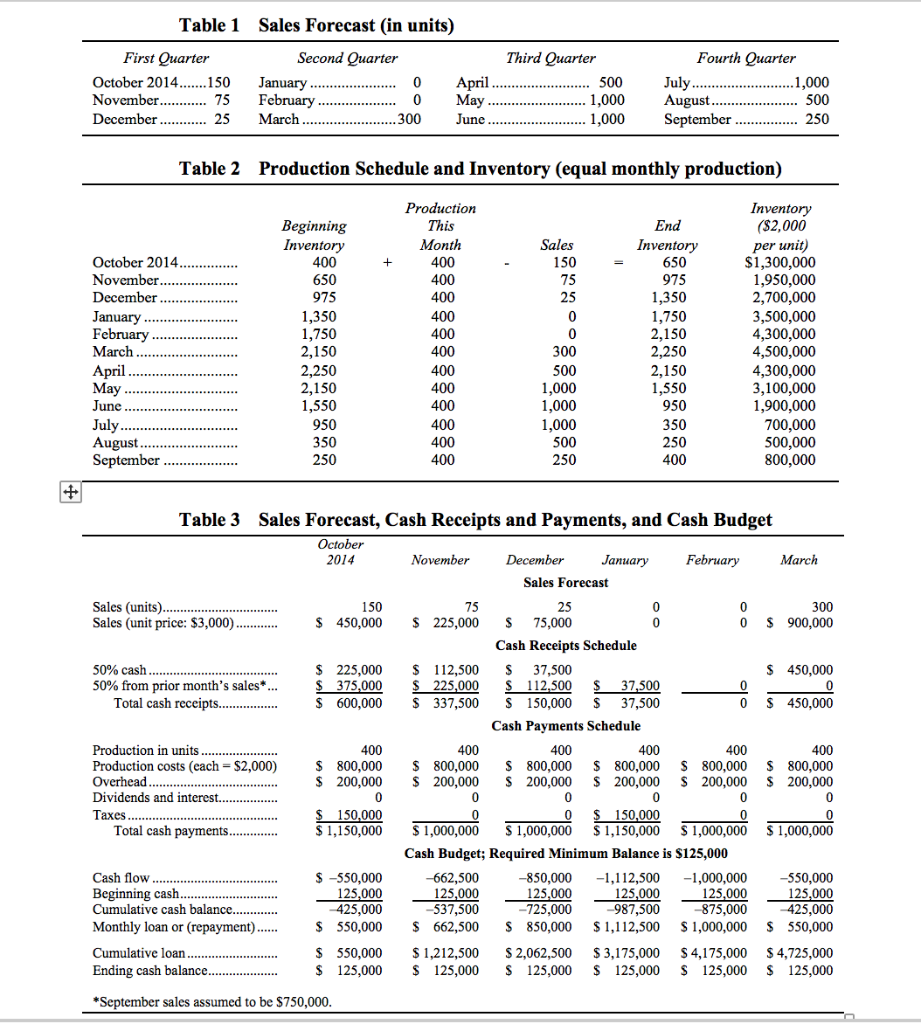
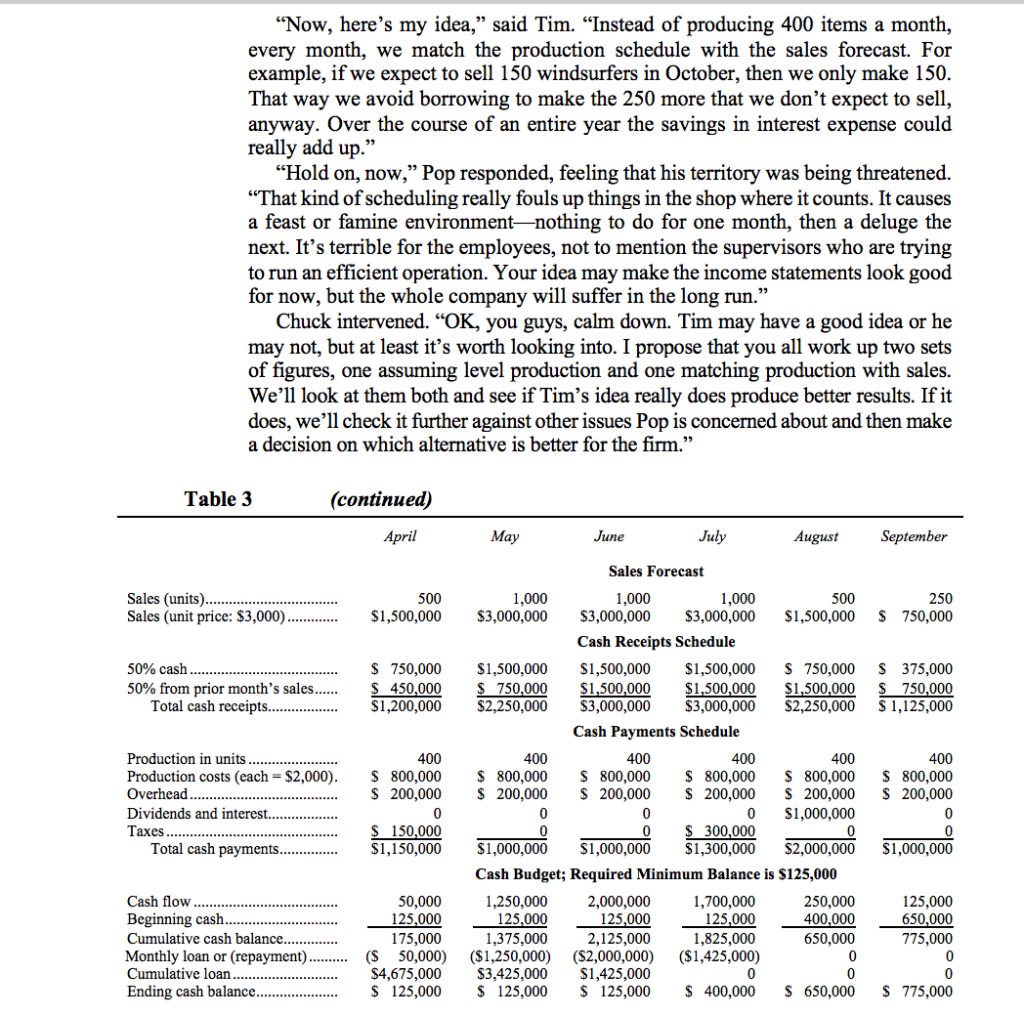
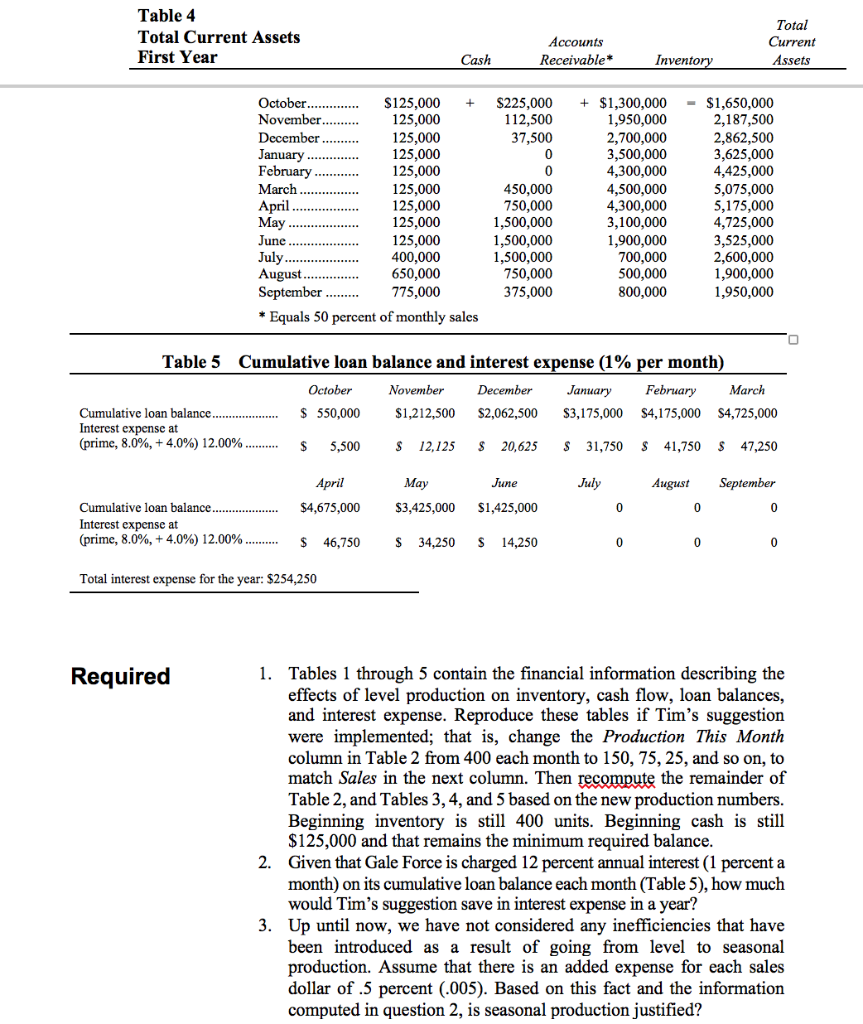
CASE 5 During mid-September 2015, the top managers of the Gale Force Corporation, a leading manufacturer of windsurfing equipment and surfboards, were gathered in the president's conference room reviewing the results of the company's operations during the past fiscal year (which runs from October 1 to September 30). Not a bad year, on the whole, remarked the president, 32-year-old Charles ("Chuck) Jamison. Sales were up, profits were up, and our return on equity was a respectable 15 percent. In fact," he continued, "the only dark spot I can find in our whole annual report is the profit margin, which is only 2.25 percent. Seems like we ought to be making more than that, don't you think, Tim?" He looked across the table at the vice president for finance, Timothy Baggit, age 28. I agree, replied Tim, "and I'm glad you brought it up, because I have a suggestion on how to improve that situation." He leaned forward in his chair as he realized he had captured the interest of the others. The problem is, we have too many expenses on our income statement that are eating up the profits. Now, I've done some checking, and the expenses all seem to be legitimate except for interest expense. Look here, we paid over $250,000 last year to the bank just to finance our short-term borrowing. If we could have kept that money instead, our profit margin ratio would have been 4.01 percent, which is higher than any other firm in the industry. "But, Tim, we have to borrow like that, responded Roy (Pop) Thomas, age 35, the vice president for production. "After all, our sales are seasonal, with almost all occurring between March and September. Since we don't have much money coming in from October to February, we have to borrow to keep the production line going. Right, Tim replied, "and it's the production line that's the problem. We produce the same number of products every month, no matter what we expect sales to be. This causes inventory to build up when sales are slow and to deplete when sales pick up. That fluctuating inventory causes all sorts of problems, including the excessive amount of borrowing we have to do to finance the inventory accumulation." (See Tables 1 through 5 for details of Gale Force's current operations based on equal monthly production.) Table 1 Sales Forecast (in units) First Quarter October 2014.......150 November.. 75 December 25 Second Quarter January 0 February 0 March 300 April May June Third Quarter 500 1,000 1,000 Fourth Quarter July 1,000 August 500 September 250 Table 2 Production Schedule and Inventory (equal monthly production) Beginning Inventory 400 650 + 975 October 2014 November December January February March April May June July August September 1,350 1,750 2,150 2,250 2,150 1,550 950 350 250 Production This Month 400 400 400 400 400 400 400 400 400 400 400 400 Sales 150 75 25 0 0 300 500 1,000 1,000 1,000 500 250 End Inventory 650 975 1,350 1,750 2,150 2,250 2,150 1,550 950 350 250 400 Inventory ($2,000 per unit) $1,300,000 1,950,000 2,700,000 3,500,000 4,300,000 4,500,000 4,300,000 3,100,000 1,900,000 700,000 500,000 800,000 Table 3 Sales Forecast, Cash Receipts and Payments, and Cash Budget October 2014 November December January February March Sales Forecast Sales (units)....... 150 75 25 0 0 300 Sales (unit price: $3,000) $ 450,000 $ 225,000 S 75,000 0 $ 900,000 Cash Receipts Schedule 50% cash...... $ 225,000 $ 112,500 S 37,500 $ 450,000 50% from prior month's sales*... $ 375,000 $ 225,000 $ 112.500 $ 37,500 0 Total cash receipts. $ 600,000 $ 337,500 $ 150,000 S 37,500 0 $ 450,000 Cash Payments Schedule Production in units ........ 400 400 400 400 400 400 Production costs (each = $2,000) $ 800,000 $ 800,000 $ 800,000 $ 800,000 S 800,000 $ 800,000 Overhead................ $ 200,000 $ 200,000 $ 200,000 $ 200,000 $ 200,000 S 200,000 Dividends and interest. 0 0 0 0 0 $ 150.000 0 $ 150,000 Total cash payments $ 1,150,000 $ 1,000,000 $ 1,150,000 $ 1,000,000 $ 1,000,000 Cash Budget; Required Minimum Balance is $125,000 Cash flow ...... $-550,000 662,500 -850,000 -1,112,500 -1,000,000 -550,000 Beginning cash 125,000 125,000 125,000 125,000 125,000 Cumulative cash balance. 425,000 -537,500 -725,000 -987,500 875,000 425,000 Monthly loan or (repayment)..... $ 550,000 $ 662,500 $ 850,000 $ 1,112,500 $ 1,000,000 $ 550,000 Cumulative loan ........... $ 550,000 $ 1,212,500 $ 2,062,500 $ 3,175,000 $4,175,000 $ 4,725,000 Ending cash balance. $ 125,000 S 125,000 S 125,000 $ 125,000 $ 125,000 $ 125,000 *September sales assumed to be $750,000. Taxes......... S 1,000,000 125,000 Now, here's my idea, said Tim. Instead of producing 400 items a month, every month, we match the production schedule with the sales forecast. For example, if we expect to sell 150 windsurfers in October, then we only make 150. That way we avoid borrowing to make the 250 more that we don't expect to sell, anyway. Over the course of an entire year the savings in interest expense could really add up." "Hold on, now, Pop responded, feeling that his territory was being threatened. That kind of scheduling really fouls up things in the shop where it counts. It causes a feast or famine environmentnothing to do for one month, then a deluge the next. It's terrible for the employees, not to mention the supervisors who are trying to run an efficient operation. Your idea may make the income statements look good for now, but the whole company will suffer in the long run. Chuck intervened. OK, you guys, calm down. Tim may have a good idea or he may not, but at least it's worth looking into. I propose that you all work up two sets of figures, one assuming level production and one matching production with sales. We'll look at them both and see if Tim's idea really does produce better results. If it does, we'll check it further against other issues Pop is concerned about and then make a decision on which alternative is better for the firm." Table 3 (continued) April May June July August September Sales Forecast Sales (units)..... Sales (unit price: $3,000).......... 500 $1,500,000 250 $750,000 50% cash 50% from prior month's sales...... Total cash receipts. $ 750,000 $ 450,000 $1,200,000 $375,000 $750,000 $ 1,125,000 Production in units Production costs (each = $2,000). Overhead ........ Dividends and interest. Taxes .... Total cash payments.. 400 $ 800,000 $ 200,000 0 $ 150,000 $1,150,000 1,000 1,000 1,000 500 $3,000,000 $3,000,000 $3,000,000 $1,500,000 Cash Receipts Schedule $1,500,000 $1,500,000 $1,500,000 750,000 $ 750,000 $1,500,000 $1,500,000 $1,500,000 $2,250,000 $3,000,000 $3,000,000 $2,250,000 Cash Payments Schedule 400 400 400 400 $ 800,000 $ 800,000 $ 800,000 $ 800,000 $ 200,000 $ 200,000 $ 200,000 $ 200,000 0 0 0 $1,000,000 0 0 $ 300,000 $1,000,000 $1,000,000 $1,300,000 Cash Budget; Required Minimum Balance is $125,000 1,250,000 2,000,000 1,700,000 250,000 125,000 125,000 125,000 400,000 1,375,000 2,125,000 1,825,000 650,000 ($1,250,000) ($2,000,000) ($1,425,000) $3,425,000 $1,425,000 0 0 $ 125,000 $ 125,000 $ 400,000 $ 650,000 400 $ 800,000 $ 200,000 0 0 $2,000,000 $1,000,000 Cash flow Beginning cash. Cumulative cash balance..... Monthly loan or (repayment).... Cumulative loan Ending cash balance. 50,000 125,000 175,000 ($ 50,000) $4,675,000 $ 125,000 125,000 650,000 775,000 0 0 $ 775,000 Table 4 Total Current Assets First Year Accounts Receivable* Total Current Assets Cash Inventory + $225,000 112,500 37,500 October $125,000 November........ 125,000 December ......... 125,000 January ............ 125,000 February ......... 125,000 March 125.000 April 125,000 May 125,000 June 125,000 July 400,000 August 650,000 September ....... 775,000 * Equals 50 percent of monthly sales 450,000 750,000 1,500,000 1,500,000 1,500,000 750,000 375,000 + $1,300,000 1,950,000 2,700,000 3,500,000 4,300,000 4,500,000 4,300,000 3,100,000 1,900,000 700,000 500,000 800,000 - $1,650,000 2,187,500 2,862,500 3,625,000 4,425,000 5,075,000 5,175,000 4,725,000 3,525,000 2,600,000 1,900,000 1,950,000 Table 5 Cumulative loan balance and interest expense (1% per month) October November December January February March Cumulative loan balance....... $ 550,000 $1,212,500 $2,062,500 $3,175,000 $4,175,000 $4,725,000 Interest expense at (prime, 8.0%, +4.0%) 12.00%......... $ 5,500 $ 12,125 $ 20,625 $ 31,750 $ 41,750 $ 47,250 April May June July August September $4,675,000 $3,425,000 $1,425,000 0 0 0 Cumulative loan balance. Interest expense at (prime, 8.0%, +4.0%) 12.00% .......... $ 46,750 $ 34,250 $ 14,250 0 0 0 Total interest expense for the year: $254,250 Required 1. Tables 1 through 5 contain the financial information describing the effects of level production on inventory, cash flow, loan balances, and interest expense. Reproduce these tables if Tim's suggestion were implemented; that is, change the Production This Month column in Table 2 from 400 each month to 150, 75, 25, and so on, to match Sales in the next column. Then recompute the remainder of Table 2, and Tables 3, 4, and 5 based on the new production numbers. Beginning inventory is still 400 units. Beginning cash is still $125,000 and that remains the minimum required balance. 2. Given that Gale Force is charged 12 percent annual interest (1 percent a month) on its cumulative loan balance each month (Table 5), how much would Tim's suggestion save in interest expense in a year? 3. Up until now, we have not considered any inefficiencies that have been introduced as a result of going from level to seasonal production. Assume that there is an added expense for each sales dollar of 5 percent (.005). Based on this fact and the information computed in question 2, is seasonal production justified? CASE 5 During mid-September 2015, the top managers of the Gale Force Corporation, a leading manufacturer of windsurfing equipment and surfboards, were gathered in the president's conference room reviewing the results of the company's operations during the past fiscal year (which runs from October 1 to September 30). Not a bad year, on the whole, remarked the president, 32-year-old Charles ("Chuck) Jamison. Sales were up, profits were up, and our return on equity was a respectable 15 percent. In fact," he continued, "the only dark spot I can find in our whole annual report is the profit margin, which is only 2.25 percent. Seems like we ought to be making more than that, don't you think, Tim?" He looked across the table at the vice president for finance, Timothy Baggit, age 28. I agree, replied Tim, "and I'm glad you brought it up, because I have a suggestion on how to improve that situation." He leaned forward in his chair as he realized he had captured the interest of the others. The problem is, we have too many expenses on our income statement that are eating up the profits. Now, I've done some checking, and the expenses all seem to be legitimate except for interest expense. Look here, we paid over $250,000 last year to the bank just to finance our short-term borrowing. If we could have kept that money instead, our profit margin ratio would have been 4.01 percent, which is higher than any other firm in the industry. "But, Tim, we have to borrow like that, responded Roy (Pop) Thomas, age 35, the vice president for production. "After all, our sales are seasonal, with almost all occurring between March and September. Since we don't have much money coming in from October to February, we have to borrow to keep the production line going. Right, Tim replied, "and it's the production line that's the problem. We produce the same number of products every month, no matter what we expect sales to be. This causes inventory to build up when sales are slow and to deplete when sales pick up. That fluctuating inventory causes all sorts of problems, including the excessive amount of borrowing we have to do to finance the inventory accumulation." (See Tables 1 through 5 for details of Gale Force's current operations based on equal monthly production.) Table 1 Sales Forecast (in units) First Quarter October 2014.......150 November.. 75 December 25 Second Quarter January 0 February 0 March 300 April May June Third Quarter 500 1,000 1,000 Fourth Quarter July 1,000 August 500 September 250 Table 2 Production Schedule and Inventory (equal monthly production) Beginning Inventory 400 650 + 975 October 2014 November December January February March April May June July August September 1,350 1,750 2,150 2,250 2,150 1,550 950 350 250 Production This Month 400 400 400 400 400 400 400 400 400 400 400 400 Sales 150 75 25 0 0 300 500 1,000 1,000 1,000 500 250 End Inventory 650 975 1,350 1,750 2,150 2,250 2,150 1,550 950 350 250 400 Inventory ($2,000 per unit) $1,300,000 1,950,000 2,700,000 3,500,000 4,300,000 4,500,000 4,300,000 3,100,000 1,900,000 700,000 500,000 800,000 Table 3 Sales Forecast, Cash Receipts and Payments, and Cash Budget October 2014 November December January February March Sales Forecast Sales (units)....... 150 75 25 0 0 300 Sales (unit price: $3,000) $ 450,000 $ 225,000 S 75,000 0 $ 900,000 Cash Receipts Schedule 50% cash...... $ 225,000 $ 112,500 S 37,500 $ 450,000 50% from prior month's sales*... $ 375,000 $ 225,000 $ 112.500 $ 37,500 0 Total cash receipts. $ 600,000 $ 337,500 $ 150,000 S 37,500 0 $ 450,000 Cash Payments Schedule Production in units ........ 400 400 400 400 400 400 Production costs (each = $2,000) $ 800,000 $ 800,000 $ 800,000 $ 800,000 S 800,000 $ 800,000 Overhead................ $ 200,000 $ 200,000 $ 200,000 $ 200,000 $ 200,000 S 200,000 Dividends and interest. 0 0 0 0 0 $ 150.000 0 $ 150,000 Total cash payments $ 1,150,000 $ 1,000,000 $ 1,150,000 $ 1,000,000 $ 1,000,000 Cash Budget; Required Minimum Balance is $125,000 Cash flow ...... $-550,000 662,500 -850,000 -1,112,500 -1,000,000 -550,000 Beginning cash 125,000 125,000 125,000 125,000 125,000 Cumulative cash balance. 425,000 -537,500 -725,000 -987,500 875,000 425,000 Monthly loan or (repayment)..... $ 550,000 $ 662,500 $ 850,000 $ 1,112,500 $ 1,000,000 $ 550,000 Cumulative loan ........... $ 550,000 $ 1,212,500 $ 2,062,500 $ 3,175,000 $4,175,000 $ 4,725,000 Ending cash balance. $ 125,000 S 125,000 S 125,000 $ 125,000 $ 125,000 $ 125,000 *September sales assumed to be $750,000. Taxes......... S 1,000,000 125,000 Now, here's my idea, said Tim. Instead of producing 400 items a month, every month, we match the production schedule with the sales forecast. For example, if we expect to sell 150 windsurfers in October, then we only make 150. That way we avoid borrowing to make the 250 more that we don't expect to sell, anyway. Over the course of an entire year the savings in interest expense could really add up." "Hold on, now, Pop responded, feeling that his territory was being threatened. That kind of scheduling really fouls up things in the shop where it counts. It causes a feast or famine environmentnothing to do for one month, then a deluge the next. It's terrible for the employees, not to mention the supervisors who are trying to run an efficient operation. Your idea may make the income statements look good for now, but the whole company will suffer in the long run. Chuck intervened. OK, you guys, calm down. Tim may have a good idea or he may not, but at least it's worth looking into. I propose that you all work up two sets of figures, one assuming level production and one matching production with sales. We'll look at them both and see if Tim's idea really does produce better results. If it does, we'll check it further against other issues Pop is concerned about and then make a decision on which alternative is better for the firm." Table 3 (continued) April May June July August September Sales Forecast Sales (units)..... Sales (unit price: $3,000).......... 500 $1,500,000 250 $750,000 50% cash 50% from prior month's sales...... Total cash receipts. $ 750,000 $ 450,000 $1,200,000 $375,000 $750,000 $ 1,125,000 Production in units Production costs (each = $2,000). Overhead ........ Dividends and interest. Taxes .... Total cash payments.. 400 $ 800,000 $ 200,000 0 $ 150,000 $1,150,000 1,000 1,000 1,000 500 $3,000,000 $3,000,000 $3,000,000 $1,500,000 Cash Receipts Schedule $1,500,000 $1,500,000 $1,500,000 750,000 $ 750,000 $1,500,000 $1,500,000 $1,500,000 $2,250,000 $3,000,000 $3,000,000 $2,250,000 Cash Payments Schedule 400 400 400 400 $ 800,000 $ 800,000 $ 800,000 $ 800,000 $ 200,000 $ 200,000 $ 200,000 $ 200,000 0 0 0 $1,000,000 0 0 $ 300,000 $1,000,000 $1,000,000 $1,300,000 Cash Budget; Required Minimum Balance is $125,000 1,250,000 2,000,000 1,700,000 250,000 125,000 125,000 125,000 400,000 1,375,000 2,125,000 1,825,000 650,000 ($1,250,000) ($2,000,000) ($1,425,000) $3,425,000 $1,425,000 0 0 $ 125,000 $ 125,000 $ 400,000 $ 650,000 400 $ 800,000 $ 200,000 0 0 $2,000,000 $1,000,000 Cash flow Beginning cash. Cumulative cash balance..... Monthly loan or (repayment).... Cumulative loan Ending cash balance. 50,000 125,000 175,000 ($ 50,000) $4,675,000 $ 125,000 125,000 650,000 775,000 0 0 $ 775,000 Table 4 Total Current Assets First Year Accounts Receivable* Total Current Assets Cash Inventory + $225,000 112,500 37,500 October $125,000 November........ 125,000 December ......... 125,000 January ............ 125,000 February ......... 125,000 March 125.000 April 125,000 May 125,000 June 125,000 July 400,000 August 650,000 September ....... 775,000 * Equals 50 percent of monthly sales 450,000 750,000 1,500,000 1,500,000 1,500,000 750,000 375,000 + $1,300,000 1,950,000 2,700,000 3,500,000 4,300,000 4,500,000 4,300,000 3,100,000 1,900,000 700,000 500,000 800,000 - $1,650,000 2,187,500 2,862,500 3,625,000 4,425,000 5,075,000 5,175,000 4,725,000 3,525,000 2,600,000 1,900,000 1,950,000 Table 5 Cumulative loan balance and interest expense (1% per month) October November December January February March Cumulative loan balance....... $ 550,000 $1,212,500 $2,062,500 $3,175,000 $4,175,000 $4,725,000 Interest expense at (prime, 8.0%, +4.0%) 12.00%......... $ 5,500 $ 12,125 $ 20,625 $ 31,750 $ 41,750 $ 47,250 April May June July August September $4,675,000 $3,425,000 $1,425,000 0 0 0 Cumulative loan balance. Interest expense at (prime, 8.0%, +4.0%) 12.00% .......... $ 46,750 $ 34,250 $ 14,250 0 0 0 Total interest expense for the year: $254,250 Required 1. Tables 1 through 5 contain the financial information describing the effects of level production on inventory, cash flow, loan balances, and interest expense. Reproduce these tables if Tim's suggestion were implemented; that is, change the Production This Month column in Table 2 from 400 each month to 150, 75, 25, and so on, to match Sales in the next column. Then recompute the remainder of Table 2, and Tables 3, 4, and 5 based on the new production numbers. Beginning inventory is still 400 units. Beginning cash is still $125,000 and that remains the minimum required balance. 2. Given that Gale Force is charged 12 percent annual interest (1 percent a month) on its cumulative loan balance each month (Table 5), how much would Tim's suggestion save in interest expense in a year? 3. Up until now, we have not considered any inefficiencies that have been introduced as a result of going from level to seasonal production. Assume that there is an added expense for each sales dollar of 5 percent (.005). Based on this fact and the information computed in question 2, is seasonal production justified
Step by Step Solution
There are 3 Steps involved in it

Get step-by-step solutions from verified subject matter experts
 Study Help