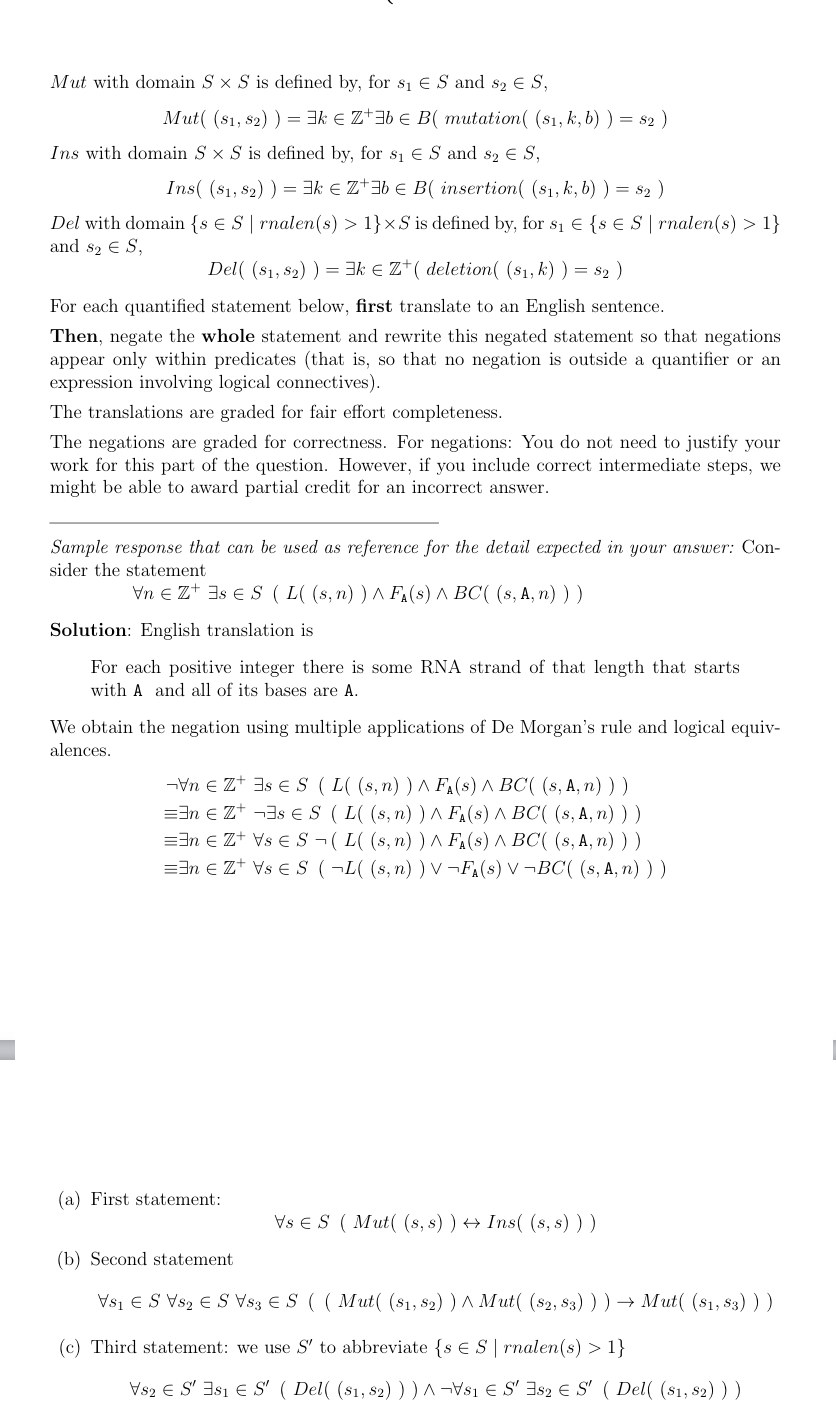
Question: Mut with domain S x S is defined by, for s, E S and $2 E S, Mut( ($1, $2) ) = k E Z+
Mut with domain S x S is defined by, for s, E S and $2 E S, Mut( ($1, $2) ) = k E Z+ 3be B( mutation( (s1, k, b) ) = $2 ) Ins with domain S x S is defined by, for s, E S and $2 E S, Ins( ($1, $2) ) = k E Z+ 3be B( insertion( ($1, k, b) ) = $2 ) Del with domain {s E S | rnalen(s) > 1} x S is defined by, for s E {s E S | rnalen(s) > 1} and $2 E S, Del( ($1, $2) ) = 3k E Z+ ( deletion( ($1, k) ) = $2 ) For each quantified statement below, first translate to an English sentence. Then, negate the whole statement and rewrite this negated statement so that negations appear only within predicates (that is, so that no negation is outside a quantifier or an expression involving logical connectives). The translations are graded for fair effort completeness. The negations are graded for correctness. For negations: You do not need to justify your work for this part of the question. However, if you include correct intermediate steps, we might be able to award partial credit for an incorrect answer. Sample response that can be used as reference for the detail expected in your answer: Con- sider the statement Vn EZ+ is ES ( L( (s, n) ) A FA(s) A BC( (s, A, n) ) ) Solution: English translation is For each positive integer there is some RNA strand of that length that starts with A and all of its bases are A. We obtain the negation using multiple applications of De Morgan's rule and logical equiv- alences. Vn E Z 3s ES ( L( (s, n) ) A FA(s) A BC( (s, A, n) ) ) Inez -3s ES ( L( (s, n) ) A FA(s) ABC( (s, A, n) ) ) in EZt VS ES -( L( (s, n) ) A FA(s) ABC( (s, A, n) ) ) 3nez VSES (-L( (s, n) ) V -FA(s) V -BC( (s, A, n) ) ) (a) First statement: VS ES ( Mut( (s, s) ) Ins( (s, s) ) ) (b) Second statement VS1 E S VS2 E S Vs3 ES ( ( Mut( ($1, $2) ) A Mut( ($2, 53) ) ) - Mut( ($1, 53) ) ) (c) Third statement: we use S' to abbreviate {s E S | rnalen(s) > 1} Vs2 E S' 3s E S' ( Del( ($1, $2) ) ) A -Vs E S' as2 E S' ( Del( ($1, $2) ) )
Step by Step Solution
There are 3 Steps involved in it
1 Expert Approved Answer
Step: 1 Unlock
Question Has Been Solved by an Expert!
Get step-by-step solutions from verified subject matter experts
Step: 2 Unlock
Step: 3 Unlock
Students Have Also Explored These Related Mathematics Questions!









 Study Help