







Question: my question is how to solve part B ? Question 4 (16 points] Consider an economy with , - 3 goods. The utility function of
my question is how to solve part B ?
![(16 points] Consider an economy with , - 3 goods. The utility](https://s3.amazonaws.com/si.experts.images/answers/2024/06/667551197ac6d_505667551191cfd1.jpg)
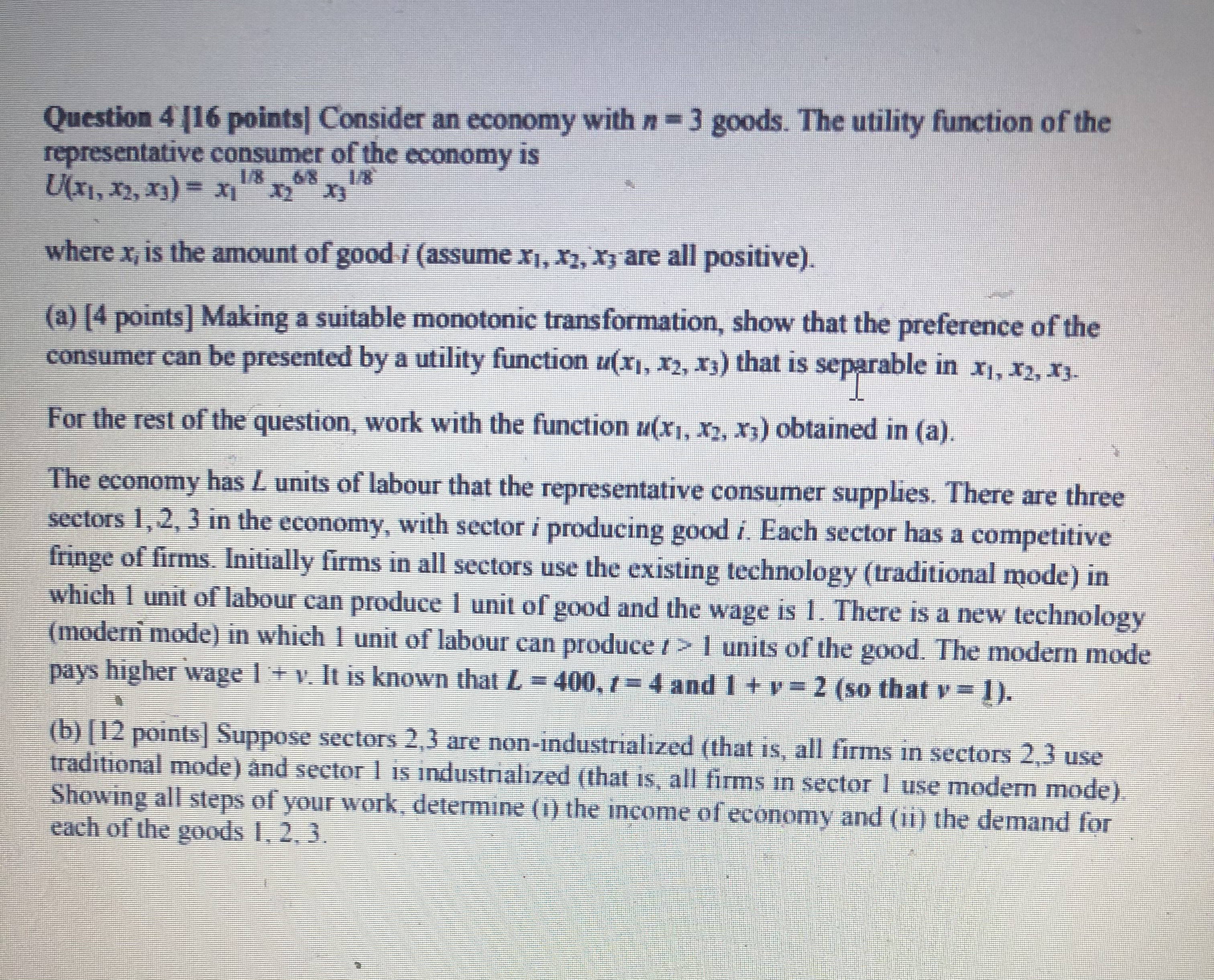
Question 4 (16 points] Consider an economy with , - 3 goods. The utility function of the representative consumer of the economy is U(x1, X2, X]) = X x x where x, is the amount of good / (assume x1, x2, x3 are all positive). (a) [4 points] Making a suitable monotonic transformation, show that the preference of the consumer can be presented by a utility function u(x1, x2, x;) that is separable in x1, X2, X3. For the rest of the question, work with the function #(x1, x2, x3) obtained in (a). The economy has & units of labour that the representative consumer supplies. There are three sectors 1, 2, 3 in the economy, with sector / producing good /. Each sector has a competitive fringe of firms. Initially firms in all sectors use the existing technology (traditional mode) in which I unit of labour can produce I unit of good and the wage is 1. There is a new technology (modern mode) in which I unit of labour can produce / > I units of the good. The modern mode pays higher wage | + v. It is known that _ = 400. / = 4 and 1 + v = 2 (so that v = 1). (b) [12 points] Suppose sectors 2,3 are non-industrialized (that is, all firms in sectors 2,3 use traditional mode) and sector | is industrialized (that is, all firms in sector I use modern mode) Showing all steps of your work, determine (1) the income of economy and (ii ) the demand for each of the goods I. 2, 3
Step by Step Solution
There are 3 Steps involved in it

Get step-by-step solutions from verified subject matter experts
 Study Help