



Question: n) An electrostatic precipitator (ESP), is to be constructed to remove flysh particles from tack you at a flow rate() equal to 10 m/sec. Analysis
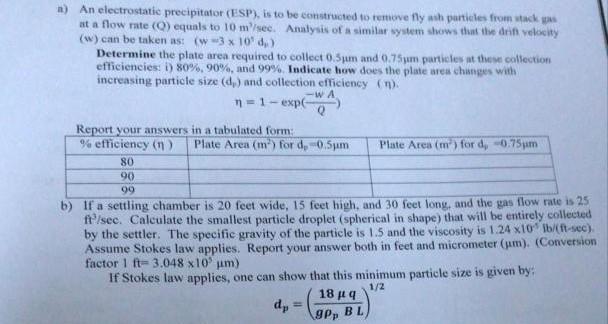
n) An electrostatic precipitator (ESP), is to be constructed to remove flysh particles from tack you at a flow rate() equal to 10 m/sec. Analysis of a similar stem shows that the drift velocity (w) can be taken as: (3 x 10 d.) Determine the plate area required to collect 0,5um and 0.75ym particles at the collection efficiencies: i) 80% 90%, and 99% Indicate how does the plate area changes with increasing particle size (d) and collection efficiency (n. -WA n=1 - exp4 Report your answers in a tabulated form: 96 efficiency (1) Plate Area (m) ford, 0.5pm Plate Area (m) ford) 0.75m 80 90 99 b) If a settling chamber is 20 feet wide, 15 feet high, and 30 feet long, and the gas flow rate is 25 ft /sec. Calculate the smallest particle droplet (spherical in shape) that will be entirely collected by the settler. The specific gravity of the particle is 1.5 and the viscosity is 1.24 x10 b/(-sec) Assume Stokes law applies. Report your answer both in feet and micrometer (m). (Conversion factor 1 ft=3.048 x10 m) If Stokes law applies, one can show that this minimum particle size is given by: 18 19 d, 1/2 \gp, Bi
Step by Step Solution
There are 3 Steps involved in it

Get step-by-step solutions from verified subject matter experts