



Question: n i=1 (a) Let X1, ..., Xn be i.i.d. random variables with E[|X1|] < and let S = 1 X. Calculate ES X1] and
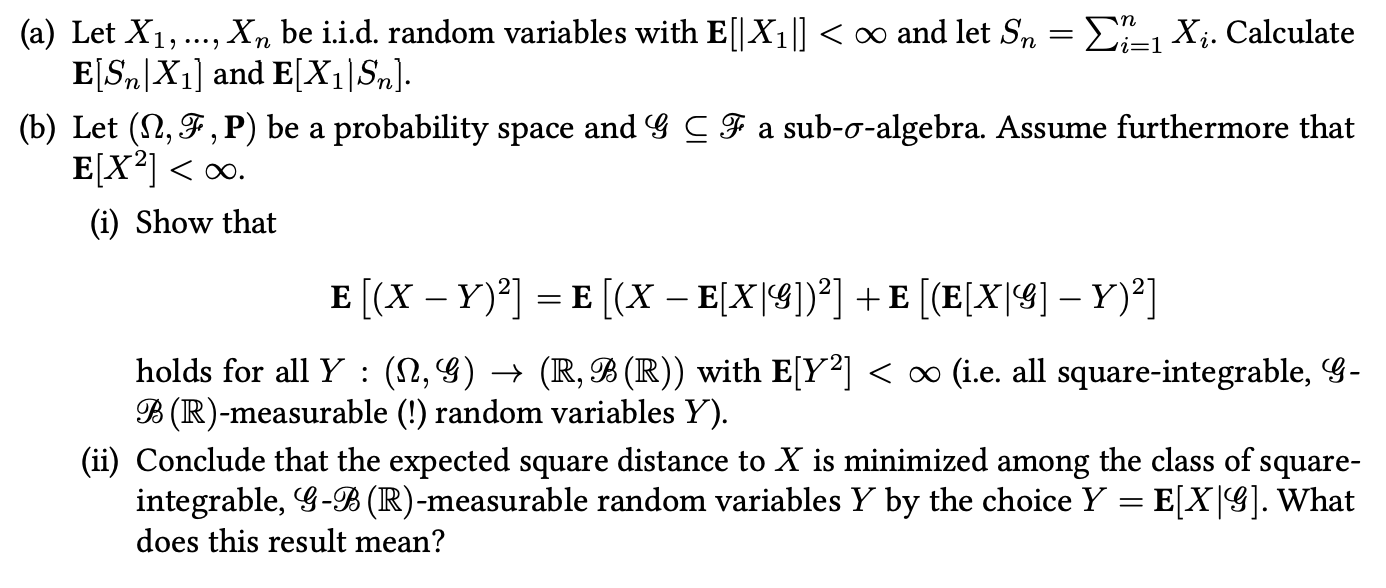
n i=1 (a) Let X1, ..., Xn be i.i.d. random variables with E[|X1|] < and let S = 1 X. Calculate ES X1] and E[X1]Sn]. (b) Let (N,F,P) be a probability space and G C F a sub--algebra. Assume furthermore that E[X2] < . (i) Show that E [(X Y)] = E [(X E[X|G])] + E [(E[X|G] Y)] holds for all Y (N,G) (R,B(R)) with E[Y] < (i.e. all square-integrable, G- B (R)-measurable (!) random variables Y). (ii) Conclude that the expected square distance to X is minimized among the class of square- integrable, G-B (R)-measurable random variables Y by the choice Y = E[X|G]. What does this result mean?
Step by Step Solution
There are 3 Steps involved in it

Get step-by-step solutions from verified subject matter experts