


Question: Name: Chem 10, Section: Lab Partner: Experiment Date: Mole Ratios and Reaction Stoichiometry Reaction A: Sodium Bicarbonate and Hydrochloric Acid Experimental Data (a) Mass of
Name: Chem 10, Section: Lab Partner: Experiment
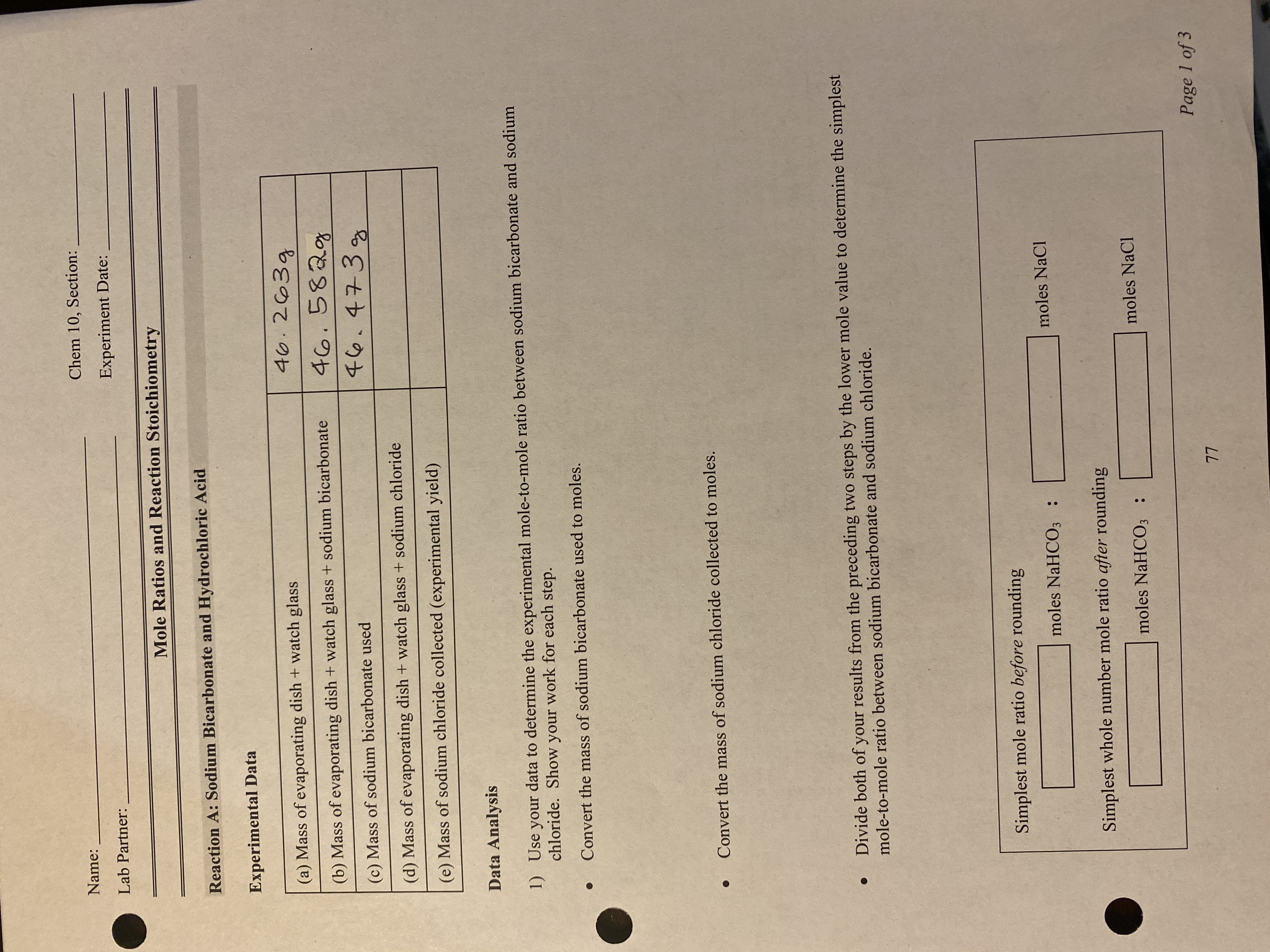
Name: Chem 10, Section: Lab Partner: Experiment Date: Mole Ratios and Reaction Stoichiometry Reaction A: Sodium Bicarbonate and Hydrochloric Acid Experimental Data (a) Mass of evaporating dish + watch glass 46 . 263 g (b) Mass of evaporating dish + watch glass + sodium bicarbonate 46 . 58 2g (c) Mass of sodium bicarbonate used 46 . 473 (d) Mass of evaporating dish + watch glass + sodium chloride (e) Mass of sodium chloride collected (experimental yield) Data Analysis 1) Use your data to determine the experimental mole-to-mole ratio between sodium bicarbonate and sodium chloride. Show your work for each step. Convert the mass of sodium bicarbonate used to moles. . Convert the mass of sodium chloride collected to moles. . Divide both of your results from the preceding two steps by the lower mole value to determine the simplest mole-to-mole ratio between sodium bicarbonate and sodium chloride. Simplest mole ratio before rounding moles NaHCO, : moles NaCl Simplest whole number mole ratio after rounding moles NaHCO, : moles NaCl 77 Page 1 of 3

Step by Step Solution

There are 3 Steps involved in it

1 Expert Approved Answer
Step: 1 Unlock blur-text-image

Question Has Been Solved by an Expert!

Get step-by-step solutions from verified subject matter experts

Step: 2 Unlock
Step: 3 Unlock

Students Have Also Explored These Related Law Questions!