







Question: Post-Lab Assignment Each student will submit her his own post-lab assignment. I encourage students to talk to each other when working on the post-lab. But
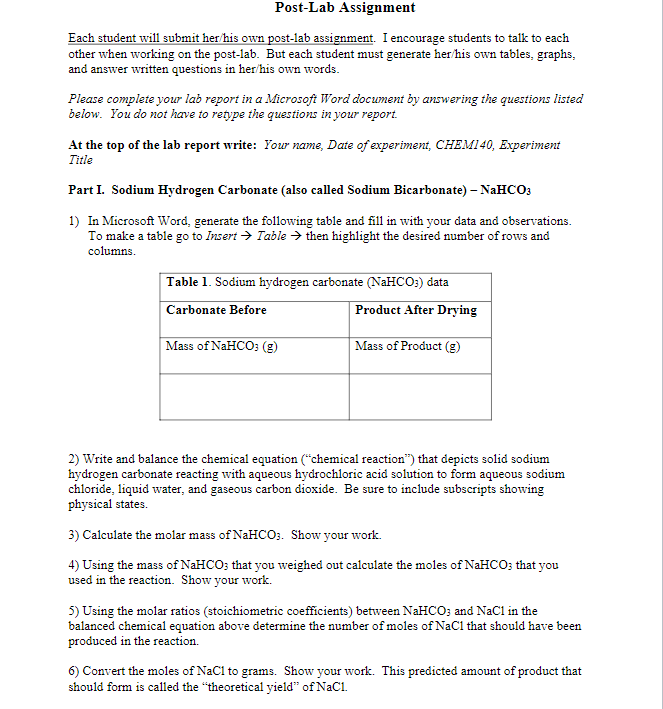
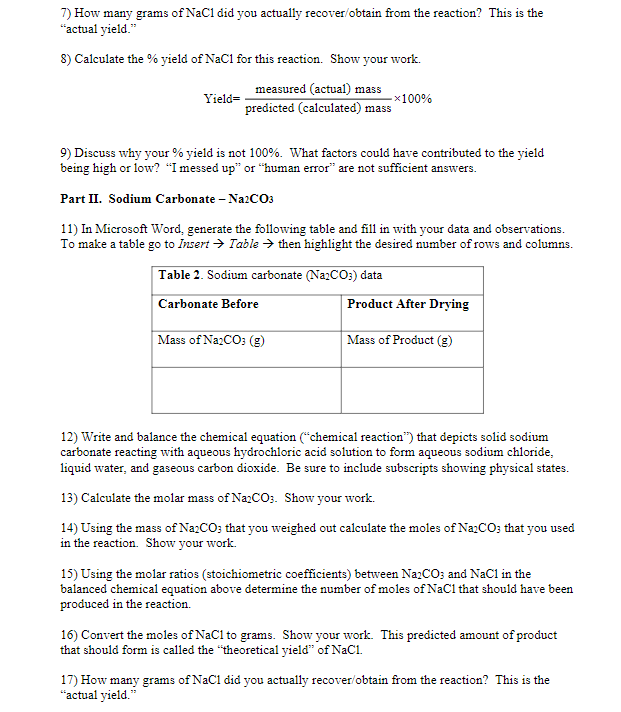
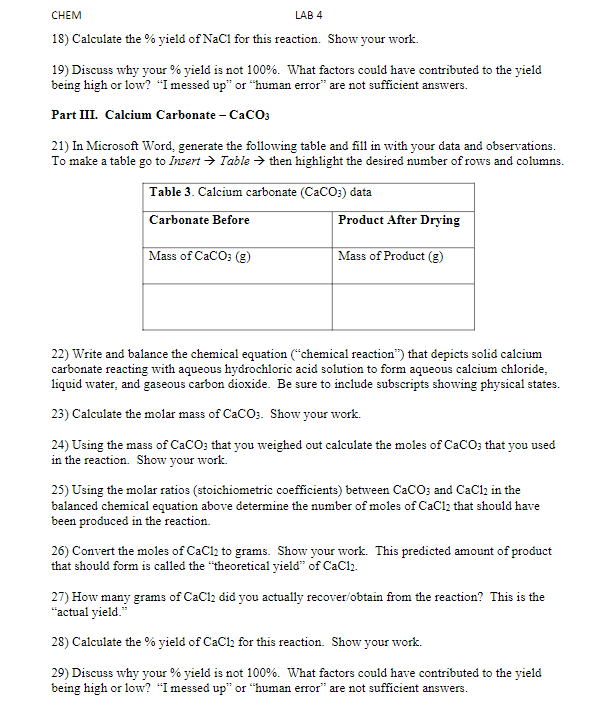
Post-Lab Assignment Each student will submit her his own post-lab assignment. I encourage students to talk to each other when working on the post-lab. But each student must generate her his own tables, graphs, and answer written questions in her/his own words. Please complete your lab report in a Microsoft Word document by answering the questions listed below. You do not have to retype the questions in your report. At the top of the lab report write: Your name, Date of experiment, CHEMI40, Experiment Title Part I. Sodium Hydrogen Carbonate (also called Sodium Bicarbonate) - NaHCO3 1) In Microsoft Word, generate the following table and fill in with your data and observations. To make a table go to Insert Table then highlight the desired number of rows and columns. Table 1. Sodium hydrogen carbonate (NaHCO3) data Carbonate Before Product After Drying Mass of NaHCO3 (9) Mass of Product (2) 2) Write and balance the chemical equation ("chemical reaction") that depicts solid sodium hydrogen carbonate reacting with aqueous hydrochloric acid solution to form aqueous sodium chloride, liquid water, and gaseous carbon dioxide. Be sure to include subscripts showing physical states. 3) Calculate the molar mass of NaHCO3. Show your work. 4) Using the mass of NaHCO3 that you weighed out calculate the moles of NaHCO3 that you used in the reaction. Show your work. 5) Using the molar ratios (stoichiometric coefficients) between NaHCO3 and NaCl in the balanced chemical equation above determine the number of moles of NaCl that should have been produced in the reaction. 6) Convert the moles of NaCl to grams. Show your work. This predicted amount of product that should form is called the "theoretical yield" of Naci. 7) How many grams of NaCl did you actually recover/obtain from the reaction? This is the "actual yield." 8) Calculate the % yield of NaCl for this reaction. Show your work. measured (actual) mass Yield= -X100% predicted (calculated) mass 9) Discuss why your % yield is not 100%. What factors could have contributed to the yield being high or low? "I messed up" or "human error are not sufficient answers. Part II. Sodium Carbonate - Na2CO3 11) In Microsoft Word, generate the following table and fill in with your data and observations. To make a table go to Insert Table then highlight the desired number of rows and columns. Table 2. Sodium carbonate (Na2CO3) data Carbonate Before Product After Drying Mass of Na2CO3 (8) Mass of Product (2) 12) Write and balance the chemical equation ("chemical reaction") that depicts solid sodium carbonate reacting with aqueous hydrochloric acid solution to form aqueous sodium chloride, liquid water, and gaseous carbon dioxide. Be sure to include subscripts showing physical states. 13) Calculate the molar mass of Na2CO3. Show your work. 14) Using the mass of Na2CO3 that you weighed out calculate the moles of Na2CO3 that you used in the reaction. Show your work. 15) Using the molar ratios (stoichiometric coefficients) between Na2CO3 and NaCl in the balanced chemical equation above determine the number of moles of NaCl that should have been produced in the reaction 16) Convert the moles of NaCl to grams. Show your work. This predicted amount of product that should form is called the theoretical yield" of Naci. 17) How many grams of NaCl did you actually recover/obtain from the reaction? This is the "actual yield." LAB 4 CHEM 18) Calculate the % yield of NaCl for this reaction. Show your work. 19) Discuss why your % yield is not 100%. What factors could have contributed to the yield being high or low? "I messed up" or "human error" are not sufficient answers. Part III. Calcium Carbonate - CaCO3 21) In Microsoft Word, generate the following table and fill in with your data and observations. To make a table go to Insert Table then highlight the desired number of rows and columns. Table 3. Calcium carbonate (CaCO3) data Carbonate Before Product After Drying Mass of CaCO3 (2) Mass of Product (2) 22) Write and balance the chemical equation ("chemical reaction') that depicts solid calcium carbonate reacting with aqueous hydrochloric acid solution to form aqueous calcium chloride, liquid water, and gaseous carbon dioxide. Be sure to include subscripts showing physical states. 23) Calculate the molar mass of CaCO3. Show your work. 24) Using the mass of CaCO3 that you weighed out calculate the moles of CaCO3 that you used in the reaction. Show your work. 25) Using the molar ratios (stoichiometric coefficients) between CaCO3 and CaCl2 in the balanced chemical equation above determine the number of moles of CaCl2 that should have been produced in the reaction. 26) Convert the moles of CaCl2 to grams. Show your work. This predicted amount of product that should form is called the theoretical yield of CaCl2. 27) How many grams of CaCl2 did you actually recover/obtain from the reaction? This is the "actual yield." 28) Calculate the % yield of CaCl2 for this reaction. Show your work. 29) Discuss why your % yield is not 100%. What factors could have contributed to the yield being high or low? "I messed up" or "human error" are not sufficient answers
Step by Step Solution
There are 3 Steps involved in it

Get step-by-step solutions from verified subject matter experts
 Study Help