







Question: Name: Grade and Section: Score: School: Teacher: Subject: General Physics 2 LAS Writer: JEREMIAH S. SABRIDO Content Evaluator: RETCHIE JOY PISANA, MICHAEL DAVE NALAGON Lesson
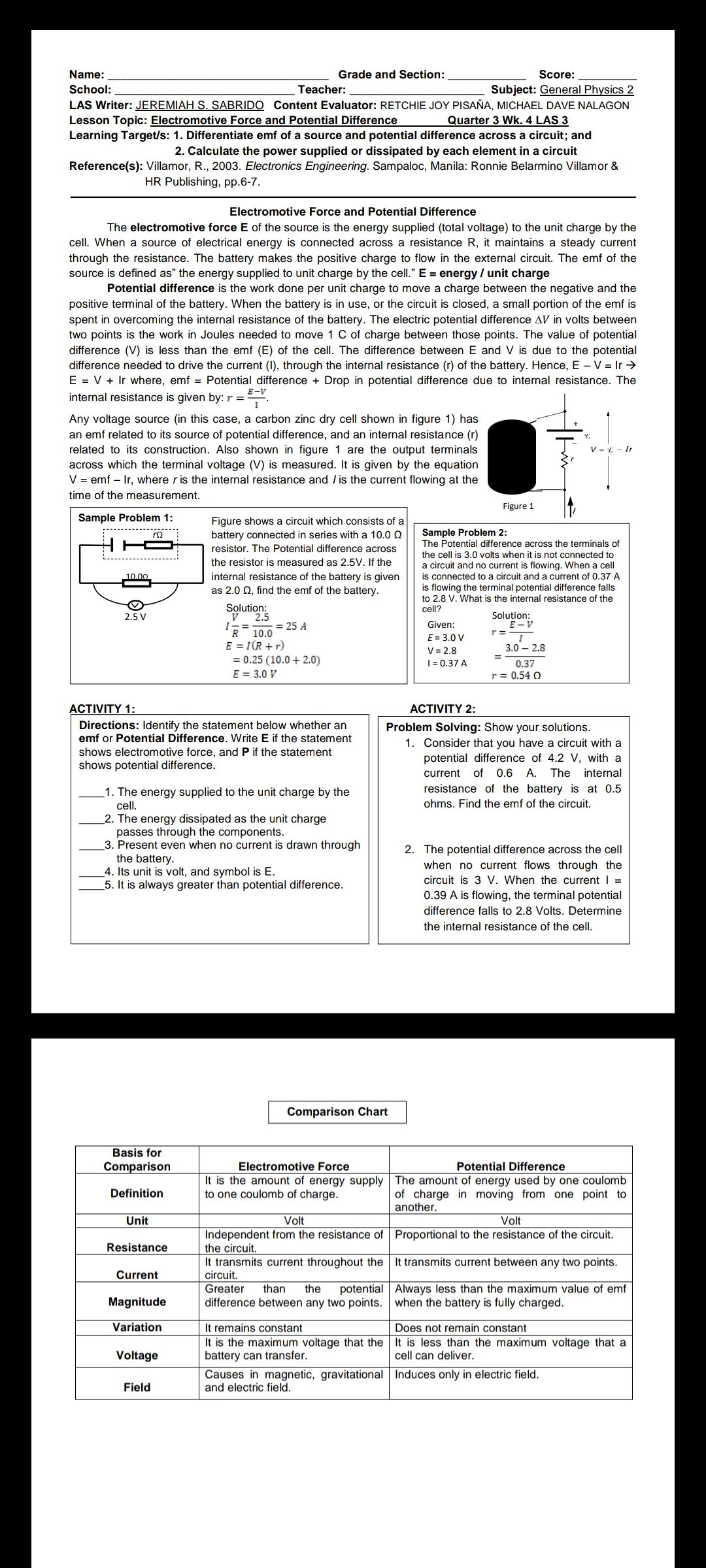
Name: Grade and Section: Score: School: Teacher: Subject: General Physics 2 LAS Writer: JEREMIAH S. SABRIDO Content Evaluator: RETCHIE JOY PISANA, MICHAEL DAVE NALAGON Lesson Topic: Electromotive Force and Potential Difference Quarter 3 Wk. 4 LAS 3 Learning Target/s: 1. Differentiate emf of a source and potential difference across a circuit; and 2. Calculate the power supplied or dissipated by each element in a circuit Reference(s): Villamor, R., 2003. Electronics Engineering. Sampaloc, Manila: Ronnie Belarmino Villamor & HR Publishing, pp.6-7. Electromotive Force and Potential Difference The electromotive force E of the source is the energy supplied (total voltage) to the unit charge by the cell. When a source of electrical energy is connected across a resistance R, it maintains a steady current through the resistance. The battery makes the positive charge to flow in the external circuit. The emf of the source is defined as" the energy supplied to unit charge by the cell." E = energy / unit charge Potential difference is the work done per unit charge to move a charge between the negative and the positive terminal of the battery. When the battery is in use, or the circuit is closed, a small portion of the emf is spent in overcoming the internal resistance of the battery. The electric potential difference AV in volts between two points is the work in Joules needed to move 1 C of charge between those points. The value of potential difference (V) is less than the emf (E) of the cell. The difference between E and V is due to the potential difference needed to drive the current (1), through the internal resistance (r) of the battery. Hence, E - V = Ir -> E = V + Ir where, emf = Potential difference + Drop in potential difference due to internal resistance. The internal resistance is given by: r = =. Any voltage source (in this case, a carbon zinc dry cell shown in figure 1) has an emf related to its source of potential difference, and an internal resistance (r) related to its construction. Also shown in figure 1 are the output terminals - E - 1 across which the terminal voltage (V) is measured. It is given by the equation V = emf - Ir, where r is the internal resistance and / is the current flowing at the time of the measurement. Figure 1 Sample Problem 1 Figure shows a circuit which consists of a battery connected in series with a 10.0 0 Sample Problem 2: resistor. The Potential difference across The Potential difference across the terminals of the resistor is measured as 2.5V. If the the cell is 3.0 volts when it is not connected to a circuit and no current is flowing. When a cell 10.00 internal resistance of the battery is given is connected to a circuit and a current of 0.37 A as 2.0 0, find the emf of the battery is flowing the terminal potential difference falls to 2.8 V. What is the internal resistance of the Solution: cell? 2.5 V 2.5 Solution R 10.0 = 25 A Given: E = 3.0 V r= E -V E = I(R + r) V = 2.8 3.0 - 2.8 = 0.25 (10.0 + 2.0) 1 = 0.37 A 0.37 E = 3.0 V r = 0.54 0 ACTIVITY 1: ACTIVITY 2: Directions: Identify the statement below whether an Problem Solving: Show your solutions. emf or Potential Difference. Write E if the statement shows electromotive force, and P if the statement 1. Consider that you have a circuit with a shows potential difference. potential difference of 4.2 V, with a current of 0.6 A. The internal 1. The energy supplied to the unit charge by the resistance of the battery is at 0.5 cell. ohms. Find the emf of the circuit. 2. The energy dissipated as the unit charge passes through the components. 3. Present even when no current is drawn through 2. The potential difference across the cell the battery. 4. Its unit is volt, and symbol is E. when no current flows through the 5. It is always greater than potential difference. circuit is 3 V. When the current | = 0.39 A is flowing, the terminal potential difference falls to 2.8 Volts. Determine the internal resistance of the cell. Comparison Chart Basis for Comparison Electromotive Force Potential Difference It is the amount of energy supply | The amount of energy used by one coulomb Definition to one coulomb of charge. of charge in moving from one point to another. Unit Volt Volt Independent from the resistance of Proportional to the resistance of the circuit. Resistance the circuit. It transmits current throughout the It transmits current between any two points. Current circuit Greater than the potential | Always less than the an the maximum value of emf Magnitude difference between any two points. when the battery is fully charged Variation It remains constant Does not remain constant It is the maximum voltage that the | It is less than the maximum voltage that a Voltage battery can transfer. cell can deliver. Causes in magnetic, gravitational | Induces only in electric field. Field and electric field
Step by Step Solution
There are 3 Steps involved in it

Get step-by-step solutions from verified subject matter experts
 Study Help