







Question: please follow the illustration example Name: Grade & Section: Score: School: Teacher: Subject: General Physics 2 LAS Writer: NELSON B. MALIFICIADO Content Editor: RETCHIE JOY
please follow the illustration example
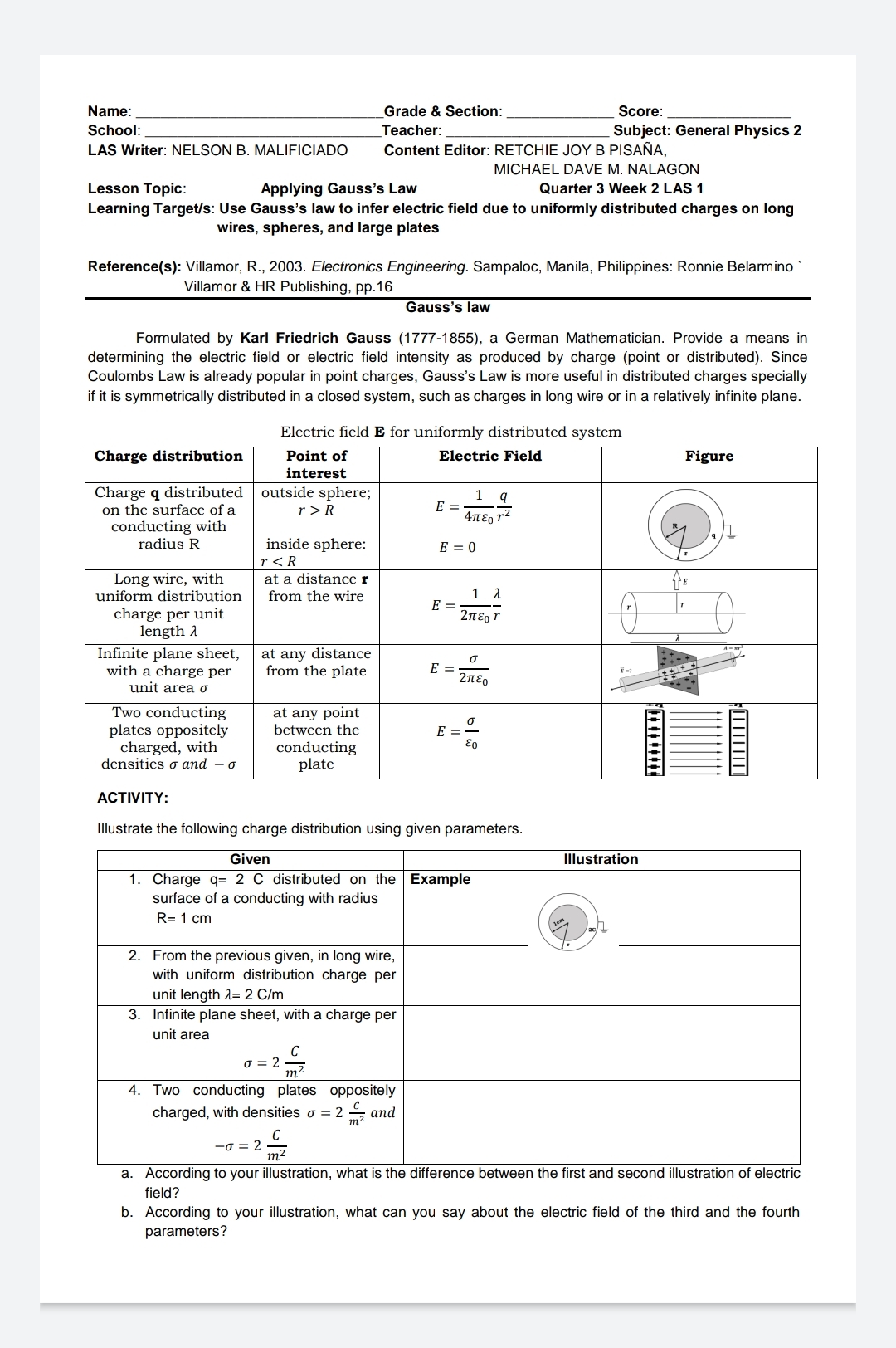
Name: Grade & Section: Score: School: Teacher: Subject: General Physics 2 LAS Writer: NELSON B. MALIFICIADO Content Editor: RETCHIE JOY B PISANA, MICHAEL DAVE M. NALAGON Lesson Topic: Applying Gauss's Law Quarter 3 Week 2 LAS 1 Learning Target/s: Use Gauss's law to infer electric field due to uniformly distributed charges on long wires, spheres, and large plates Reference(s): Villamor, R., 2003. Electronics Engineering. Sampaloc, Manila, Philippines: Ronnie Belarmino Villamor & HR Publishing, pp. 16 Gauss's law Formulated by Karl Friedrich Gauss (1777-1855), a German Mathematician. Provide a means in determining the electric field or electric field intensity as produced by charge (point or distributed). Since Coulombs Law is already popular in point charges, Gauss's Law is more useful in distributed charges specially if it is symmetrically distributed in a closed system, such as charges in long wire or in a relatively infinite plane. Electric field E for uniformly distributed system Charge distribution Point of Electric Field Figure interest Charge q distributed outside sphere; 1 q on the surface of a r > R AnEO 12 conducting with radius R inside sphere: E =0
Step by Step Solution
There are 3 Steps involved in it

Get step-by-step solutions from verified subject matter experts
 Study Help