







Question: Name ( please print ) : Total Points: ( last ) 9 . [ 4 0 points ] Pictured at right is a schematic of
Name please print: Total Points:
last
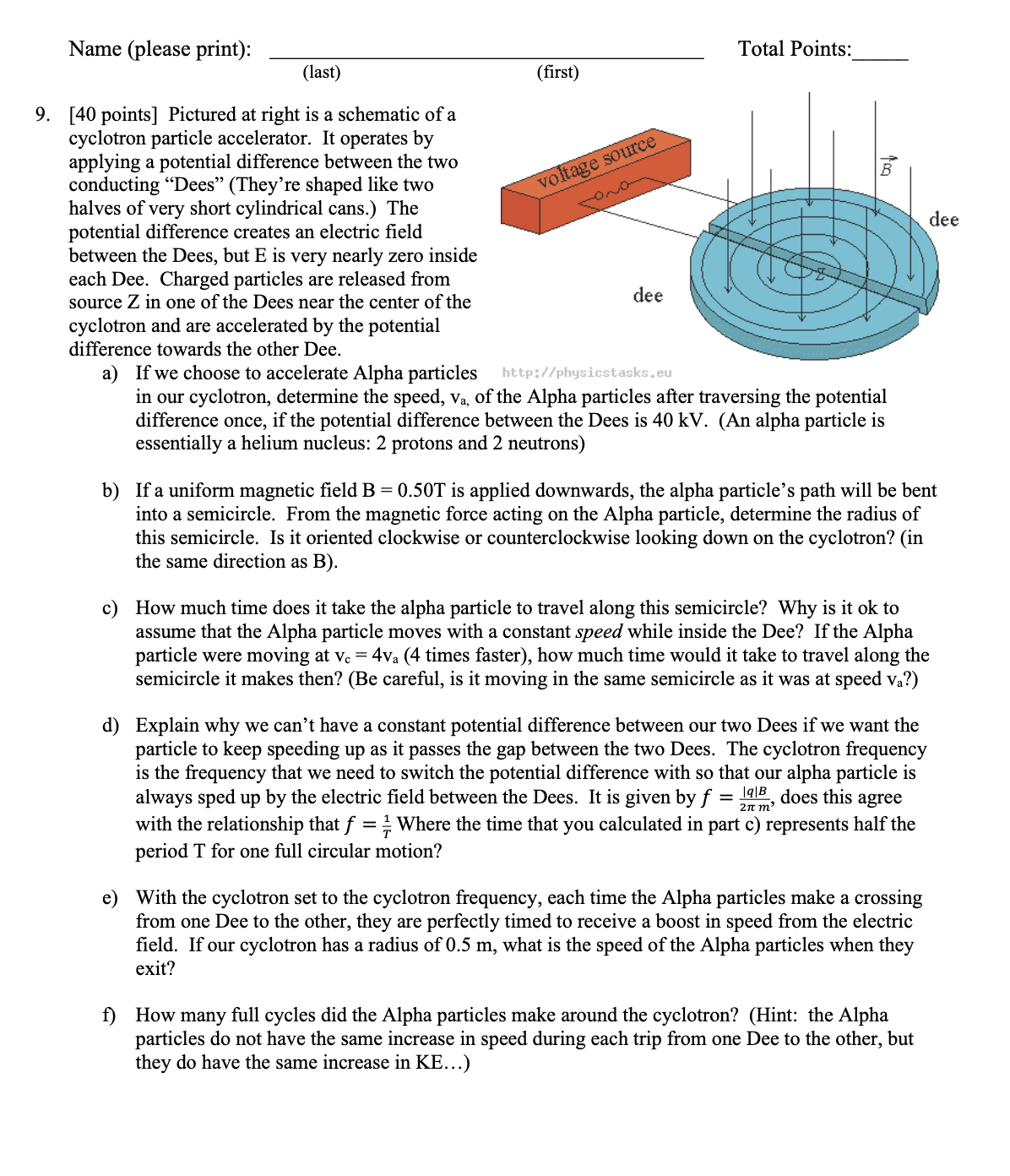
points Pictured at right is a schematic of a cyclotron particle accelerator. It operates by applying a potential difference between the two conducting "Dees" Theyre shaped like two halves of very short cylindrical cans. The potential difference creates an electric field between the Dees, but E is very nearly zero inside each Dee. Charged particles are released from source Z in one of the Dees near the center of the cyclotron and are accelerated by the potential difference towards the other Dee.
a If we choose to accelerate Alpha particles
in our cyclotron, determine the speed, mathrmvmathrma of the Alpha particles after traversing the potential difference once, if the potential difference between the Dees is kV An alpha particle is essentially a helium nucleus: protons and neutrons
b If a uniform magnetic field mathrmBmathrm~T is applied downwards, the alpha particle's path will be bent into a semicircle. From the magnetic force acting on the Alpha particle, determine the radius of this semicircle. Is it oriented clockwise or counterclockwise looking down on the cyclotron? in the same direction as B
c How much time does it take the alpha particle to travel along this semicircle? Why is it ok to assume that the Alpha particle moves with a constant speed while inside the Dee? If the Alpha particle were moving at mathrmvmathrmcmathrmvmathrma times faster how much time would it take to travel along the semicircle it makes then? Be careful, is it moving in the same semicircle as it was at speed mathrmvmathrma
d Explain why we can't have a constant potential difference between our two Dees if we want the particle to keep speeding up as it passes the gap between the two Dees. The cyclotron frequency is the frequency that we need to switch the potential difference with so that our alpha particle is always sped up by the electric field between the Dees. It is given by ffracq Bpi m does this agree with the relationship that ffracT Where the time that you calculated in part c represents half the period T for one full circular motion?
e With the cyclotron set to the cyclotron frequency, each time the Alpha particles make a crossing from one Dee to the other, they are perfectly timed to receive a boost in speed from the electric field. If our cyclotron has a radius of m what is the speed of the Alpha particles when they exit?
f How many full cycles did the Alpha particles make around the cyclotron? Hint: the Alpha particles do not have the same increase in speed during each trip from one Dee to the other, but they do have the same increase in KE
Step by Step Solution
There are 3 Steps involved in it
1 Expert Approved Answer
Step: 1 Unlock

Question Has Been Solved by an Expert!
Get step-by-step solutions from verified subject matter experts
Step: 2 Unlock
Step: 3 Unlock
 Study Help