



Question: Name: Section: Group members: MATH 116-01-03 Fall 2020 Worksheet #6, Friday, October 2, 2020. Smiles and Leniency Can a simple smile have an effect on
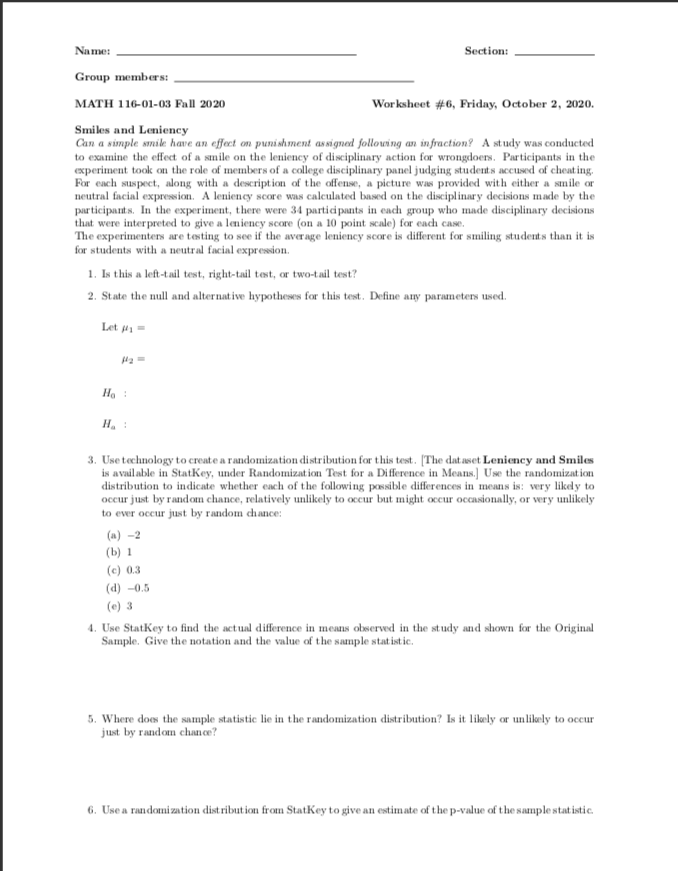
Name: Section: Group members: MATH 116-01-03 Fall 2020 Worksheet #6, Friday, October 2, 2020. Smiles and Leniency Can a simple smile have an effect on punishment assigned following an infraction? A study was conducted to examine the effect of a smile on the leniency of disciplinary action for wrongdoers. Participants in the experiment took on the role of members of a college disciplinary panel judging students accused of cheating. For each suspect, along with a description of the offense, a picture was provided with either a smile or neutral facial expression. A leniency score was calculated based on the disciplinary decisions made by the participants. In the experiment, there were 34 participants in each group who made disciplinary decisions that were interpreted to give a leniency score (on a 10 point scale) for each case. The experimenters are testing to see if the average leniency score is different for smiling students than it is for students with a neutral facial expression. 1. Is this a left-tail test, right-tail test, or two-tail test? 2. State the null and alternative hypotheses for this test. Define any parameters used. Let /1 = Ha : Ha : 3. Use technology to create a randomization distribution for this test. [The dataset Leniency and Smiles is available in Statkey, under Randomization Test for a Difference in Means.] Use the randomization distribution to indicate whether each of the following possible differences in means is: very likely to occur just by random chance, relatively unlikely to occur but might occur occasionally, or very unlikely to ever occur just by random chance: (a) -2 (b) 1 (c) 0.3 (d) -0.5 (e) 3 4. Use Statkey to find the actual difference in means observed in the study and shown for the Original Sample, Give the notation and the value of the sample statistic. 5. Where does the sample statistic lie in the randomization distribution? Is it likely or unlikely to occur just by random chance? 6. Use a randomization distribution from Statkey to give an estimate of the p-value of the sample statistic
Step by Step Solution
There are 3 Steps involved in it

Get step-by-step solutions from verified subject matter experts