Question: need a executive summary Lean Production 401 CASE STUDY 15.1 Murphy Manufacturing When Joe Volibeach vice president of operations for Murphy Manufacturing was given the
need a executive summary
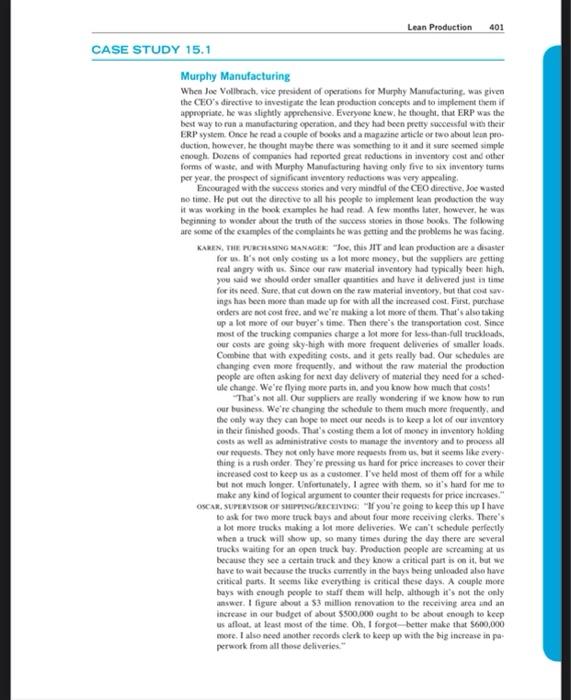
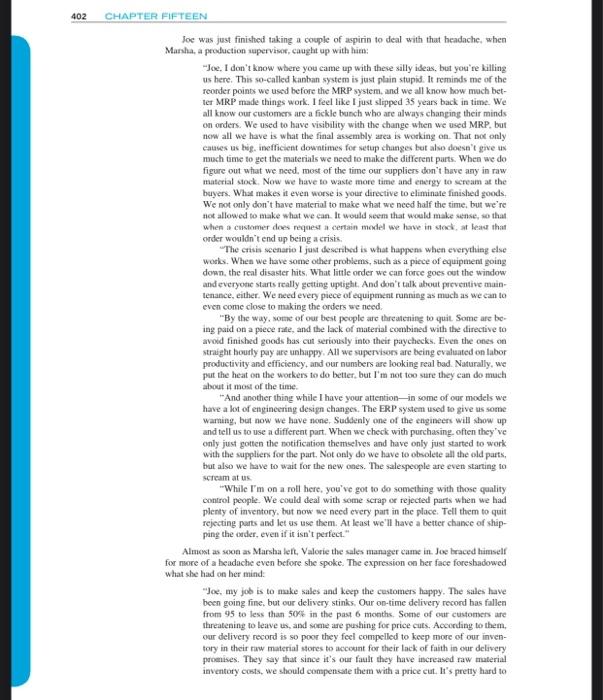
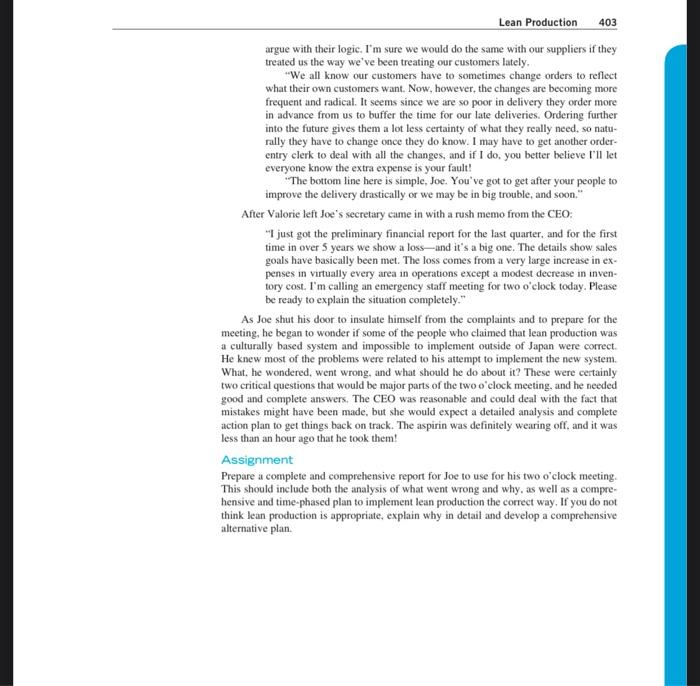
Lean Production 401 CASE STUDY 15.1 Murphy Manufacturing When Joe Volibeach vice president of operations for Murphy Manufacturing was given the CEO's directive to investigate the lean production concepts and to implement them if appropriate, he was slightly apprehensive. Everyone knew, he thought that ERP was the best way to run a manufacturing operation, and they had been pretty successful with their ERP system. Once he read a couple of books and a magazine article or two about lean pro duction, however, he thought maybe there was something to it and it sure seemed simple enough. Dezetts of companies and reported great reductions in inventory cost and other forms of wateand with Murphy Manufacturing having only five to six inventory tums per year, the prospect of significant inventory reductions was very appealing Encouraged with the success stories and very mindful of the CEO directive. Joe wasted no time. He put out the directive to all his people to implement lean production the way it was working in the hook examples he had read. A few months later, however, he was beginning to wonder about the truth of the success stories in those books. The following are some of the examples of the complaints he was getting and the problems he was facing KAREN. THE PURCHASING MANAGER". this JIT and lean production are a disaster for us. It's not only conting us a lot more money, but the suppliers are getting real angry with us. Since our raw material inventory had typically been high, you said we should onder smaller quantities and have it delivered just in time for its need. Sure, that cut down on the raw material inventory, but that cod sav. ings has been more than made up for with all the increased cost. First, purchase orders are not cost free, and we're muking a lot more of them. That's also taking up a lot more of our buyer's time. Then there's the transportation cost. Since most of the trucking companies charge a lot more for less than full trackloads, our costs are going sky-high with more frequent deliveries of smaller loads Combine that with expediting costs, and it gets really bad. Our schedules are changing even more frequently, and without the raw material the production people are often asking for next day delivery of material they need for a sched ule change. We're flying more parts in, and you know how much that cons! "That's not all. Our suppliers are really wondering if we know how to run our business. We're changing the schedule to them much more frequently, and the only way they can hope to meet our needs is to keep a lot of our inventory in their finished goods. That's costing them a lot of money in inventory holding costs as well as administrative costs to manage the inventory and to process all our requests. They not only have more requests from us, but it seems like every thing is a rush order. They're pressing us hard for price increases to cover their increased cost to keep us as a customer. I've held most of them off for a while but not much longer. Unfortunately, I agree with them. so it's hard for me to make any kind of logical argument to counter their requests for price increases." OSCAR, SUPERVISOR OF SHIPPING RECEIVING If you're going to keep this up I have to ask for two more truck bays and about four more receiving clerks. There's a lot more trucks making a lot more deliveries. We can't schedule perfectly when a truck will show up. so many times during the day there are several trucks waiting for an open truck bay. Production people are screaming at us because they see a certain truck and they know a critical part is on it but we have to wait because the trucks currently in the bays being unloaded also have critical parts. It seems like everything is critical these days. A couple more hays with enough people to staff them will help, although it's not the only answer. I figure about a 53 million renovation to the receiving area and an increase in our budget of about $500,000 ought to be about cnough to keep us afloat. at least most of the time. Oh, I forgot-better make that 5600,000 more. Talso need another records clerk to keep up with the big increase in po perwork from all these deliveries 402 CHAPTER FIFTEEN Joe was just finished taking a couple of aspirin to deal with that headache, when Marsha, a production supervisor, caught up with him: "Joe. I don't know where you came up with these silly ideas, but you're killing us here. This so-called Kanban system is just plain stupid. It reminds me of the reorder points we used before the MRP system, and we all know how much bet- ter MRP made things work. I feel like I just slipped 35 years back in time. We all know our customers are a fickle bunch who are always changing their minds on orders. We used to have visibility with the change when we used MRP, but now all we have is what the final assembly area is working on. That not only causes us big, inefficient downtimes for setup changes but also doesn't give us mach time to get the materials we need to make the different parts. When we do figure out what we need, most of the time our suppliers don't have any in raw material stock. Now we have to waste more time and energy to scream at the buyers. What makes it even worse is your directive to eliminate finished goods, We not only don't have material to make what we need half the time, but we're not allowed to make what we can. It would seem that would make sense, so that when a customer does request a certain model we have in stock, at least that order wouldn't end up being a crisis. "The crisis scenario I just described is what happens when everything else works. When we have some other problems, such as a piece of equipment going down, the real disaster hits. What little order we can force goes out the window and everyone starts really getting uptight. And don't talk about preventive main- tenance, either. We need every piece of equipment running as much as we can to even come close to making the orders we need "By the way, some of our best people are threatening to quit Some are bo ing paid on a piece rate, and the lack of material combined with the directive to avoid finished goods has cut seriously into their paychecks. Even the ones on straight hourly pay are unhappy. All we supervisors are being evaluated on labor productivity and efficiency, and our numbers are looking real bad. Naturally, we put the heat on the workers to do better, but I'm not too sure they can do much about it most of the time. And another thing while I have your attentionin some of our models we have a lot of engineering design changes. The ERP system used to give us some Waming, but now we have none. Suddenly one of the engineers will show up and tell us to use a different part. When we check with purchasing. often they've only just gotten the notification themselves and have only just started to work with the suppliers for the part. Not only do we have to obsolete all the old parts, but also we have to wait for the new ones. The salespeople are even starting to scream at us While I'm on a roll here, you've got to do something with these quality control people. We could deal with some scrap or rejected parts when we had plenty of inventory, but now we need every part in the place. Tell them to quit rejecting parts and let us use them. At least we'll have a better chance of ship- ping the order, even if it isn't perfect." Almocast as soon as Marsha lett, Valorie the sales manager came in. Joe braced himself for more of a headache even before she spoke. The expression on her face foreshadowed what she had on her mind "Joe, my job is to make sales and keep the customers happy. The sales have been going fine, but our delivery stinks. Our on-time delivery record has fallen from 95 to less than 50% in the past 6 months. Some of our customers are threatening to leave us, and some are pushing for price cuts. According to them. our delivery record is so poor they feel compelled to keep more of our inven- tory in their raw material stores to account for their lack of faith in our delivery promises. They say that since it's our fault they have increased raw material inventory costs, we should compensate them with a price cut. It's pretty hard to Lean Production 403 argue with their logic. I'm sure we would do the same with our suppliers if they treated us the way we've been treating our customers lately. "We all know our customers have to sometimes change orders to reflect what their own customers want. Now, however, the changes are becoming more frequent and radical. It seems since we are so poor in delivery they order more in advance from us to buffer the time for our late deliveries. Ordering further into the future gives them a lot less certainty of what they really need, so natu- rally they have to change once they do know. I may have to get another order- entry clerk to deal with all the changes, and if I do, you better believe I'll let everyone know the extra expense is your fault! "The bottom line here is simple, Joe. You've got to get after your people to improve the delivery drastically or we may be in big trouble, and soon." After Valorie left Joe's secretary came in with a rush memo from the CEO: "I just got the preliminary financial report for the last quarter, and for the first time in over 5 years we show a loss and it's a big one. The details show sales goals have basically been met. The loss comes from a very large increase in ex- penses in virtually every area in operations except a modest decrease in inven- tory cost. I'm calling an emergency staff meeting for two o'clock today. Please be ready to explain the situation completely." As Joe shut his door to insulate himself from the complaints and to prepare for the meeting, he began to wonder if some of the people who claimed that lean production was a culturally based system and impossible to implement outside of Japan were correct. He knew most of the problems were related to his attempt to implement the new system. What, he wondered, went wrong, and what should he do about it? These were certainly two critical questions that would be major parts of the two o'clock meeting, and he needed good and complete answers. The CEO was reasonable and could deal with the fact that mistakes might have been made, but she would expect a detailed analysis and complete action plan to get things back on track. The aspirin was definitely wearing off, and it was less than an hour ago that he took them! Assignment Prepare a complete and comprehensive report for Joe to use for his two o'clock meeting. This should include both the analysis of what went wrong and why, as well as a compre- hensive and time-phased plan to implement lean production the correct way. If you do not think lean production is appropriate, explain why in detail and develop a comprehensive alternative plan









 Study Help