



Question: Need all the answer Case: Internet Versus Mail Surveys Questions 1. Are the study objectives and methodology appropriate for the information needs given in the
Need all the answer
Case: Internet Versus Mail Surveys
Questions
1. Are the study objectives and methodology appropriate for the information needs given in the case? Discuss.
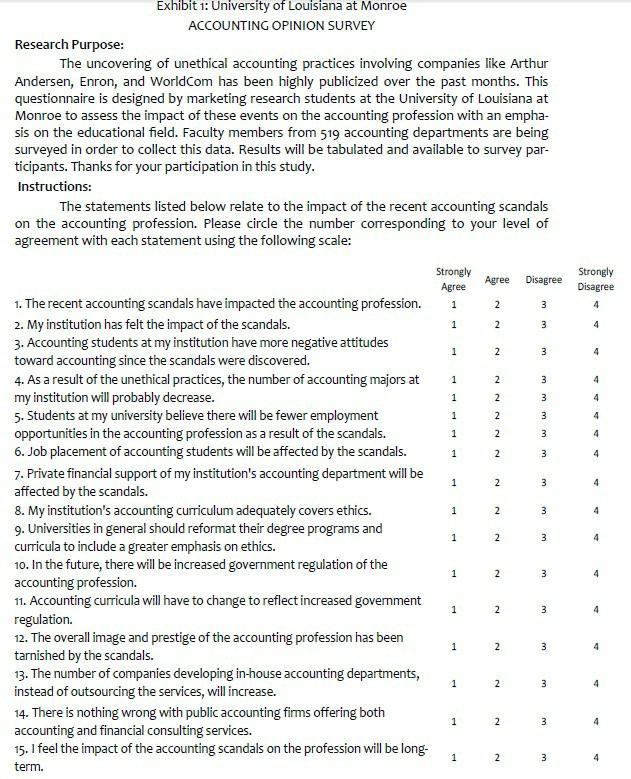
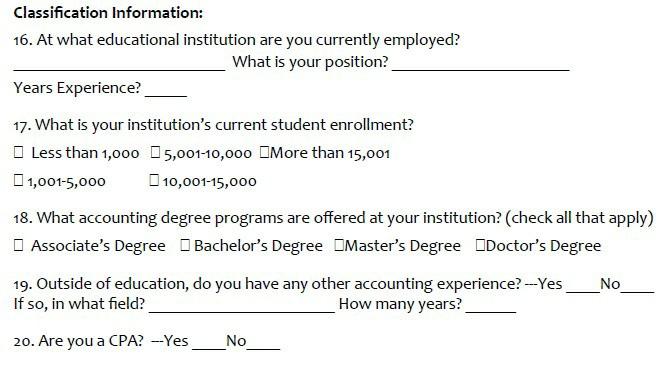
2. Evaluate the questionnaire in relation to the research objectives. Are the appro-priate topics covered? Is the sequence of questions logical? Is the structure of the individual questions appropriate for the needed data? Is the use of a 4 point scale with no neutral point appropriate? Discuss.
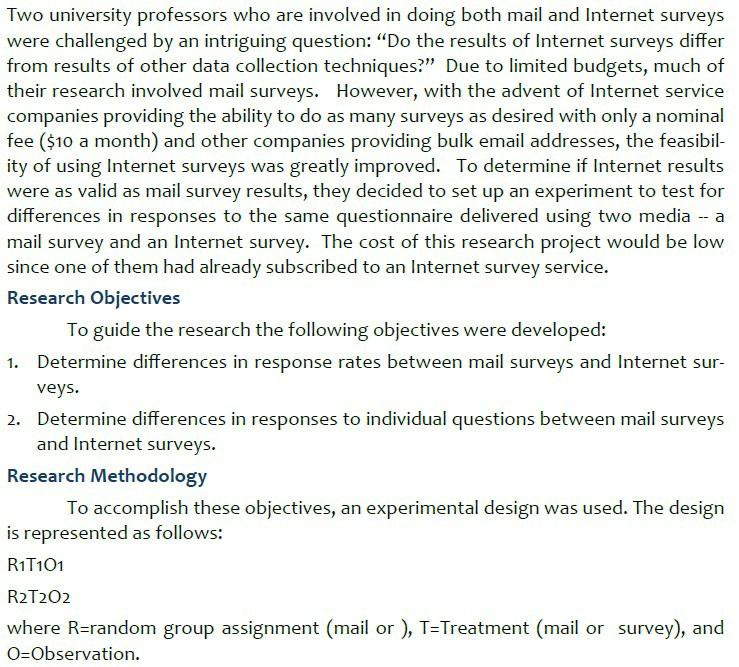
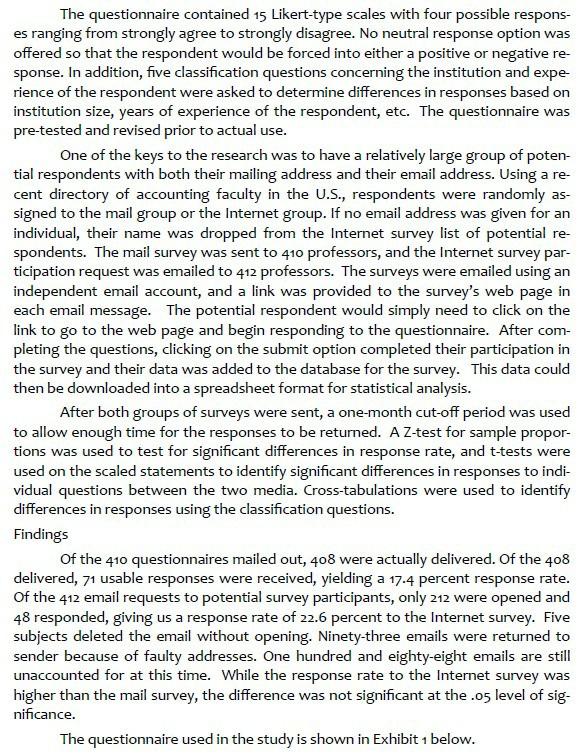
Two university professors who are involved in doing both mail and Internet surveys were challenged by an intriguing question: "Do the results of Internet surveys differ from results of other data collection techniques?" Due to limited budgets, much of their research involved mail surveys. However, with the advent of Internet service companies providing the ability to do as many surveys as desired with only a nominal fee ($10 a month) and other companies providing bulk email addresses, the feasibil- ity of using Internet surveys was greatly improved. To determine if Internet results were as valid as mail survey results, they decided to set up an experiment to test for differences in responses to the same questionnaire delivered using two media - a mail survey and an Internet survey. The cost of this research project would be low since one of them had already subscribed to an Internet survey service. Research Objectives To guide the research the following objectives were developed: 1. Determine differences in response rates between mail surveys and Internet sur- veys. 2. Determine differences in responses to individual questions between mail surveys and Internet surveys. Research Methodology To accomplish these objectives, an experimental design was used. The design is represented as follows: R1T101 R2T202 where R=random group assignment (mail or ), T=Treatment (mail or survey), and O=Observation. The questionnaire contained 15 Likert-type scales with four possible respons- es ranging from strongly agree to strongly disagree. No neutral response option was offered so that the respondent would be forced into either a positive or negative re- sponse. In addition, five classification questions concerning the institution and expe rience of the respondent were asked to determine differences in responses based on institution size, years of experience of the respondent, etc. The questionnaire was pre-tested and revised prior to actual use. One of the keys to the research was to have a relatively large group of poten- tial respondents with both their mailing address and their email address. Using a re- cent directory of accounting faculty in the U.S., respondents were randomly as- signed to the mail group or the Internet group. If no email address was given for an individual, their name was dropped from the Internet survey list of potential re- spondents. The mail survey was sent to 410 professors, and the Internet survey par- ticipation request was emailed to 412 professors. The surveys were emailed using an independent email account, and a link was provided to the survey's web page in each email message. The potential respondent would simply need to click on the link to go to the web page and begin responding to the questionnaire. After com- pleting the questions, clicking on the submit option completed their participation in the survey and their data was added to the database for the survey. This data could then be downloaded into a spreadsheet format for statistical analysis. After both groups of surveys were sent, a one-month cut-off period was used to allow enough time for the responses to be returned. A Z-test for sample propor- tions was used to test for significant differences in response rate, and t-tests were used on the scaled statements to identify significant differences in responses to indi- vidual questions between the two media. Cross-tabulations were used to identify differences in responses using the classification questions. Findings Of the 410 questionnaires mailed out, 408 were actually delivered. Of the 408 delivered, 71 usable responses were received, yielding a 17.4 percent response rate. Of the 412 email requests to potential survey participants, only 212 were opened and 48 responded, giving us a response rate of 22.6 percent to the Internet survey. Five subjects deleted the email without opening. Ninety-three emails were returned to sender because of faulty addresses. One hundred and eighty-eight emails are still unaccounted for at this time. While the response rate to the Internet survey was higher than the mail survey, the difference was not significant at the.o5 level of sig- nificance. The questionnaire used in the study is shown in Exhibit 1 below. Exhibit 1: University of Louisiana at Monroe ACCOUNTING OPINION SURVEY Research Purpose: The uncovering of unethical accounting practices involving companies like Arthur Andersen, Enron, and World Com has been highly publicized over the past months. This questionnaire is designed by marketing research students at the University of Louisiana at Monroe to assess the impact of these events on the accounting profession with an empha- sis on the educational field. Faculty members from 519 accounting departments are being surveyed in order to collect this data. Results will be tabulated and available to survey par- ticipants. Thanks for your participation in this study. Instructions: The statements listed below relate to the impact of the recent accounting scandals on the accounting profession. Please circle the number corresponding to your level of agreement with each statement using the following scale: Strongly Agree Agree Disagree Strongly Disagree 1 2 3 4 1 2 3 4 1 2 3 4 1 2 4 1 2 mmm 4 1 2 4 1 2 3 4 1 2 3 4 1 2 3 4 1 2 3 3 4 1. The recent accounting scandals have impacted the accounting profession. 2. My institution has felt the impact of the scandals. 3. Accounting students at my institution have more negative attitudes toward accounting since the scandals were discovered. 4. As a result of the unethical practices, the number of accounting majors at my institution will probably decrease. 5. Students at my university believe there will be fewer employment opportunities in the accounting profession as a result of the scandals. 6. Job placement of accounting students will be affected by the scandals. 7. Private financial support of my institution's accounting department will be affected by the scandals. 8. My institution's accounting curriculum adequately covers ethics. 9. Universities in general should reformat their degree programs and curricula to include a greater emphasis on ethics. 10. In the future, there will be increased government regulation of the accounting profession. 11. Accounting curricula will have to change to reflect increased government regulation 12. The overall image and prestige of the accounting profession has been tarnished by the scandals. 13. The number of companies developing in-house accounting departments, instead of outsourcing the services, will increase. 14. There is nothing wrong with public accounting firms offering both accounting and financial consulting services. 15. I feel the impact of the accounting scandals on the profession will be long- term. 2 2 1 3 4 1 2 3 4 1 2 3 4 1 1 2 3 4 1 2 3 4 1 2 2 3 4 Classification Information: 16. At what educational institution are you currently employed? What is your position? Years Experience? 17. What is your institution's current student enrollment? Less than 1,000 5,001-10,000 More than 15,001 1,001-5,000 10,001-15,000 18. What accounting degree programs are offered at your institution? (check all that apply) Associate's Degree Bachelor's Degree Master's Degree Doctor's Degree No 19. Outside of education, do you have any other accounting experience? --Yes If so, in what field? How many years? 20. Are you a CPA? - Yes NoStep by Step Solution
There are 3 Steps involved in it
1 Expert Approved Answer
Step: 1 Unlock

Question Has Been Solved by an Expert!
Get step-by-step solutions from verified subject matter experts
Step: 2 Unlock
Step: 3 Unlock