





Question: Need all work shown please ! Preferably on notebook ! Thank you !! 20 31 38 54 64 75 87 (years since 1933) P(1) 19.91

Need all work shown please ! Preferably on notebook ! Thank you !!
Need all work shown please ! Preferably on
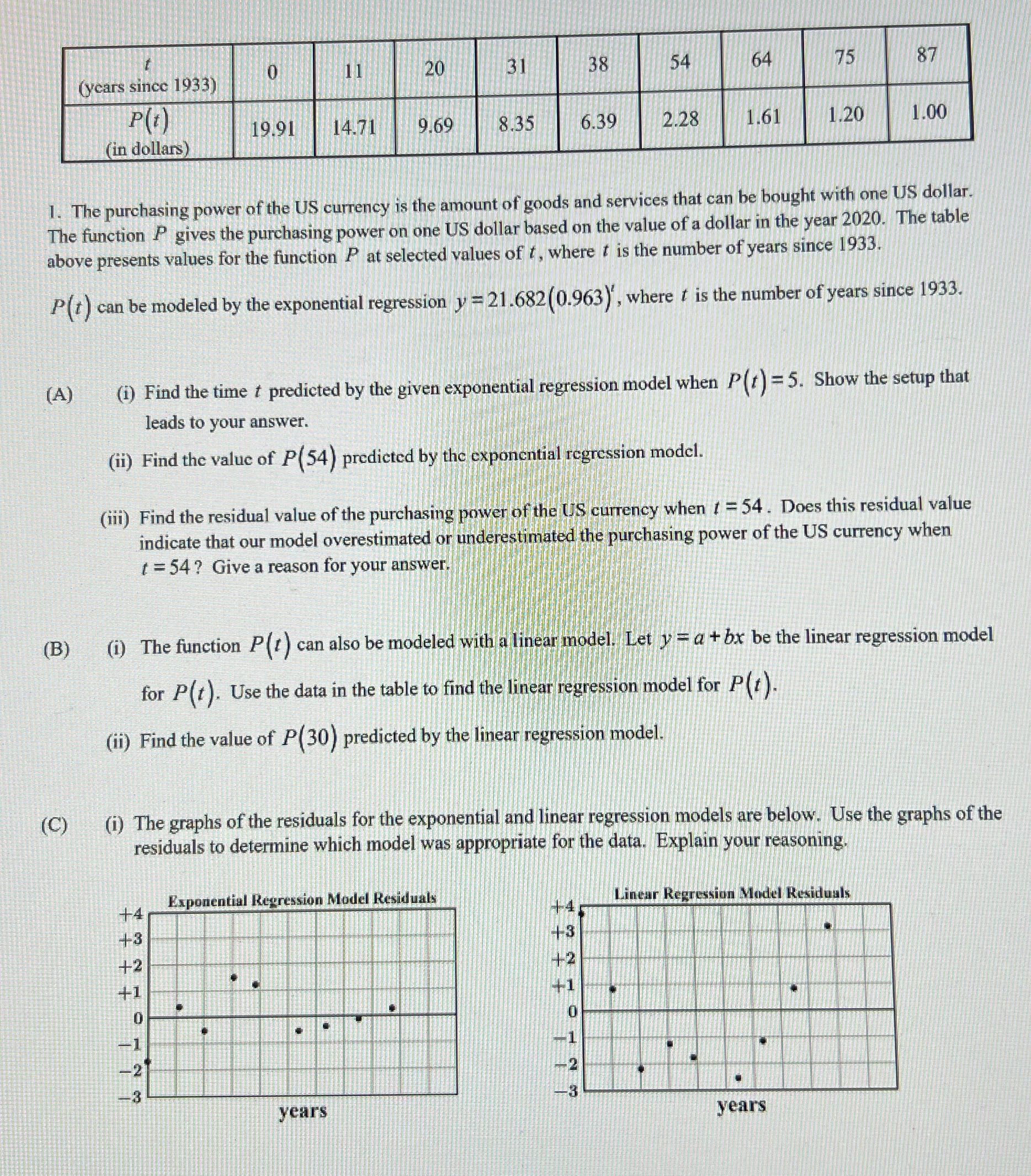
20 31 38 54 64 75 87 (years since 1933) P(1) 19.91 14.71 9.69 8.35 6.39 2.28 1.61 1.20 1.00 (in dollars) 1. The purchasing power of the US currency is the amount of goods and services that can be bought with one US dollar. The function P gives the purchasing power on one US dollar based on the value of a dollar in the year 2020. The table above presents values for the function P at selected values of t , where I is the number of years since 1933. P(t ) can be modeled by the exponential regression y - 21.682 (0.963 ) , where z is the number of years since 1933. (A) (i) Find the time t predicted by the given exponential regression model when P(1) = 5. Show the setup that leads to your answer. (ii) Find the value of P(54) predicted by the exponential regression model. (iii) Find the residual value of the purchasing power of the US currency when / = 54. Does this residual value indicate that our model overestimated or underestimated the purchasing power of the US currency when 1=54? Give a reason for your answer. (B) (1) The function P() can also be modeled with a linear model. Let y = a + bx be the linear regression model for P(t). Use the data in the table to find the linear regression model for P(t). (ii) Find the value of P(30) predicted by the linear regression model. (C) (i) The graphs of the residuals for the exponential and linear regression models are below. Use the graphs of the residuals to determine which model was appropriate for the data. Explain your reasoning. Exponential Regression Model Residuals +4 Linear Regression Model Residuals +3 H2 +2 1 -21 years years

Step by Step Solution

There are 3 Steps involved in it

1 Expert Approved Answer
Step: 1 Unlock blur-text-image

Question Has Been Solved by an Expert!

Get step-by-step solutions from verified subject matter experts

Step: 2 Unlock
Step: 3 Unlock

Students Have Also Explored These Related Mathematics Questions!