







Question: NEED ANSWER ONLY TO QUESTION 3) NOT 2) . PLEASE ANSWER ONLY QUESTION 3) (2) Convert the followjng NFA into an equivalent DFA. The components
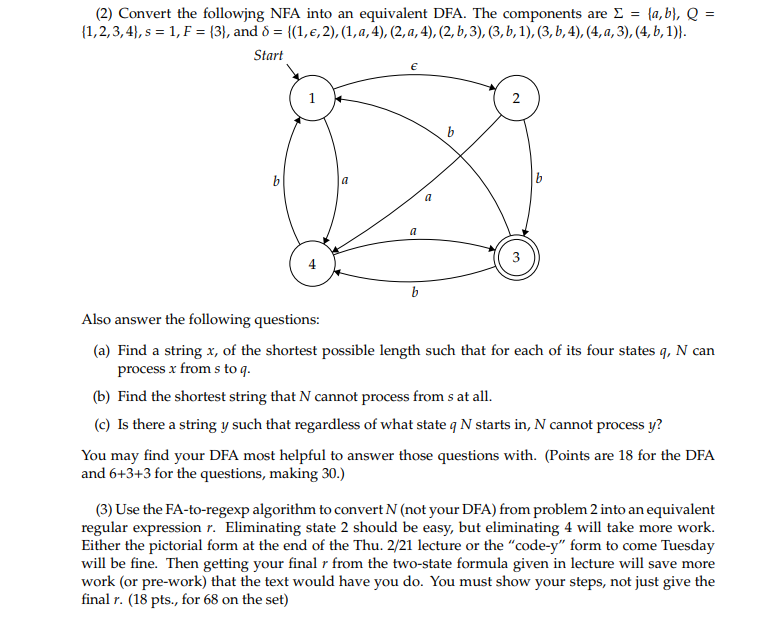
NEED ANSWER ONLY TO QUESTION 3) NOT 2) .
PLEASE ANSWER ONLY QUESTION 3)
(2) Convert the followjng NFA into an equivalent DFA. The components are 2 -(a, bl, Q { 1, 2, 3, 4, s-1, F-{3}, and -{(1, e, 2), (1, a, 4), (2, a, 4), (2, b, 3), (3, b, 1), (3, b, 4), (4, a, 3), (4, b, 1)) - Start 2 3 Also answer the following questions: (a) Find a string x, of the shortest possible length such that for each of its four states q, N can process x from s to q (b) Find the shortest string that N cannot process from s at all. (c) Is there a string y such that regardless of what state q N starts in, N cannot process y? You may find your DFA most helpful to answer those questions with. (Points are 18 for the DFA and 6+3+3 for the questions, making 30.) (3) Use the FA-to-regexp algorithm to convert N (not your DFA) from problem 2 into an equivalent regular expression r. Eliminating state 2 should be Either the pictorial form at the end of the Thu. 2/21 lecture or the "code-y" form to come Tuesday will be fine. Then getting your final r from the two-state formula given in lecture will save more work (or pre-work) that the text would have you do. You must show your steps, not just give the final r. (18 pts., for 68 on the set) easy, but eliminating 4 will take more work. (2) Convert the followjng NFA into an equivalent DFA. The components are 2 -(a, bl, Q { 1, 2, 3, 4, s-1, F-{3}, and -{(1, e, 2), (1, a, 4), (2, a, 4), (2, b, 3), (3, b, 1), (3, b, 4), (4, a, 3), (4, b, 1)) - Start 2 3 Also answer the following questions: (a) Find a string x, of the shortest possible length such that for each of its four states q, N can process x from s to q (b) Find the shortest string that N cannot process from s at all. (c) Is there a string y such that regardless of what state q N starts in, N cannot process y? You may find your DFA most helpful to answer those questions with. (Points are 18 for the DFA and 6+3+3 for the questions, making 30.) (3) Use the FA-to-regexp algorithm to convert N (not your DFA) from problem 2 into an equivalent regular expression r. Eliminating state 2 should be Either the pictorial form at the end of the Thu. 2/21 lecture or the "code-y" form to come Tuesday will be fine. Then getting your final r from the two-state formula given in lecture will save more work (or pre-work) that the text would have you do. You must show your steps, not just give the final r. (18 pts., for 68 on the set) easy, but eliminating 4 will take more work
Step by Step Solution
There are 3 Steps involved in it

Get step-by-step solutions from verified subject matter experts
 Study Help