







Question: need as soon as possible, pls Project Work: This narrative is based on a hypothetical scenario Fossil fuels are used for generating more than 50%
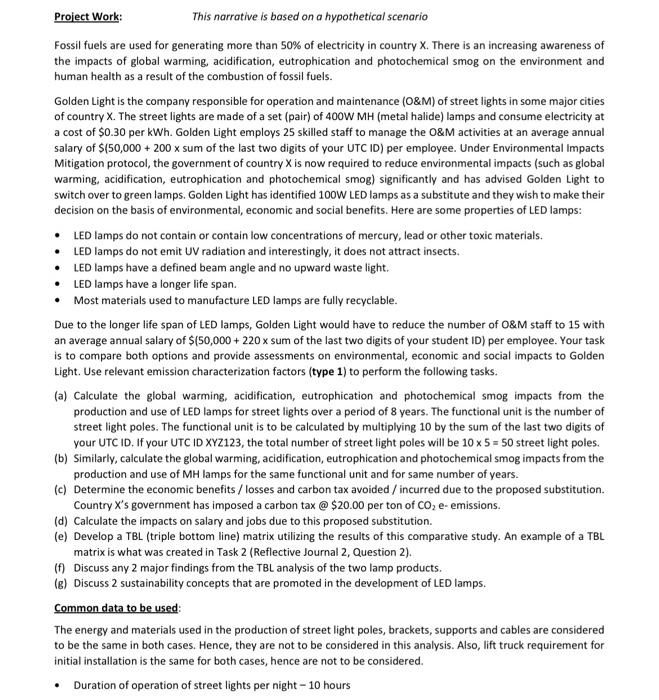
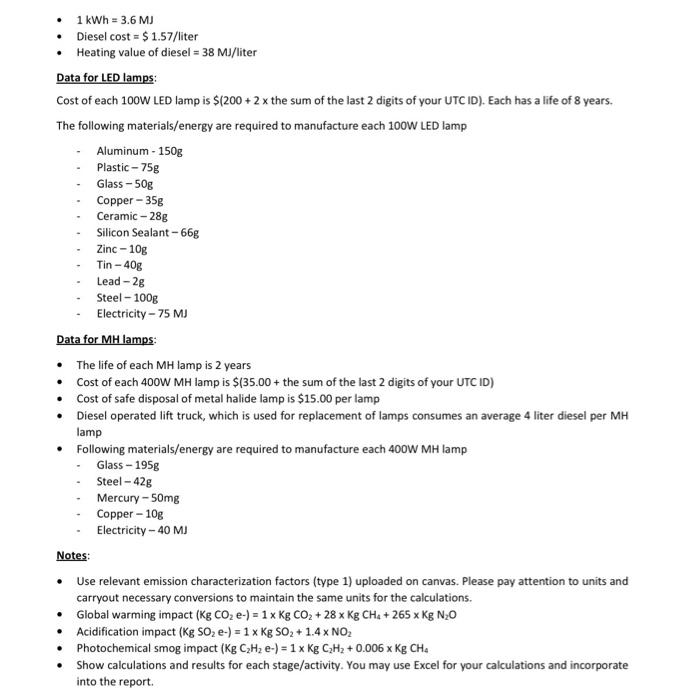
Project Work: This narrative is based on a hypothetical scenario Fossil fuels are used for generating more than 50% of electricity in country X. There is an increasing awareness of the impacts of global warming, acidification, eutrophication and photochemical smog on the environment and human health as a result of the combustion of fossil fuels. Golden Light is the company responsible for operation and maintenance (O\&M) of street lights in some major cities of country X. The street lights are made of a set (pair) of 400WMH (metal halide) lamps and consume electricity at a cost of $0.30 per kWh. Golden Light employs 25 skilled staff to manage the O\&M activities at an average annual salary of $(50,000+200 sum of the last two digits of your UTC ID) per employee. Under Environmental Impacts Mitigation protocol, the government of country X is now required to reduce environmental impacts (such as global warming, acidification, eutrophication and photochemical smog) significantly and has advised Golden Light to switch over to green lamps. Golden Light has identified 100W LED lamps as a substitute and they wish to make their decision on the basis of environmental, economic and social benefits. Here are some properties of LED lamps: - LED lamps do not contain or contain low concentrations of mercury, lead or other toxic materials. - LED lamps do not emit UV radiation and interestingly, it does not attract insects. - LED lamps have a defined beam angle and no upward waste light. - LED lamps have a longer life span. - Most materials used to manufacture LED lamps are fully recyclable. Due to the longer life span of LED lamps, Golden Light would have to reduce the number of O\&M staff to 15 with an average annual salary of $(50,000+220x sum of the last two digits of your student ID) per employee. Your task is to compare both options and provide assessments on environmental, economic and social impacts to Golden Light. Use relevant emission characterization factors (type 1) to perform the following tasks. (a) Calculate the global warming, acidification, eutrophication and photochemical smog impacts from the production and use of LED lamps for street lights over a period of 8 years. The functional unit is the number of street light poles. The functional unit is to be calculated by multiplying 10 by the sum of the last two digits of your UTC ID. If your UTC ID XYZ123, the total number of street light poles will be 105=50 street light poles. (b) Similarly, calculate the global warming, acidification, eutrophication and photochemical smog impacts from the production and use of MH lamps for the same functional unit and for same number of years. (c) Determine the economic benefits / losses and carbon tax avoided / incurred due to the proposed substitution. Country X's government has imposed a carbon tax @ $20.00 per ton of CO2e - emissions. (d) Calculate the impacts on salary and jobs due to this proposed substitution. (e) Develop a TBL (triple bottom line) matrix utilizing the results of this comparative study. An example of a TBL matrix is what was created in Task 2 (Reflective Journal 2, Question 2). (f) Discuss any 2 major findings from the TBL analysis of the two lamp products. (g) Discuss 2 sustainability concepts that are promoted in the development of LED lamps. Common data to be used: The energy and materials used in the production of street light poles, brackets, supports and cables are considered to be the same in both cases. Hence, they are not to be considered in this analysis. Also, lift truck requirement for initial installation is the same for both cases, hence are not to be considered. - Duration of operation of street lights per night -10 hours - 1kWh=3.6MJ - Diesel cost =$1.57/ liter - Heating value of diesel = 38MJ/ liter Data for LED lamps: Cost of each 100W LED lamp is $(200+2x the sum of the last 2 digits of your UTC ID). Each has a life of 8 years. The following materials/energy are required to manufacture each 100W LED lamp - Aluminum-150g - Plastic-75g - Glass 50g - Copper-35g - Ceramic 28g - Silicon Sealant 66g - Zinc 10g - Tin 40g - Lead-2g - Steel-100g - Electricity - 75MJ Data for MH lamps: - The life of each MH lamp is 2 years - Cost of each 400W MH lamp is $(35.00+ the sum of the last 2 digits of your UTC ID) - Cost of safe disposal of metal halide lamp is $15.00 per lamp - Diesel operated lift truck, which is used for replacement of lamps consumes an average 4 liter diesel per MH lamp - Following materials/energy are required to manufacture each 400WMH lamp - Glass 195g - Steel-42g - Mercury - 50mg - Copper 10g - Electricity 40MJ Notes: - Use relevant emission characterization factors (type 1) uploaded on canvas. Please pay attention to units and carryout necessary conversions to maintain the same units for the calculations. - Global warming impact (KgCO2e)=1KgCO2+28KgCH4+265KgN2O - Acidification impact (KgSO2e)=1KgSO2+1.4NO2 - Photochemical smog impact (KgC2H2e)=1KgC2H2+0.006KgCH4 - Show calculations and results for each stage/activity. You may use Excel for your calculations and incorporate into the report
Step by Step Solution
There are 3 Steps involved in it

Get step-by-step solutions from verified subject matter experts
 Study Help