







Question: NEED HELP ASAP NB: Do NOT answer the questions that are part of the case. This should be written in a paper format. Do NOT
NEED HELP ASAP
NB: Do NOT answer the questions that are part of the case. This should be written in a paper format. Do NOT use this sheet as a fillable worksheet nor should your paper be written in bullet points. Follow the process below. Format: APA formatting and citation required. See the handouts under Course Content for guidance. Length: 1-2 pages, double-spaced with 12 point font not including headers, footnotes, etc. Sources: Please ONLY use the textbook. Do NOT use outside sources. i will provide pictures Assignment: After carefully reading and considering the case, you should complete the following steps: 1. Issue a. Clearly and directly state the ethical question that arises in the case. You should phrase it as question. Ethical questions usually include the word "should" or "ought". You should have one issue. Avoid asking a question that is merely factual. 2. Moral Theory a. Pick Virtue Ethics (p. 114), Utilitarianism (p. 96), Kantianism (p. 100), or Care Ethics (p. 117). You may also use material from assigned chapters of the textbook. Use the Class 3 Agenda and Chapter 3 for guidance. 3. Application a. This is the most important part of your paper and should be the most substantial section of your paper. b. Use a Moral Theory to help you answer the moral question. c. You must apply the moral theory you picked in Step #2 to the facts of the case to answer the question you asked in Step #1. d. You cannot reach a conclusion until this step is complete. 4. Conclusion a. Simply and directly state the answer to the question you asked in Step #1. There should be no new information in your conclusion
 Kantianism (p. 100)
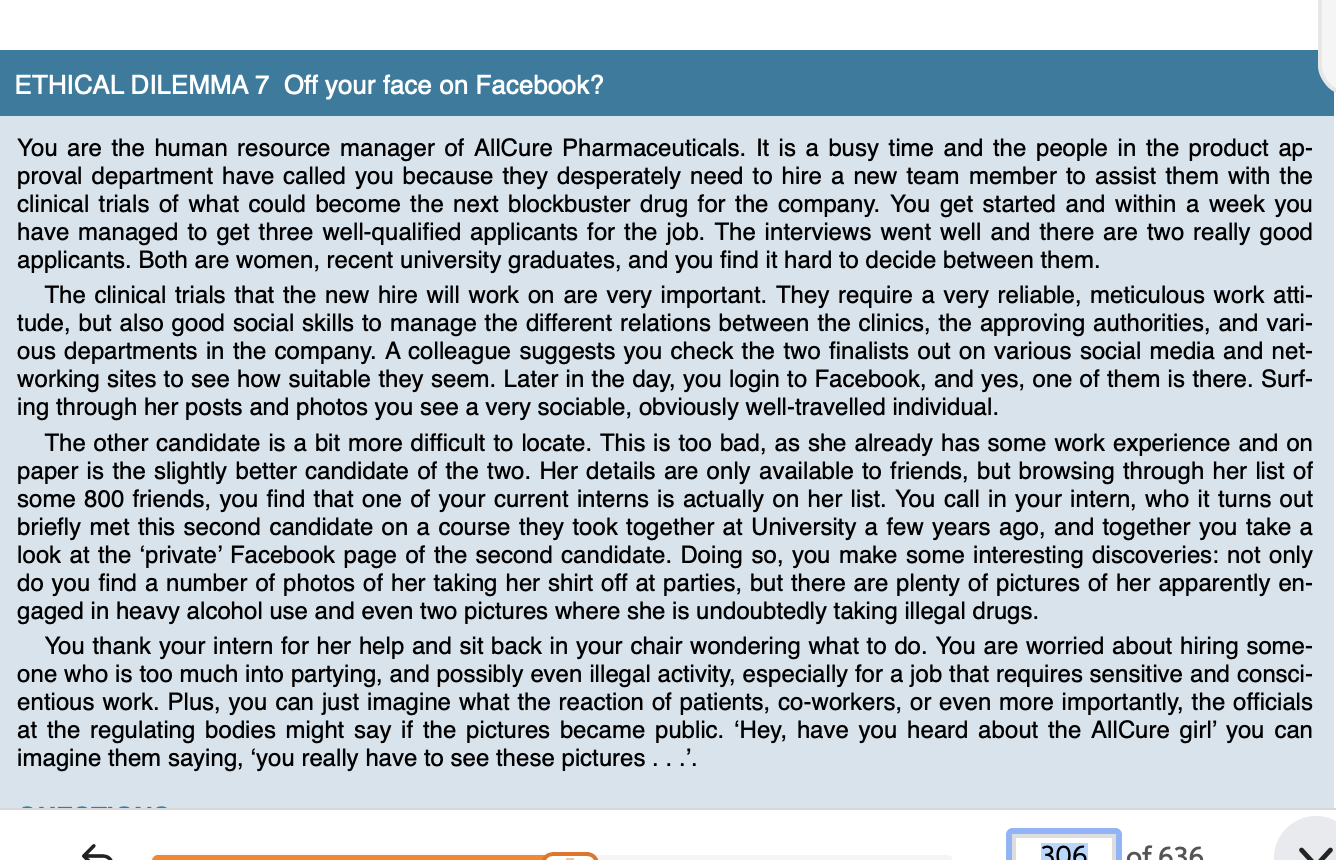
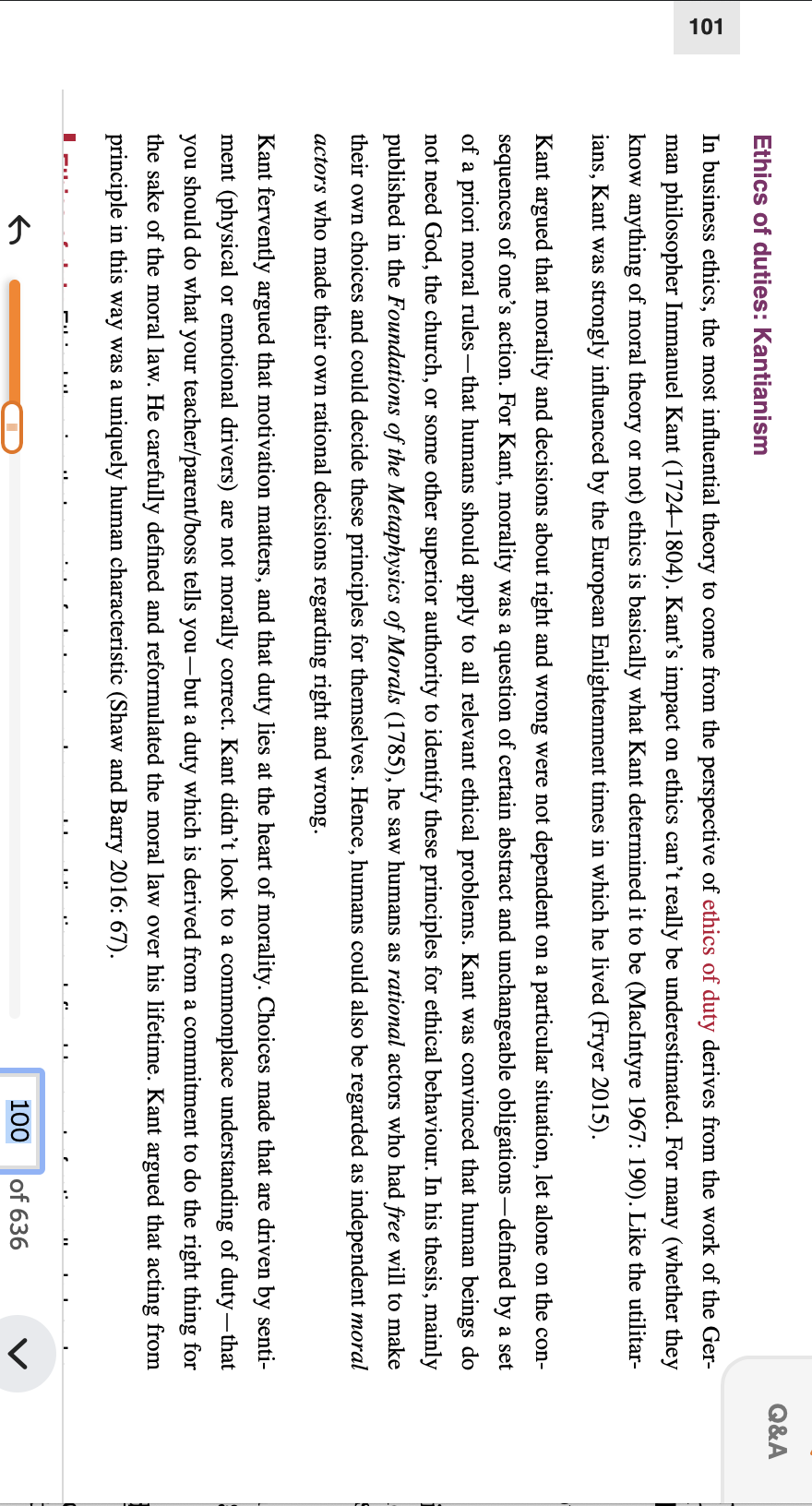
You are the human resource manager of AllCure Pharmaceuticals. It is a busy time and the people in the product approval department have called you because they desperately need to hire a new team member to assist them with the clinical trials of what could become the next blockbuster drug for the company. You get started and within a week you have managed to get three well-qualified applicants for the job. The interviews went well and there are two really good applicants. Both are women, recent university graduates, and you find it hard to decide between them. The clinical trials that the new hire will work on are very important. They require a very reliable, meticulous work attitude, but also good social skills to manage the different relations between the clinics, the approving authorities, and various departments in the company. A colleague suggests you check the two finalists out on various social media and networking sites to see how suitable they seem. Later in the day, you login to Facebook, and yes, one of them is there. Surfing through her posts and photos you see a very sociable, obviously well-travelled individual. The other candidate is a bit more difficult to locate. This is too bad, as she already has some work experience and on paper is the slightly better candidate of the two. Her details are only available to friends, but browsing through her list of some 800 friends, you find that one of your current interns is actually on her list. You call in your intern, who it turns out briefly met this second candidate on a course they took together at University a few years ago, and together you take a look at the 'private' Facebook page of the second candidate. Doing so, you make some interesting discoveries: not only do you find a number of photos of her taking her shirt off at parties, but there are plenty of pictures of her apparently engaged in heavy alcohol use and even two pictures where she is undoubtedly taking illegal drugs. You thank your intern for her help and sit back in your chair wondering what to do. You are worried about hiring someone who is too much into partying, and possibly even illegal activity, especially for a job that requires sensitive and conscientious work. Plus, you can just imagine what the reaction of patients, co-workers, or even more importantly, the officials at the regulating bodies might say if the pictures became public. 'Hey, have you heard about the AllCure girl' you can imagine them saying, 'you really have to see these pictures... Ethics of duties: Kantianism In business ethics, the most influential theory to come from the perspective of ethics of duty derives from the work of the German philosopher Immanuel Kant (1724-1804). Kant's impact on ethics can't really be underestimated. For many (whether they know anything of moral theory or not) ethics is basically what Kant determined it to be (MacIntyre 1967: 190). Like the utilitarians, Kant was strongly influenced by the European Enlightenment times in which he lived (Fryer 2015). Kant argued that morality and decisions about right and wrong were not dependent on a particular situation, let alone on the consequences of one's action. For Kant, morality was a question of certain abstract and unchangeable obligations-defined by a set of a priori moral rules - that humans should apply to all relevant ethical problems. Kant was convinced that human beings do not need God, the church, or some other superior authority to identify these principles for ethical behaviour. In his thesis, mainly published in the Foundations of the Metaphysics of Morals (1785), he saw humans as rational actors who had free will to make their own choices and could decide these principles for themselves. Hence, humans could also be regarded as independent moral actors who made their own rational decisions regarding right and wrong. Kant fervently argued that motivation matters, and that duty lies at the heart of morality. Choices made that are driven by sentiment (physical or emotional drivers) are not morally correct. Kant didn't look to a commonplace understanding of duty-that you should do what your teacher/parent/boss tells you-but a duty which is derived from a commitment to do the right thing for the sake of the moral law. He carefully defined and reformulated the moral law over his lifetime. Kant argued that acting from principle in this way was a uniquely human characteristic (Shaw and Barry 2016: 67)
Step by Step Solution
There are 3 Steps involved in it

Get step-by-step solutions from verified subject matter experts
 Study Help