







Question: Need Help! Discrete math! ------------------------------------------------------------------------ --------------------------------------------------------- Use propositional logic to prove the validity of the arguments in Exercises 25-33. These will become additional derivation rules
Need Help!
Discrete math!
------------------------------------------------------------------------
---------------------------------------------------------
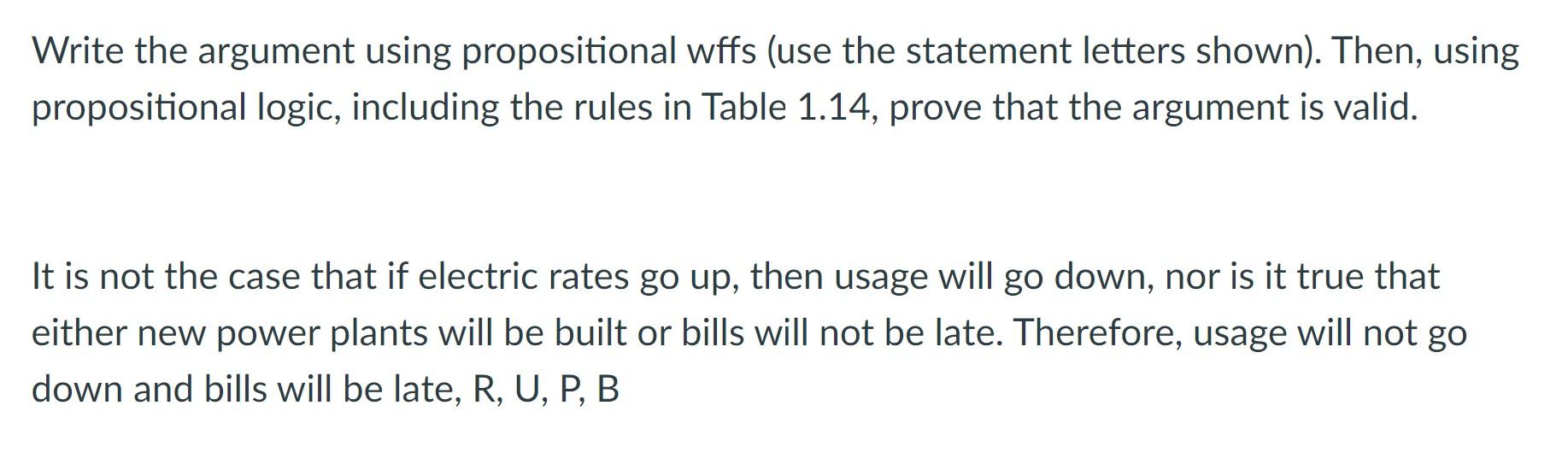
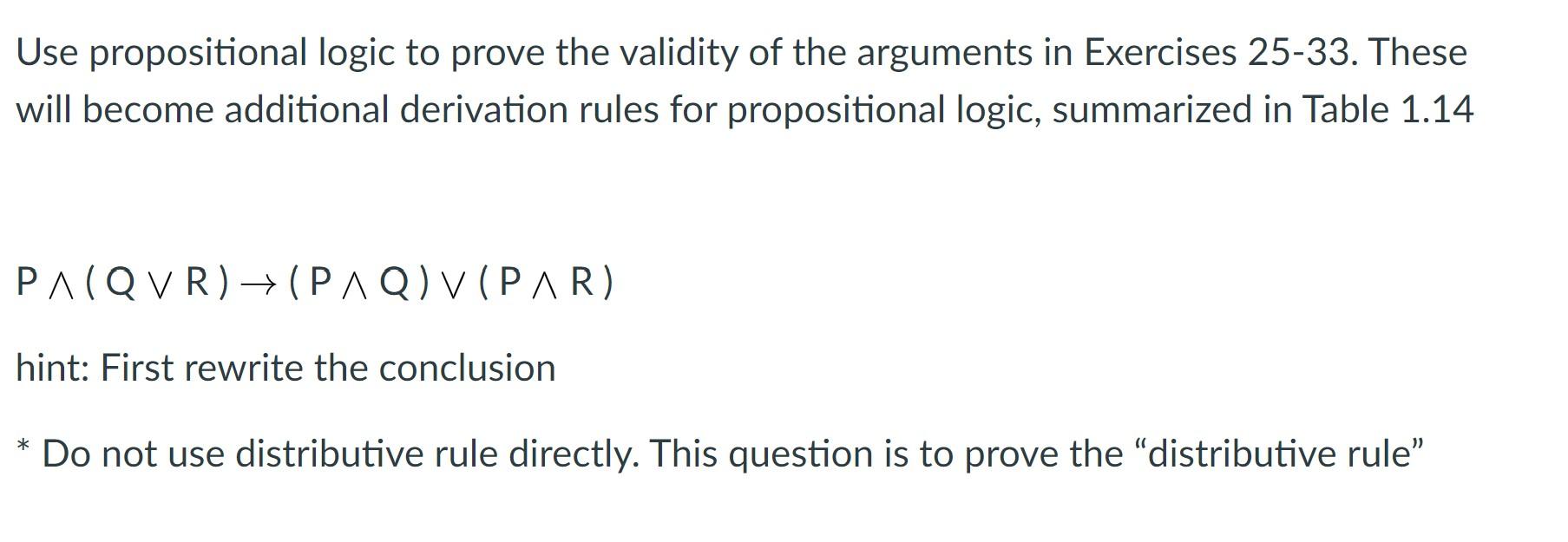
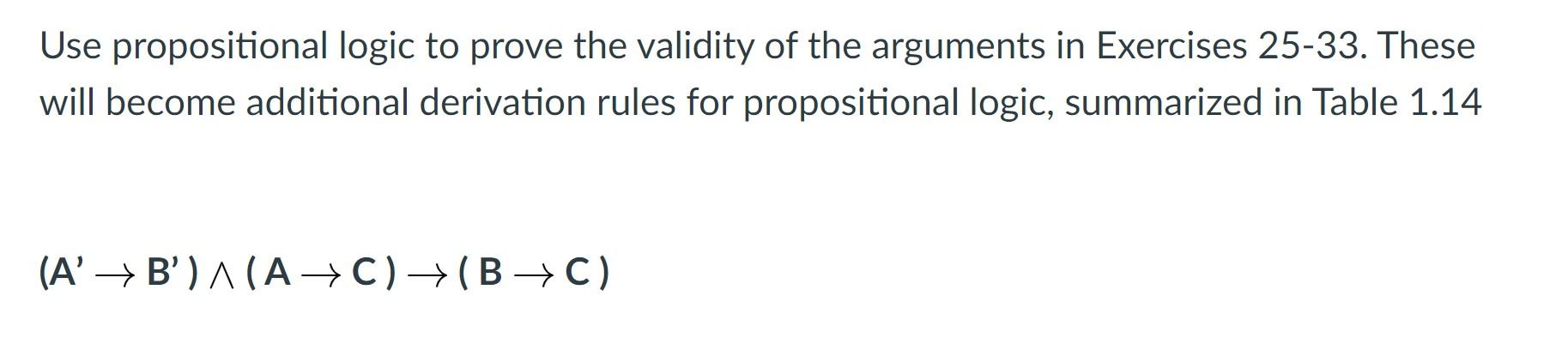
Use propositional logic to prove the validity of the arguments in Exercises 25-33. These will become additional derivation rules for propositional logic, summarized in Table 1.14 PA(QVR) (PAQ) V (PAR) hint: First rewrite the conclusion * Do not use distributive rule directly. This question is to prove the "distributive rule" Use propositional logic to prove the validity of the arguments in Exercises 25-33. These will become additional derivation rules for propositional logic, summarized in Table 1.14 (A' + B')^(A+C)+(B+C) Write the argument using propositional wffs (use the statement letters shown). Then, using propositional logic, including the rules in Table 1.14, prove that the argument is valid. It is not the case that if electric rates go up, then usage will go down, nor is it true that either new power plants will be built or bills will not be late. Therefore, usage will not go down and bills will be late, R, U, P, B Use propositional logic to prove the validity of the arguments in Exercises 25-33. These will become additional derivation rules for propositional logic, summarized in Table 1.14 PA(QVR) (PAQ) V (PAR) hint: First rewrite the conclusion * Do not use distributive rule directly. This question is to prove the "distributive rule" Use propositional logic to prove the validity of the arguments in Exercises 25-33. These will become additional derivation rules for propositional logic, summarized in Table 1.14 (A' + B')^(A+C)+(B+C) Write the argument using propositional wffs (use the statement letters shown). Then, using propositional logic, including the rules in Table 1.14, prove that the argument is valid. It is not the case that if electric rates go up, then usage will go down, nor is it true that either new power plants will be built or bills will not be late. Therefore, usage will not go down and bills will be late, R, U, P, B
Step by Step Solution
There are 3 Steps involved in it

Get step-by-step solutions from verified subject matter experts
 Study Help