







Question: Need help for the matlab question This question is motivated by one in Numerical Computing with MATLAB by C. Moler. The question shows that a
 Need help for the matlab question
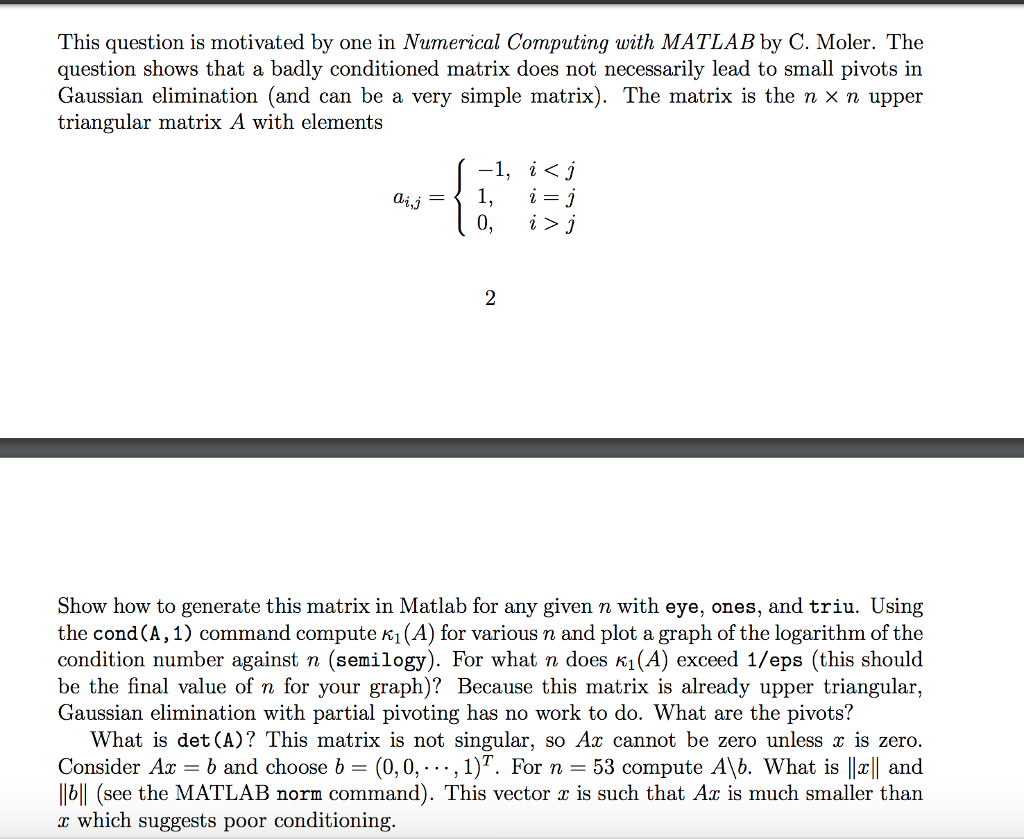
This question is motivated by one in Numerical Computing with MATLAB by C. Moler. The question shows that a badly conditioned matrix does not necessarily lead to small pivots in Gaussian elimination (and can be a very simple matrix). The matrix is the n x n upper triangular matrix A with elements 0, i>j Show how to generate this matrix in Matlab for any given n with eye, ones, and triu. Using the cond (A,1) command compute K1 (A) for various n and plot a graph of the logarithm of the condition number against n (semilogy). For what n does K1(A) exceed 1/eps (this should be the final value of n for your graph)? Because this matrix is already upper triangular, Gaussian elimination with partial pivoting has no work to do. What are the pivots? What is det(A)? This matrix is not singular, so Ax cannot be zero unless x is zero. Consider Ax = b and choose b = (0,0, . .. , 1)". For n = 53 compute Ab. What is llxl and bll (see the MATLAB norm command). This vector z is such that Az is much smaller than a which suggests poor con This question is motivated by one in Numerical Computing with MATLAB by C. Moler. The question shows that a badly conditioned matrix does not necessarily lead to small pivots in Gaussian elimination (and can be a very simple matrix). The matrix is the n x n upper triangular matrix A with elements 0, i>j Show how to generate this matrix in Matlab for any given n with eye, ones, and triu. Using the cond (A,1) command compute K1 (A) for various n and plot a graph of the logarithm of the condition number against n (semilogy). For what n does K1(A) exceed 1/eps (this should be the final value of n for your graph)? Because this matrix is already upper triangular, Gaussian elimination with partial pivoting has no work to do. What are the pivots? What is det(A)? This matrix is not singular, so Ax cannot be zero unless x is zero. Consider Ax = b and choose b = (0,0, . .. , 1)". For n = 53 compute Ab. What is llxl and bll (see the MATLAB norm command). This vector z is such that Az is much smaller than a which suggests poor con
Step by Step Solution
There are 3 Steps involved in it

Get step-by-step solutions from verified subject matter experts
 Study Help