







Question: NEED HELP! so for context this is the question I had to answer then this is what I put but my professor said to fix
NEED HELP! so for context this is the question I had to answer
then this is what I put but my professor said to fix it
this is what my professor said about my work
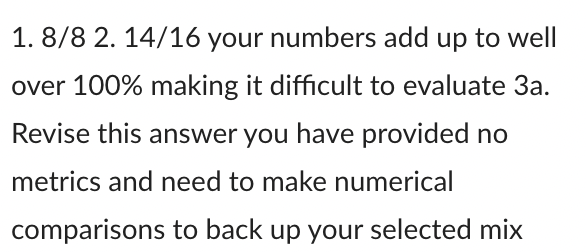
I'm not sure what he means by I have provided no metrics and I need to make numerical comparisons so can you help me fix my answers by making my chart add up to 100% and explain what he means by providing metrics and numerical comparisons I'm going to add what I wrote for 3a & 3b and the question
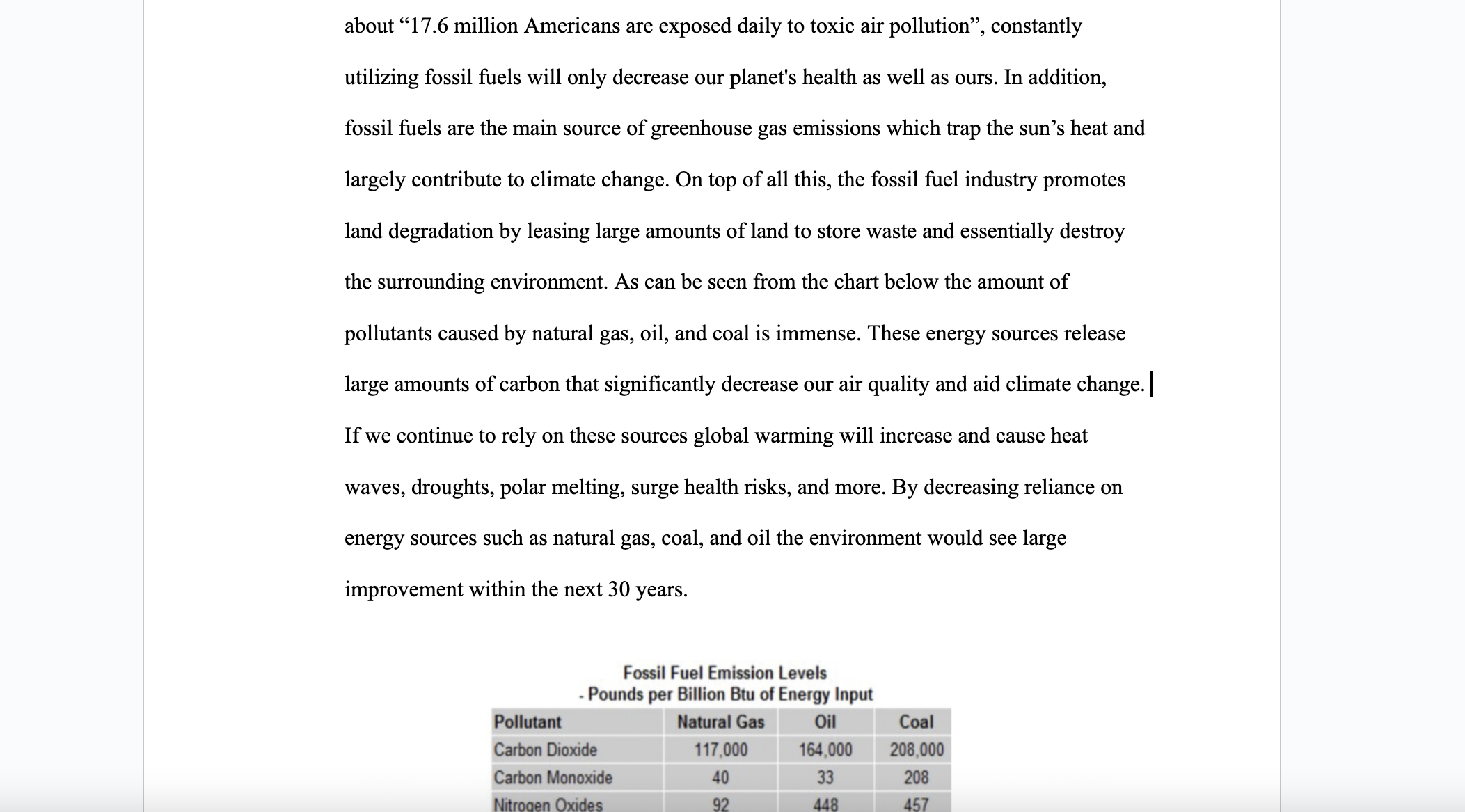
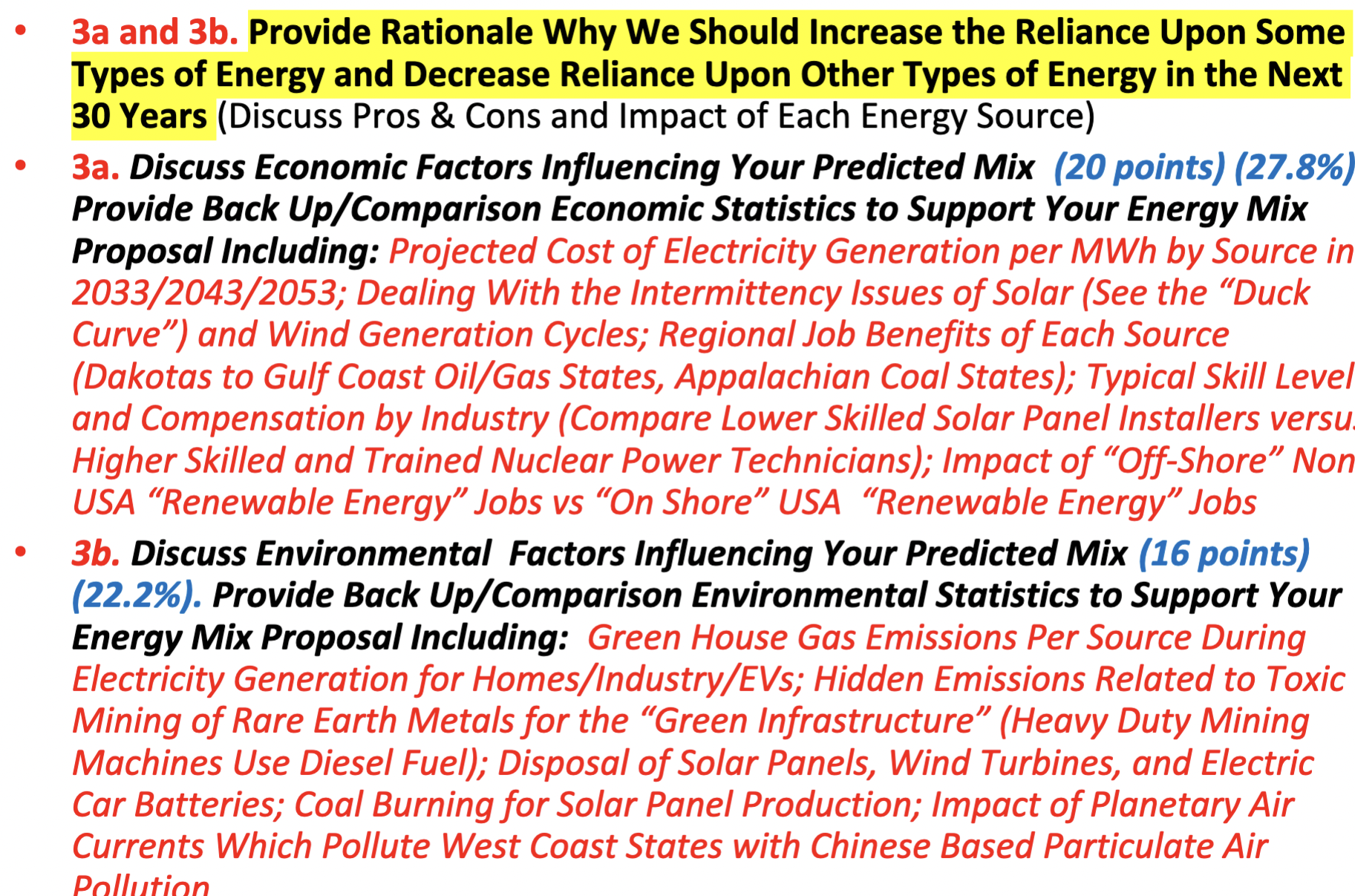
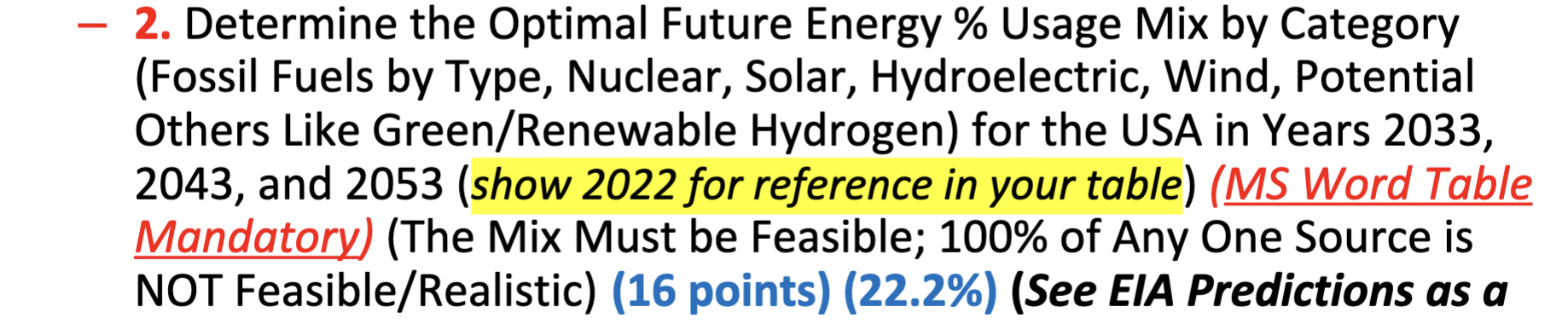
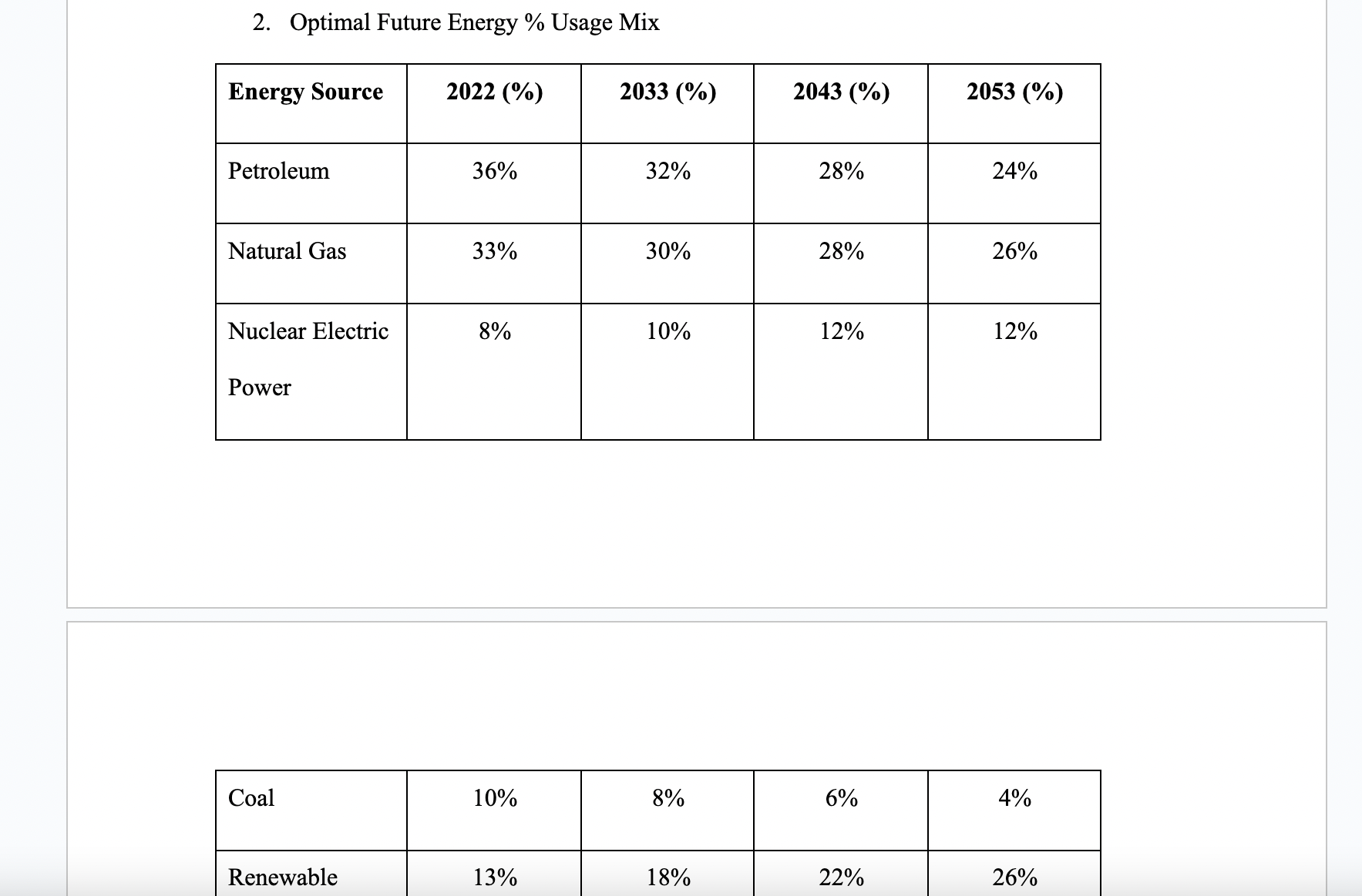
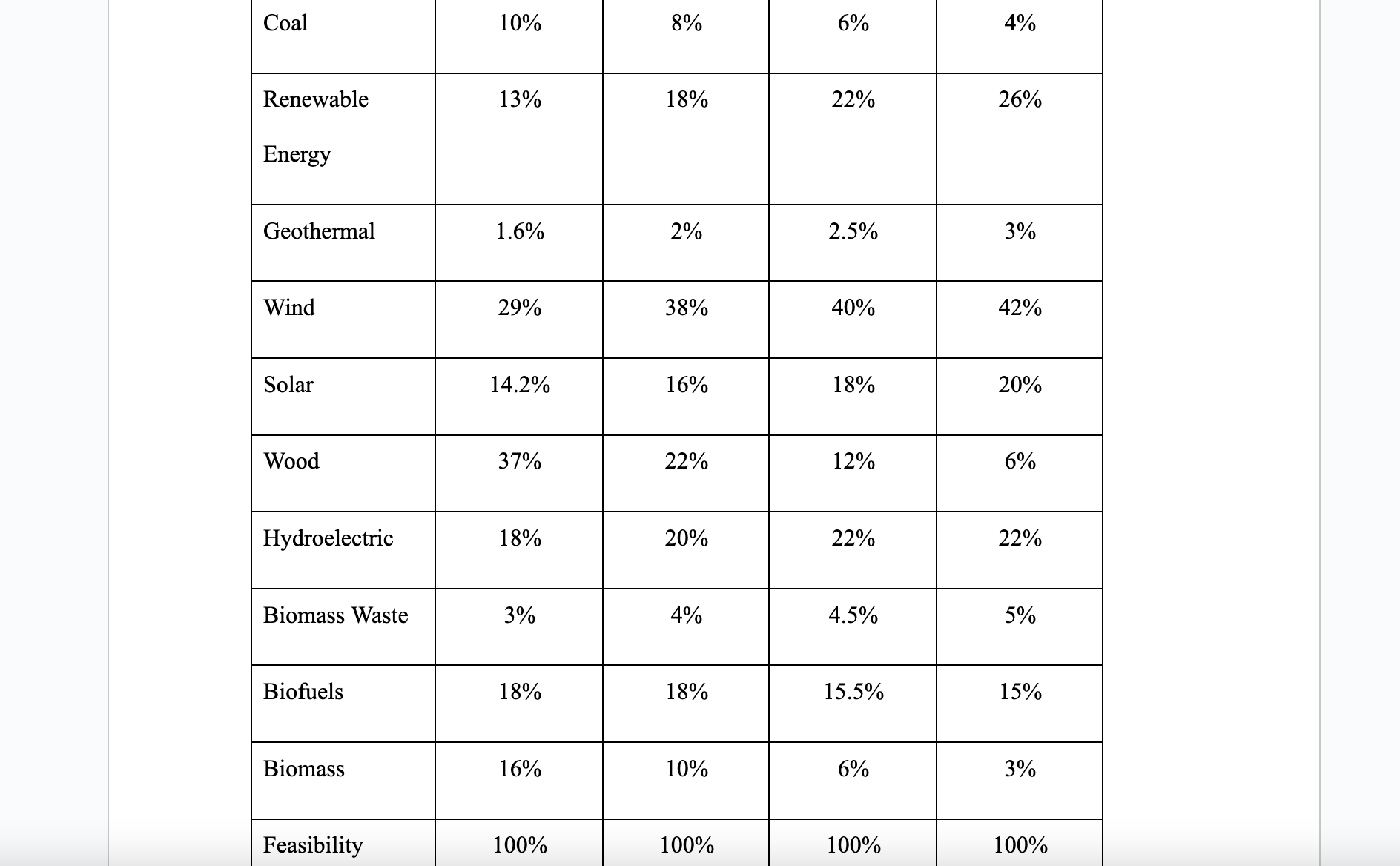
2. Determine the Optimal Future Energy \% Usage Mix by Category (Fossil Fuels by Type, Nuclear, Solar, Hydroelectric, Wind, Potential Others Like Green/Renewable Hydrogen) for the USA in Years 2033, 2043, and 2053 (show 2022 for reference in your table) Mandatory) (The Mix Must be Feasible; 100% of Any One Source is NOT Feasible/Realistic) (16 points) (22.2\%) (See EIA Predictions as a 2. Optimal Future Energy \% Usage Mix \begin{tabular}{|l|c|c|c|c|} \hline Coal & 10% & 8% & 6% & 4% \\ \hline Renewable & 13% & 18% & 22% & 26% \\ \hline Geothermal & 1.6% & 2% & 2.5% & 3% \\ \hline Wind & 29% & 38% & 40% & 42% \\ \hline Solar & 14.2% & 16% & 18% & 20% \\ \hline Wood & 37% & 22% & 12% & 6% \\ \hline Hydroelectric & 18% & 20% & 22% & 22% \\ \hline Biomass Waste & 3% & 4% & 4.5% & 5% \\ \hline Biofuels & 18% & 18% & 15.5% & 15% \\ \hline Biomass & 16% & 10% & 6% & 3% \\ \hline Feasibility & 100% & 100% & 100% & 100% \\ \hline \end{tabular} 1. 8/8 2. 14/16 your numbers add up to well over 100% making it difficult to evaluate 3 a. Revise this answer you have provided no metrics and need to make numerical comparisons to back up your selected mix 3. a. We should increase our reliance upon some types of energy in the next 30 years because there are many environmental benefits such as the fact that renewable energy sources don't create emissions that contribute to air pollution or climate change. According to "Renewable Energy - Powering A Safer Future" by the United Nations, "renewable energy sources... are replenished by nature and emit little to no greenhouse gases or pollutants into the air". Moreover, increasing reliance on renewable energy sources has economic benefits and promotes sustainability. While renewable energy sources are becoming increasingly competitive with fossil fuels, the cost is actually declining. In an article on the United Nations Climate Change page called "Renewable Power Remains Cost-Competitive amid Fossil Fuel Crisis" they state that the cost for Power Remains Cost-Competitive amid Fossil Fuel Crisis" they state that the cost for renewables "continued to fall in 2021". Lastly, renewable sources will not run out in the near future as they can be naturally replenished. Wind and solar energy are abundant and clean as well as affordable, they have their downsides but are far better compared to other energy sources that produce carbon emissions. While we have issues recycling the materials used to produce wind and solar energy, focusing more on those sources can bring light to a better solution to salvage the utilized materials once they're ready to be disposed of. Geothermal energy is yet another energy source that we should increase reliance on, since it can be generated from the heat within Earth, it is sustainable and dependable. The Department of Energy concludes in "Geothermal FAQs" that "geothermal power is "homegrown," offering a domestic source" that happens to be reliable. There are many benefits to using geothermal energy, not only do these plants that store geothermal power have high capacity, but this type of energy is available 24 hours a day. It can be used to heat and cool homes, businesses, and large establishments, and releases practically zero emissions. Shifting towards energy sources such as these can prove to be advantageous compared to the sources that we have been using that emit prove to be advantageous compared to the sources that we have been using that emit greenhouse gases. b. Decreasing reliance upon other types of energy sources in the next 30 years is also critical because we need to think about the environmental impacts and how sustainable are the resources we have now. Fossil fuels will eventually run out and the cost of them is fraught, they are subjected to lots of fluctuations when it comes to the global market. They also contribute to air and water pollution which causes respiratory problems as well as other health issues. Melissa Denchak states in "Fossil Fuels: The Dirty Facts" that about "17.6 million Americans are exposed daily to toxic air pollution", constantly about "17.6 million Americans are exposed daily to toxic air pollution", constantly utilizing fossil fuels will only decrease our planet's health as well as ours. In addition, fossil fuels are the main source of greenhouse gas emissions which trap the sun's heat and largely contribute to climate change. On top of all this, the fossil fuel industry promotes land degradation by leasing large amounts of land to store waste and essentially destroy the surrounding environment. As can be seen from the chart below the amount of pollutants caused by natural gas, oil, and coal is immense. These energy sources release large amounts of carbon that significantly decrease our air quality and aid climate change. If we continue to rely on these sources global warming will increase and cause heat waves, droughts, polar melting, surge health risks, and more. By decreasing reliance on energy sources such as natural gas, coal, and oil the environment would see large improvement within the next 30 years. Fossil Fuel Emission Levels Pounds per Billion Btu of Energy Input 3a and 3b. Provide Rationale Why We Should Increase the Reliance Upon Some Types of Energy and Decrease Reliance Upon Other Types of Energy in the Next 30 Years (Discuss Pros \& Cons and Impact of Each Energy Source) 3a. Discuss Economic Factors Influencing Your Predicted Mix (20 points) (27.8\%, Provide Back Up/Comparison Economic Statistics to Support Your Energy Mix Proposal Including: Projected Cost of Electricity Generation per MWh by Source ir 2033/2043/2053; Dealing With the Intermittency Issues of Solar (See the "Duck Curve") and Wind Generation Cycles; Regional Job Benefits of Each Source (Dakotas to Gulf Coast Oil/Gas States, Appalachian Coal States); Typical Skill Leve and Compensation by Industry (Compare Lower Skilled Solar Panel Installers versu Higher Skilled and Trained Nuclear Power Technicians); Impact of "Off-Shore" Nor USA "Renewable Energy" Jobs vs "On Shore" USA "Renewable Energy" Jobs 3b. Discuss Environmental Factors Influencing Your Predicted Mix (16 points) (22.2\%). Provide Back Up/Comparison Environmental Statistics to Support Your Energy Mix Proposal Including: Green House Gas Emissions Per Source During Electricity Generation for Homes/Industry/EVs; Hidden Emissions Related to Toxic Mining of Rare Earth Metals for the "Green Infrastructure" (Heavy Duty Mining Machines Use Diesel Fuel); Disposal of Solar Panels, Wind Turbines, and Electric Car Batteries; Coal Burning for Solar Panel Production; Impact of Planetary Air Currents Which Pollute West Coast States with Chinese Based Particulate Air
Step by Step Solution
There are 3 Steps involved in it

Get step-by-step solutions from verified subject matter experts
 Study Help