







Question: Need help solving iii), b. and c . We know that from ii) we have the consumption choices that solve P(p) is c n =
Need help solving iii), b. and c. We know that from ii) we have the consumption choices that solve P(p) is cn=(/pn).
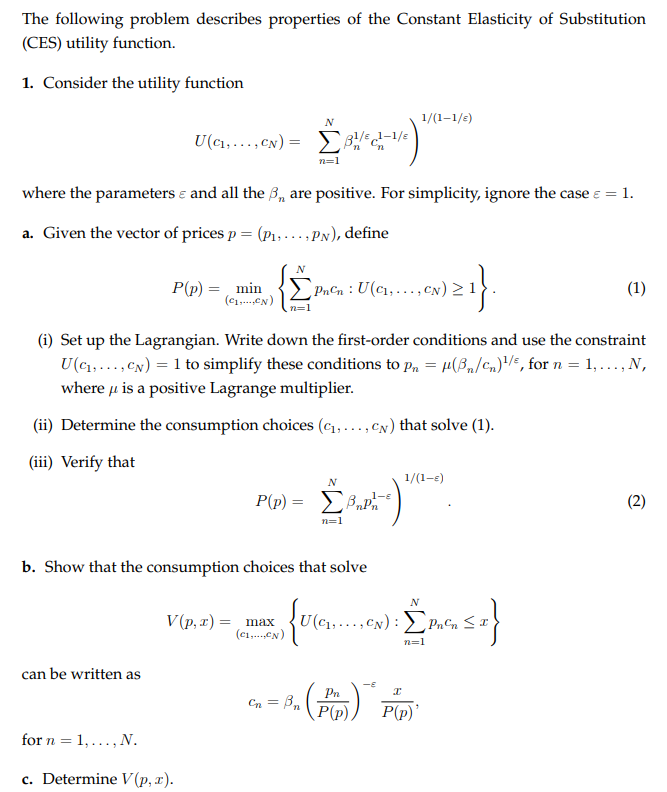
The following problem describes properties of the Constant Elasticity of Substitution (CES) utility function. 1. Consider the utility function 1/(1-1/=) U(CI, . .. . CN) = n=1 where the parameters & and all the ,, are positive. For simplicity, ignore the case = = 1. a. Given the vector of prices p = (P1, . . . ; PN), define P(p) = min Epnon : U(ci; ..., CN) 21 (1) (i) Set up the Lagrangian. Write down the first-order conditions and use the constraint U(C1, . ..; CN) = 1 to simplify these conditions to pr = #(B,/c,)1/, for n = 1, ..., N, where u is a positive Lagrange multiplier. (ii) Determine the consumption choices (c1, . .., CN) that solve (1). (iii) Verify that N 1/(1-E) P(p) = BnPn (2) n=1 b. Show that the consumption choices that solve V(p, I) = max (CI,....CN) U( G . ..., CN) : EPnon SI can be written as Cn = Pn Pn P(p) P(p) for n = 1, . .., N. c. Determine V(p, I)
Step by Step Solution
There are 3 Steps involved in it

Get step-by-step solutions from verified subject matter experts
 Study Help