







Question: Need help solving the following problem, If anything can be used from the proofs from the Understanding Machine Learning: From Theory to Algorithms by Shai
Need help solving the following problem, If anything can be used from the proofs from the Understanding Machine Learning: From Theory to Algorithms by Shai & Shai it may be used, just please reference it
A decision list may be thought of as an ordered sequence of ifthenelse statements. The sequence of conditions in the decision list is tested in order, and the answer associated with the first satisfied condition is output.
More formally, a decision list over the boolean variables dots, is an ordered sequence dots, and a bit in which each is a conjunction of at most literals over dots, and each For any input ain the value is defined to be where is the smallest index satisfying ; if no such index exists, then Thus, is the "default" value in case a falls off the end of the list. We call the bit associated with the condition
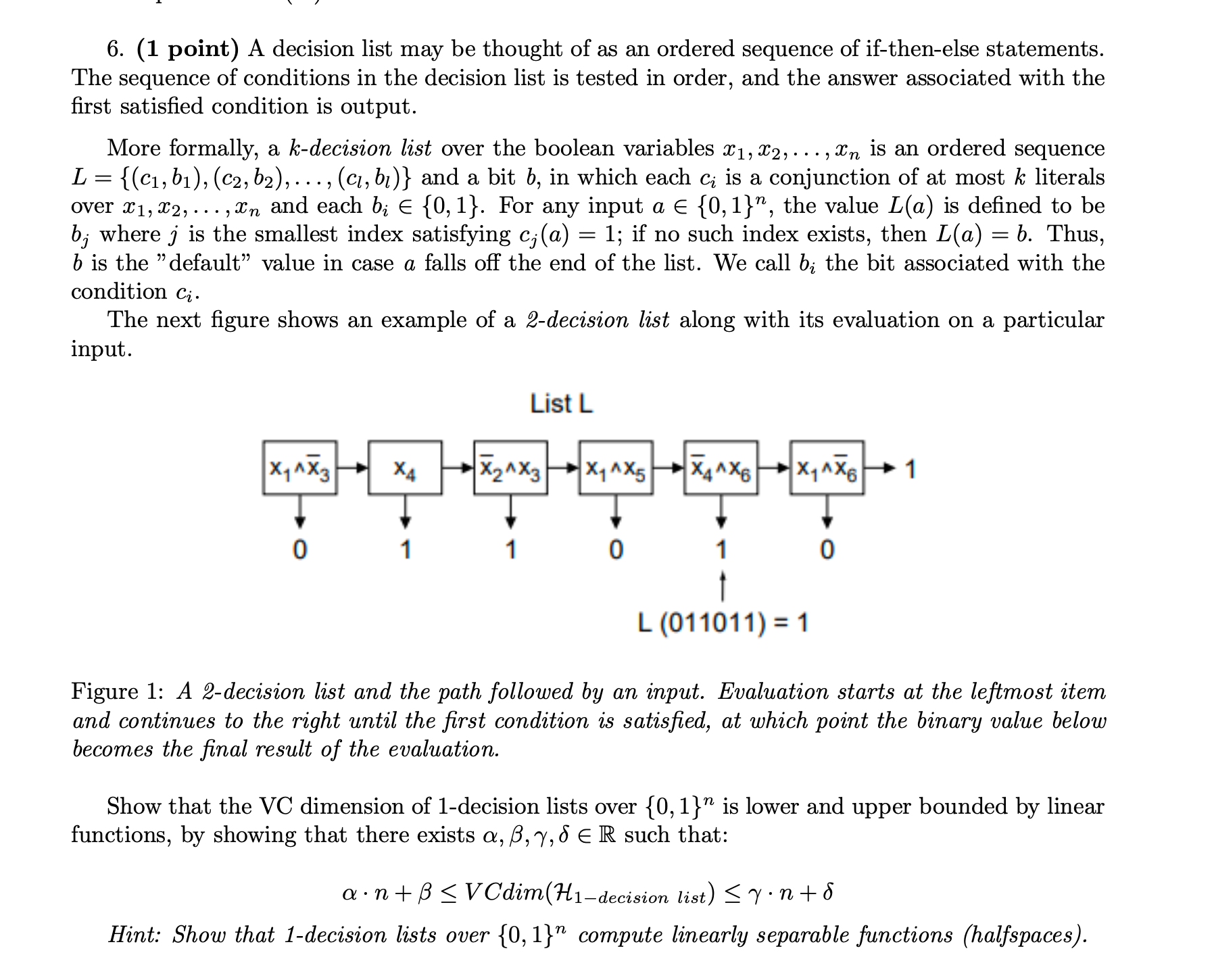
The next figure shows an example of a decision list along with its evaluation on a particular input.
Figure : A decision list and the path followed by an input. Evaluation starts at the leftmost item and continues to the right until the first condition is satisfied, at which point the binary value below becomes the final result of the evaluation.
Show that the VC dimension of decision lists over is lower and upper bounded by linear functions, by showing that there exists such that:
VCdim
Hint: Show that decision lists over compute linearly separable functions halfspaces
Step by Step Solution
There are 3 Steps involved in it
1 Expert Approved Answer
Step: 1 Unlock

Question Has Been Solved by an Expert!
Get step-by-step solutions from verified subject matter experts
Step: 2 Unlock
Step: 3 Unlock
 Study Help