







Question: need help summarizing this case study, please Wolfgang Keller at Knigsbru-TAK A graduate of Harvard Business School, 34-year-old German national Wolfgang Keller was named general
need help summarizing this case study, please
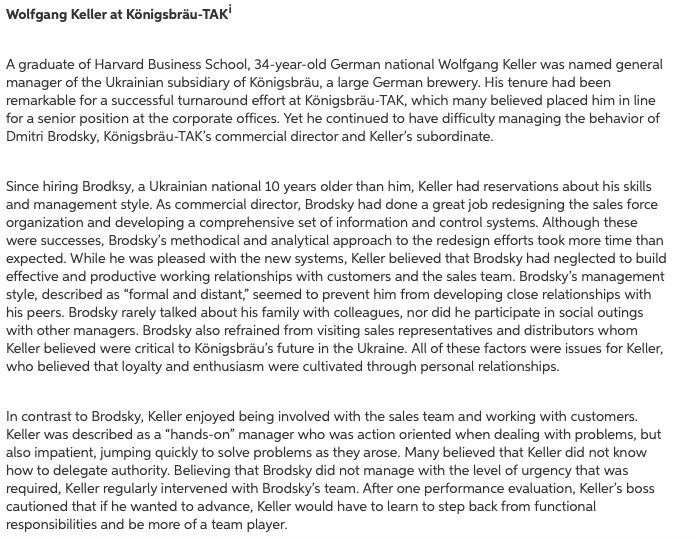
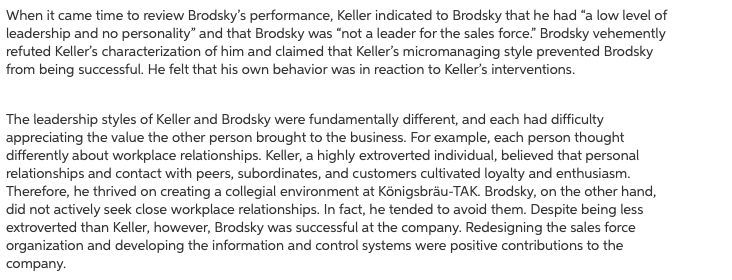
Wolfgang Keller at Knigsbru-TAK A graduate of Harvard Business School, 34-year-old German national Wolfgang Keller was named general manager of the Ukrainian subsidiary of Knigsbru, a large German brewery. His tenure had been remarkable for a successful turnaround effort at Knigsbru-TAK, which many believed placed him in line for a senior position at the corporate offices. Yet he continued to have difficulty managing the behavior of Dmitri Brodsky, Knigsbru-TAK's commercial director and Keller's subordinate. Since hiring Brodksy, a Ukrainian national 10 years older than him, Keller had reservations about his skills and management style. As commercial director, Brodsky had done a great job redesigning the sales force organization and developing a comprehensive set of information and control systems. Although these were successes, Brodsky's methodical and analytical approach to the redesign efforts took more time than expected. While he was pleased with the new systems, Keller believed that Brodsky had neglected to build effective and productive working relationships with customers and the sales team. Brodsky's management style, described as "formal and distant," seemed to prevent him from developing close relationships with his peers. Brodsky rarely talked about his family with colleagues, nor did he participate in social outings with other managers. Brodsky also refrained from visiting sales representatives and distributors whom Keller believed were critical to Knigsbru's future in the Ukraine. All of these factors were issues for Keller, who believed that loyalty and enthusiasm were cultivated through personal relationships. In contrast to Brodsky, Keller enjoyed being involved with the sales team and working with customers. Keller was described as a "hands-on" manager who was action oriented when dealing with problems, but also impatient, jumping quickly to solve problems as they arose. Many believed that Keller did not know how to delegate authority. Believing that Brodsky did not manage with the level of urgency that was required, Keller regularly intervened with Brodsky's team. After one performance evaluation, Keller's boss cautioned that if he wanted to advance, Keller would have to learn to step back from functional responsibilities and be more of a team player. When it came time to review Brodsky's performance, Keller indicated to Brodsky that he had a low level of leadership and no personality" and that Brodsky was not a leader for the sales force." Brodsky vehemently refuted Keller's characterization of him and claimed that Keller's micromanaging style prevented Brodsky from being successful. He felt that his own behavior was in reaction to Keller's interventions. The leadership styles of Keller and Brodsky were fundamentally different, and each had difficulty appreciating the value the other person brought to the business. For example, each person thought differently about workplace relationships. Keller, a highly extroverted individual, believed that personal relationships and contact with peers, subordinates, and customers cultivated loyalty and enthusiasm. Therefore, he thrived on creating a collegial environment at Knigsbru-TAK. Brodsky, on the other hand, did not actively seek close workplace relationships. In fact, he tended to avoid them. Despite being less extroverted than Keller, however, Brodsky was successful at the company. Redesigning the sales force organization and developing the information and control systems were positive contributions to the companyStep by Step Solution
There are 3 Steps involved in it
1 Expert Approved Answer
Step: 1 Unlock

Question Has Been Solved by an Expert!
Get step-by-step solutions from verified subject matter experts
Step: 2 Unlock
Step: 3 Unlock
 Study Help