







Question: need help to solve this question It is often argued that investing in mass transport system is beneficial to citizens because reducing commuting time to

need help to solve this question
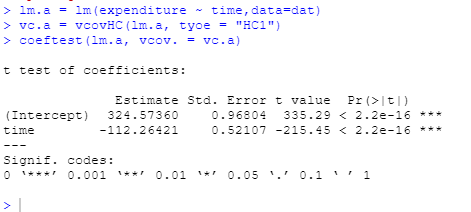
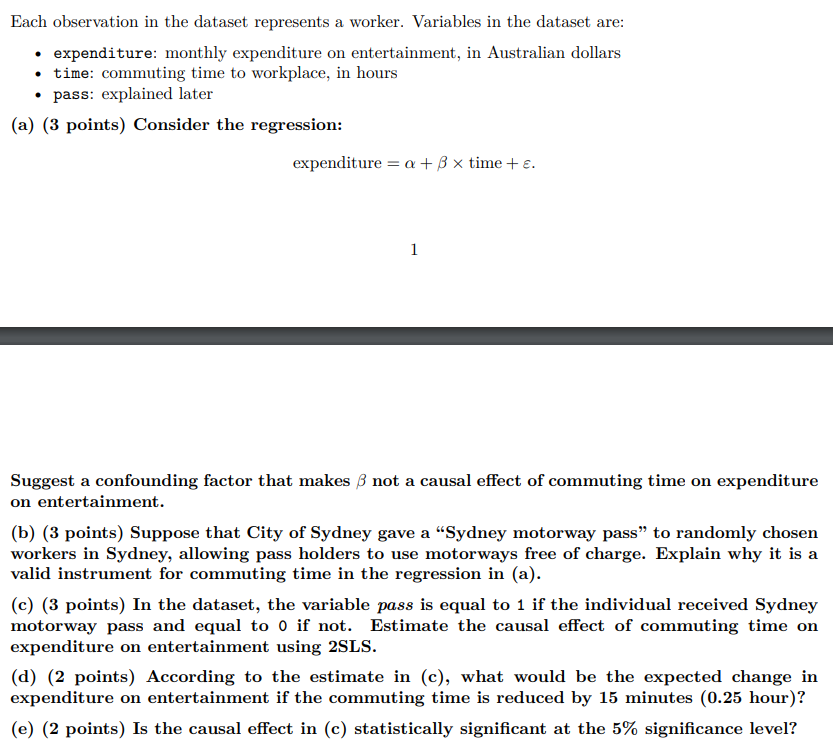
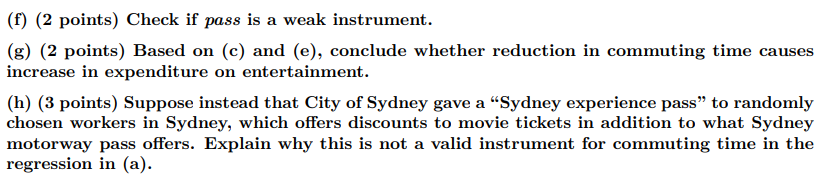
It is often argued that investing in mass transport system is beneficial to citizens because reducing commuting time to workplace allows workers to spend more time on leisure. To study this, you collected data of Sydney residents on commuting time to workplace and expenditure on entertainment. Load the dataset using the following command: Each observation in the dataset represents a worker. Variables in the dataset are: expenditure: monthly expenditure on entertainment, in Australian dollars time: commuting time to workplace, in hours pass: explained later (a) (3 points) Consider the regression: expenditure = a + 3x time + . 1 Suggest a confounding factor that makes not a causal effect of commuting time on expenditure on entertainment. (b) (3 points) Suppose that City of Sydney gave a "Sydney motorway pass" to randomly chosen workers in Sydney, allowing pass holders to use motorways free of charge. Explain why it is a valid instrument for commuting time in the regression in (a). (c) (3 points) In the dataset, the variable pass is equal to 1 if the individual received Sydney motorway pass and equal to 0 if not. Estimate the causal effect of commuting time on expenditure on entertainment using 2SLS. (d) (2 points) According to the estimate in (c), what would be the expected change in expenditure on entertainment if the commuting time is reduced by 15 minutes (0.25 hour)? (e) (2 points) Is the causal effect in (c) statistically significant at the 5% significance level? (f) (2 points) Check if pass is a weak instrument. (g) (2 points) Based on (c) and (e), conclude whether reduction in commuting time causes increase in expenditure on entertainment. (h) (3 points) Suppose instead that City of Sydney gave a "Sydney experience pass" to randomly chosen workers in Sydney, which offers discounts to movie tickets in addition to what Sydney motorway pass offers. Explain why this is not a valid instrument for commuting time in the regression in (a). > 1m. a = 1m 1m (expenditure (expenditure ~ time, data=dat) > vc.a = vcovHC (1m.a, tyoe = "HC1") > coeftest (1m.a, vcov. = vc.a) t test of coefficients: Pr (>|t|) Estimate Std. Error t value 324.57360 (Intercept) 0.96804 335.29 1m. a = 1m 1m (expenditure (expenditure ~ time, data=dat) > vc.a = vcovHC (1m.a, tyoe = "HC1") > coeftest (1m.a, vcov. = vc.a) t test of coefficients: Pr (>|t|) Estimate Std. Error t value 324.57360 (Intercept) 0.96804 335.29
Step by Step Solution
There are 3 Steps involved in it

Get step-by-step solutions from verified subject matter experts
 Study Help