







Question: need help with #4-6. Consider this... A saturated solution of AgBr(s) in deionized water contains tiny concentrations of Ag and Br, and in fact we
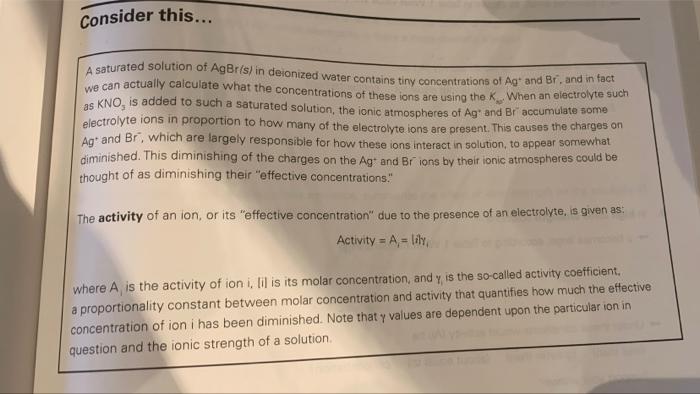

Consider this... A saturated solution of AgBr(s) in deionized water contains tiny concentrations of Ag and Br, and in fact we can actually calculate what the concentrations of these ions are using the K. When an electrolyte such as KNO, is added to such a saturated solution, the ionic atmospheres of Ag and Br accumulate some electrolyte ions in proportion to how many of the electrolyte ions are present. This causes the charges on Ag and Br, which are largely responsible for how these ions interact in solution, to appear somewhat diminished. This diminishing of the charges on the Ag and Brions by their ionic atmospheres could be thought of as diminishing their effective concentrations." The activity of an ion, or its "effective concentration due to the presence of an electrolyte, is given as: Activity = A = lily where A is the activity of ioni, lilis its molar concentration, and is the so-called activity coefficient a proportionality constant between molar concentration and activity that quantifies how much the effective concentration of ion i has been diminished. Note that y values are dependent upon the particular ion in question and the ionic strength of a solution 4. Examine the activity coefficients for Ag+ in Table 1. What happens to the magnitude of the activity coefficient, Yo, as the concentration of KNO, increases? 5. What happens to the magnitude of the activity coefficient. Y, as the concentration of the KNO, increases? 6. Compare the changes in the magnitudes of YA and Yerin KNO, to those in Mg(NO), Which electrolyte is having a greater impact on these activity coefficients
Step by Step Solution
There are 3 Steps involved in it

Get step-by-step solutions from verified subject matter experts
 Study Help