Question: PLEASE HELP General Guidelines A clear structure includes following the steps listed at the end of the case and incorporating the referenced material. Ideas must
PLEASE HELP
General Guidelines
A clear structure includes following the steps listed at the end of the case and incorporating the referenced material. Ideas must be clear and organized. Each question must be answered in the submitted case notes to receive full credit.
Use the questions to guide the flow and organization of case notes. While reading and examining the case, there should be an apparent connection to the textbook material. The connection should include references to figures, key terms, and overarching themes from the chapter. Writing should contain proper grammar and punctuation
Step 1: Defining the Problem Identification of the problem and the connection to the text is made first. A summary with examples from the book is appropriate. Make sure to identify from whose perspective the problems are being viewed
Step 2: Identify the causes of the Problem
While determining the causes of the problem, it is important to include the person and situation factors in the analysis.
Step 3: Recommendations
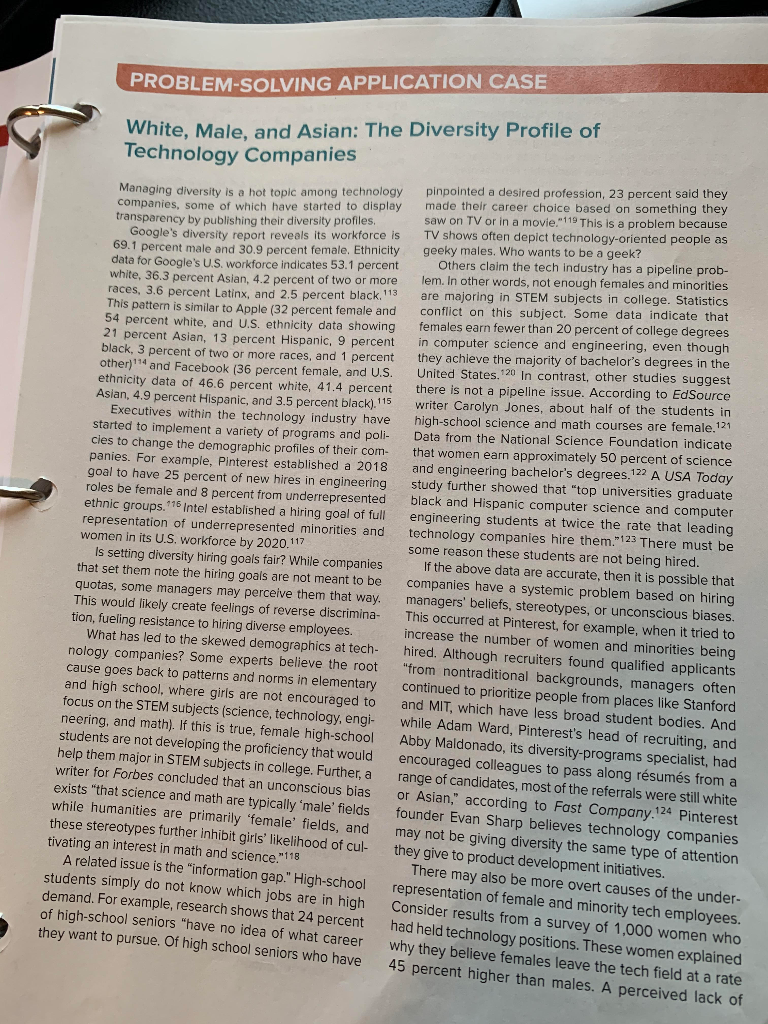
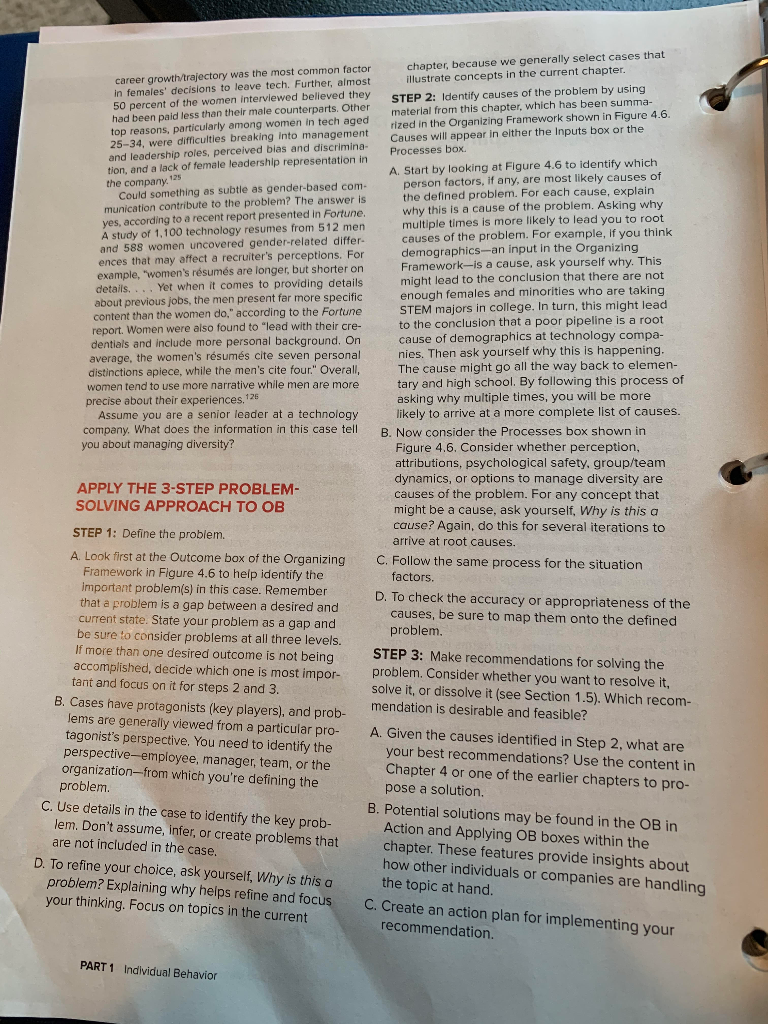
PROBLEM SOLVING APPLICATION CASE in computer panies. repnic groups White, Male, and Asian: The Diversity Profile of Technology Companies pinpointed a desired profession, 23 percent said they Managing diversity is a hot topic among technology made their career choice based on something they companies, some of which have started to display saw on TV or in a movie."119 This is a problem because transparency by publishing their diversity profiles. Google's diversity report reveals its workforce is TV shows often depict technology-oriented people as 69.1 percent male and 30.9 percent female. Ethnicity geeky males. Who wants to be a geek? Others claim the tech Industry has a pipeline prob- data for Google's U.S. workforce indicates 53.1 percent white, 36.3 percent Asian, 4.2 percent of two or more lem. In other words, not enough females and minorities races, 3.6 percent Latinx, and 2.5 percent black. 113 are majoring in STEM subjects in college. Statistics This pattern is similar to Apple (32 percent female and conflict on this subject. Some data indicate that 54 percent white, and U.S. ethnicity data showing females earn fewer than 20 percent of college degrees 21 percent Asian, 13 percent Hispanic, 9 percent science and engineering, even though black, 3 percent of two or more races, and 1 percent chieve the majority of bachelor's degrees in the other) and Facebook (36 percent female, and U.S. United States.120 In contrast, other studies suggest ethnicity data of 46.6 percent white, 41.4 percent there is not a ta pipeline issue. According to Ed Source Asian, 4.9 percent Hispanic, and 3.5 percent black)."15 writer Carolyn Jones, about half of of the students in Executives within the technology industry have high-school science and math courses are female.121 started to implement a variety of programs and poli- Data from the National Science Foundation indicate cies to change the demographic profiles of their com that women earn approximately 50 percent of science For example, Pinterest established a 2018 and engineering bachelor's degrees.122 A USA Today goal to have 25 percent of new hires in engineering study further showed that "top universities graduate roles be female and 8 percent from underrepresented black and Hispanic computer science and computer ethnic *16 Intel established a hiring goal of full engineering students at twice the rate that leading representation of underrepresent underrepresented minorities and technology companies hire them."123 There must be women in its U.S. workforce by 2020.117 some reason these students are not being hired. Is setting diversity hiring goals fair? While companies If the above data are accurate, then it is possible that that set them note the hiring goals are not meant to be companies have a systemic problem based on hiring quotas, some managers may perceive them that way. managers' beliefs, stereotypes, or unconscious biases. This would likely create feelings of reverse discrimina This occurred at Pinterest, for example, when it tried to tion, fueling resistance to hiring diverse employees. increase the number of women and minorities being What has led to the skewed demographics at tech hired. Although recruiters found qualified applicants nology companies? Some experts believe the root "from nontraditional backgrounds, managers often cause goes back to patterns and norms in elementary continued to prioritize people from places like Stanford and high school, where girls are not encouraged to and MIT, which have less broad student bodies. And focus on the STEM subjects (science, technology, engi while Adam Ward, Pinterest's head of recruiting, and neering, and math). If this is true, female high-school students are not developing the proficiency that would Abby Maldonado, its diversity-programs specialist, had help them major in STEM subjects in college. Further, a encouraged colleagues to pass along rsums from a writer for Forbes concluded that an unconscious bias range of candidates, most of the referrals were still white exists that science and math are typically 'male' fields or Asian, according to Fast Company. 124 Pinterest while humanities are primarily 'female' fields, and founder Evan Sharp believes technology companies these stereotypes further inhibit girls' likelihood of cul- may not be giving diversity the same type of attention tivating an interest in math and science."118 they give to product development initiatives. A related issue is the "information gap." High-school There may also be more overt causes of the under- students simply do not know which jobs are in high demand. For example, research shows that 24 percent of high-school seniors "have no idea of what career they want to pursue. Of high school seniors who have representation of female and minority tech employees. Consider results from a survey of 1,000 women who had held technology positions. These women explained why they believe females leave the tech field at a rate 45 percent higher than males. A perceived lack of chapter, because we generally select cases that career growth/trajectory was the most common factor illustrate concepts in the current chapter. in females' decisions to leave tech. Further, almost 50 percent of the women interviewed believed they STEP 2: Identify causes of the problem by using had been paid less than their male counterparts. Other material from this chapter, which has been summa- top reasons, particularly among women in tech aged rized in the Organizing Framework shown in Figure 4.6 25-34, were difficulties breaking into management Causes will appear in elther the inputs box or the and leadership roles, perceived blas and discrimina Processes box tion, and a lack of female leadership representation in A. Start by looking at Figure 4.6 to identify which the company. 125 Could something as subtle as gender-based com person factors, if any, are most likely causes of munication contribute to the problem? The answer is the defined problem. For each cause, explain yes, according to a recent report presented in Fortune. why this is a cause of the problem. Asking why A study of 1,100 technology resumes from 512 men multiple times is more likely to lead you to root and 588 women uncovered gender-related differ causes of the problem. For example, if you think ences that may affect a recruiter's perceptions. For demographics-an input in the Organizing example, "women's rsums are longer, but shorter on Framework-is a cause, ask yourself why. This details. Yet when it comes to providing details might lead to the conclusion that there are not about previous jobs, the men present far more specific enough females and minorities who are taking content than the women do." according to the Fortune STEM majors in college. In turn, this might lead report. Women were also found to "lead with their cre to the conclusion that a poor pipeline a root dentials and include more personal background. On cause of demographics at technology compa- average, the women's rsums cite seven personal nies. Then ask yourself why this is happening. distinctions apiece, while the men's cite four." Overall, The cause might go all the way back to elemen- women tend to use more narrative while men are more tary and high school. By following this process of precise about their experiences.126 asking why multiple times, you will be more Assume you are a senior leader at a technology likely to arrive at a more complete list of causes. company. What does the information in this case tell you about managing diversity? B. Now consider the Processes box shown in Figure 4.6. Consider whether perception, attributions, psychological safety, group/team APPLY THE 3-STEP PROBLEM- dynamics, or options to manage diversity are SOLVING APPROACH TO OB causes of the problem. For any concept that might be a cause, ask yourself, Why is this a STEP 1: Define the problem. cause? Again, do this for several iterations to arrive at root causes. A. Look first at the outcome box of the Organizing Framework in Figure 4.6 to help identify the C. Follow the same process for the situation important problem(s) in this case. Remember that a problem is a gap between a desired and D. To check the accuracy or appropriateness of the current state. State your problem as a gap and causes, be sure to map them onto the defined be sure to consider problems at all three levels. problem. If more than one desired outcome is not being accomplished, decide which one is most impor- factors. STEP 3: Make recommendations for solving the problem. Consider whether you want to resolve it, solve it, or dissolve it (see Section 1.5). Which recom- mendation is desirable and feasible? tant and focus on it for steps 2 and 3. B. Cases have protagonists (key players), and prob- lems are generally viewed from a particular pro- tagonist's perspective. You need to identify the perspective-employee, manager, team, or the organization-from which you're defining the problem. C. Use details in the case to identify the key prob- lem. Don't assume, infer, or create problems that are not included in the case. D. To refine your choice, ask yourself, Why is this a problem? Explaining why helps refine and focus your thinking. Focus on topics in the current A. Given the causes identified in Step 2, what are your best recommendations? Use the content in Chapter 4 or one of the earlier chapters to pro- pose a solution. B. Potential solutions may be found in the OB in Action and Applying OB boxes within the chapter. These features provide insights about how other individuals or companies are handling the topic at hand. C. Create an action plan for implementing your recommendation. PART 1 Individual Behavior PROBLEM SOLVING APPLICATION CASE in computer panies. repnic groups White, Male, and Asian: The Diversity Profile of Technology Companies pinpointed a desired profession, 23 percent said they Managing diversity is a hot topic among technology made their career choice based on something they companies, some of which have started to display saw on TV or in a movie."119 This is a problem because transparency by publishing their diversity profiles. Google's diversity report reveals its workforce is TV shows often depict technology-oriented people as 69.1 percent male and 30.9 percent female. Ethnicity geeky males. Who wants to be a geek? Others claim the tech Industry has a pipeline prob- data for Google's U.S. workforce indicates 53.1 percent white, 36.3 percent Asian, 4.2 percent of two or more lem. In other words, not enough females and minorities races, 3.6 percent Latinx, and 2.5 percent black. 113 are majoring in STEM subjects in college. Statistics This pattern is similar to Apple (32 percent female and conflict on this subject. Some data indicate that 54 percent white, and U.S. ethnicity data showing females earn fewer than 20 percent of college degrees 21 percent Asian, 13 percent Hispanic, 9 percent science and engineering, even though black, 3 percent of two or more races, and 1 percent chieve the majority of bachelor's degrees in the other) and Facebook (36 percent female, and U.S. United States.120 In contrast, other studies suggest ethnicity data of 46.6 percent white, 41.4 percent there is not a ta pipeline issue. According to Ed Source Asian, 4.9 percent Hispanic, and 3.5 percent black)."15 writer Carolyn Jones, about half of of the students in Executives within the technology industry have high-school science and math courses are female.121 started to implement a variety of programs and poli- Data from the National Science Foundation indicate cies to change the demographic profiles of their com that women earn approximately 50 percent of science For example, Pinterest established a 2018 and engineering bachelor's degrees.122 A USA Today goal to have 25 percent of new hires in engineering study further showed that "top universities graduate roles be female and 8 percent from underrepresented black and Hispanic computer science and computer ethnic *16 Intel established a hiring goal of full engineering students at twice the rate that leading representation of underrepresent underrepresented minorities and technology companies hire them."123 There must be women in its U.S. workforce by 2020.117 some reason these students are not being hired. Is setting diversity hiring goals fair? While companies If the above data are accurate, then it is possible that that set them note the hiring goals are not meant to be companies have a systemic problem based on hiring quotas, some managers may perceive them that way. managers' beliefs, stereotypes, or unconscious biases. This would likely create feelings of reverse discrimina This occurred at Pinterest, for example, when it tried to tion, fueling resistance to hiring diverse employees. increase the number of women and minorities being What has led to the skewed demographics at tech hired. Although recruiters found qualified applicants nology companies? Some experts believe the root "from nontraditional backgrounds, managers often cause goes back to patterns and norms in elementary continued to prioritize people from places like Stanford and high school, where girls are not encouraged to and MIT, which have less broad student bodies. And focus on the STEM subjects (science, technology, engi while Adam Ward, Pinterest's head of recruiting, and neering, and math). If this is true, female high-school students are not developing the proficiency that would Abby Maldonado, its diversity-programs specialist, had help them major in STEM subjects in college. Further, a encouraged colleagues to pass along rsums from a writer for Forbes concluded that an unconscious bias range of candidates, most of the referrals were still white exists that science and math are typically 'male' fields or Asian, according to Fast Company. 124 Pinterest while humanities are primarily 'female' fields, and founder Evan Sharp believes technology companies these stereotypes further inhibit girls' likelihood of cul- may not be giving diversity the same type of attention tivating an interest in math and science."118 they give to product development initiatives. A related issue is the "information gap." High-school There may also be more overt causes of the under- students simply do not know which jobs are in high demand. For example, research shows that 24 percent of high-school seniors "have no idea of what career they want to pursue. Of high school seniors who have representation of female and minority tech employees. Consider results from a survey of 1,000 women who had held technology positions. These women explained why they believe females leave the tech field at a rate 45 percent higher than males. A perceived lack of chapter, because we generally select cases that career growth/trajectory was the most common factor illustrate concepts in the current chapter. in females' decisions to leave tech. Further, almost 50 percent of the women interviewed believed they STEP 2: Identify causes of the problem by using had been paid less than their male counterparts. Other material from this chapter, which has been summa- top reasons, particularly among women in tech aged rized in the Organizing Framework shown in Figure 4.6 25-34, were difficulties breaking into management Causes will appear in elther the inputs box or the and leadership roles, perceived blas and discrimina Processes box tion, and a lack of female leadership representation in A. Start by looking at Figure 4.6 to identify which the company. 125 Could something as subtle as gender-based com person factors, if any, are most likely causes of munication contribute to the problem? The answer is the defined problem. For each cause, explain yes, according to a recent report presented in Fortune. why this is a cause of the problem. Asking why A study of 1,100 technology resumes from 512 men multiple times is more likely to lead you to root and 588 women uncovered gender-related differ causes of the problem. For example, if you think ences that may affect a recruiter's perceptions. For demographics-an input in the Organizing example, "women's rsums are longer, but shorter on Framework-is a cause, ask yourself why. This details. Yet when it comes to providing details might lead to the conclusion that there are not about previous jobs, the men present far more specific enough females and minorities who are taking content than the women do." according to the Fortune STEM majors in college. In turn, this might lead report. Women were also found to "lead with their cre to the conclusion that a poor pipeline a root dentials and include more personal background. On cause of demographics at technology compa- average, the women's rsums cite seven personal nies. Then ask yourself why this is happening. distinctions apiece, while the men's cite four." Overall, The cause might go all the way back to elemen- women tend to use more narrative while men are more tary and high school. By following this process of precise about their experiences.126 asking why multiple times, you will be more Assume you are a senior leader at a technology likely to arrive at a more complete list of causes. company. What does the information in this case tell you about managing diversity? B. Now consider the Processes box shown in Figure 4.6. Consider whether perception, attributions, psychological safety, group/team APPLY THE 3-STEP PROBLEM- dynamics, or options to manage diversity are SOLVING APPROACH TO OB causes of the problem. For any concept that might be a cause, ask yourself, Why is this a STEP 1: Define the problem. cause? Again, do this for several iterations to arrive at root causes. A. Look first at the outcome box of the Organizing Framework in Figure 4.6 to help identify the C. Follow the same process for the situation important problem(s) in this case. Remember that a problem is a gap between a desired and D. To check the accuracy or appropriateness of the current state. State your problem as a gap and causes, be sure to map them onto the defined be sure to consider problems at all three levels. problem. If more than one desired outcome is not being accomplished, decide which one is most impor- factors. STEP 3: Make recommendations for solving the problem. Consider whether you want to resolve it, solve it, or dissolve it (see Section 1.5). Which recom- mendation is desirable and feasible? tant and focus on it for steps 2 and 3. B. Cases have protagonists (key players), and prob- lems are generally viewed from a particular pro- tagonist's perspective. You need to identify the perspective-employee, manager, team, or the organization-from which you're defining the problem. C. Use details in the case to identify the key prob- lem. Don't assume, infer, or create problems that are not included in the case. D. To refine your choice, ask yourself, Why is this a problem? Explaining why helps refine and focus your thinking. Focus on topics in the current A. Given the causes identified in Step 2, what are your best recommendations? Use the content in Chapter 4 or one of the earlier chapters to pro- pose a solution. B. Potential solutions may be found in the OB in Action and Applying OB boxes within the chapter. These features provide insights about how other individuals or companies are handling the topic at hand. C. Create an action plan for implementing your recommendation. PART 1 Individual Behavior









 Study Help