







Question: Need help with A and B. Styles Question 4: [40 points) Let us consider the following program, where the copy function is a (naive) attempt
Need help with A and B.
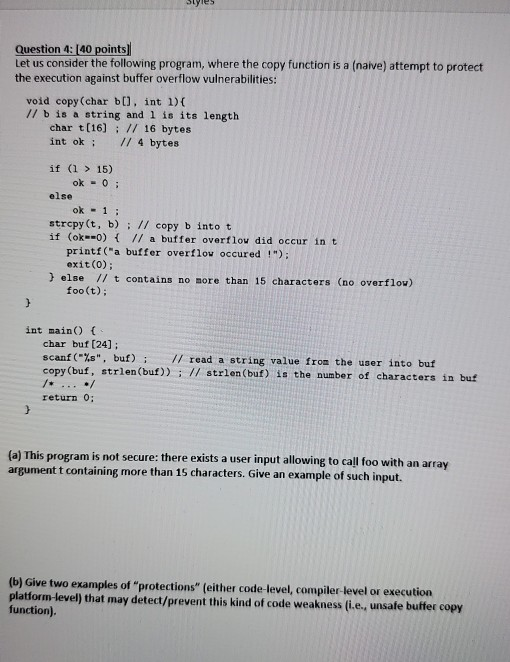
Styles Question 4: [40 points) Let us consider the following program, where the copy function is a (naive) attempt to protect the execution against buffer overflow vulnerabilities: void copy (char b[], int 1) { // bis a string and 1 is its length char t(16) ; // 16 bytes int ok : // 4 bytes if (1 > 15) ok - 0; else ok - 1: strcpy(t, b); // copy b into t if (oke=0) { // a buffer overflow did occur in t printf("a buffer overflow occured!"); exit(0); } else 77 t contains no more than 15 characters (no overflow) foo(t); int main() { char buf (24): scanf("%s", buf); // read a string value from the user into buf copy (buf, strlen(buf)); // strlen(buf) is the number of characters in but 1 ... / return 0; (a) This program is not secure: there exists a user input allowing to call foo with an array argument t containing more than 15 characters. Give an example of such input. (b) Give two examples of "protections" (either code-level, compiler-level or execution platform-level) that may detect/prevent this kind of code weakness (ie, unsate buffer copy function)
Step by Step Solution
There are 3 Steps involved in it

Get step-by-step solutions from verified subject matter experts
 Study Help