







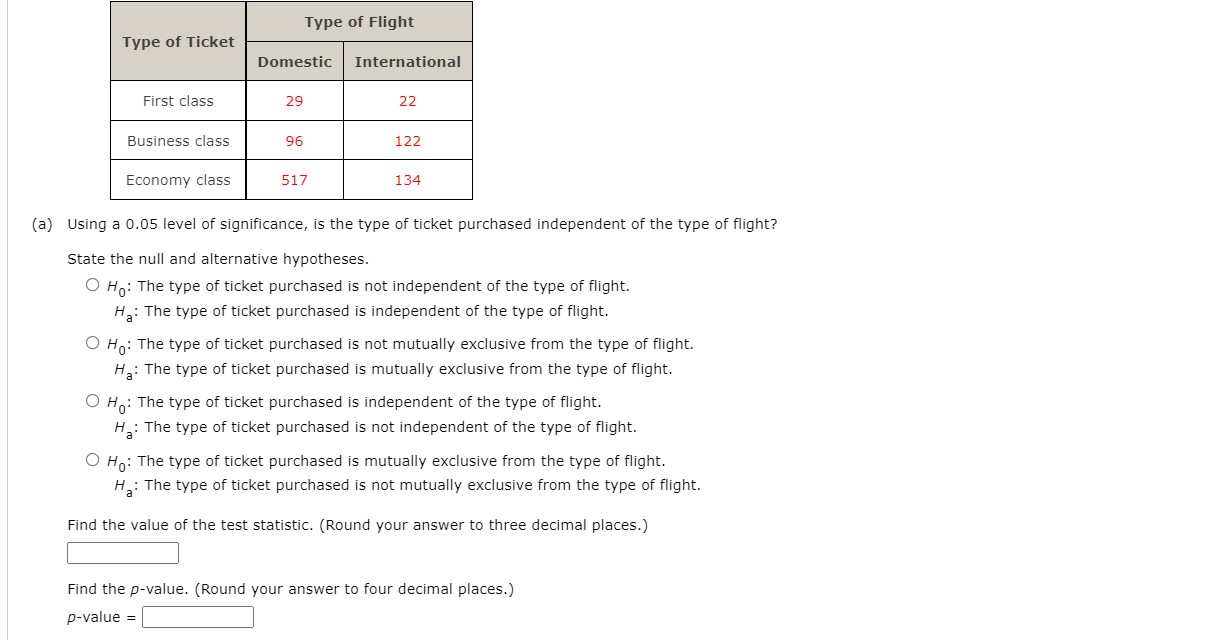
Question: Need help with ANOVA & Chi Squared Please!! Type of Flight Type of Ticket Domestic International First class 29 22 Business class 96 122 Economy

Need help with ANOVA & Chi Squared Please!!
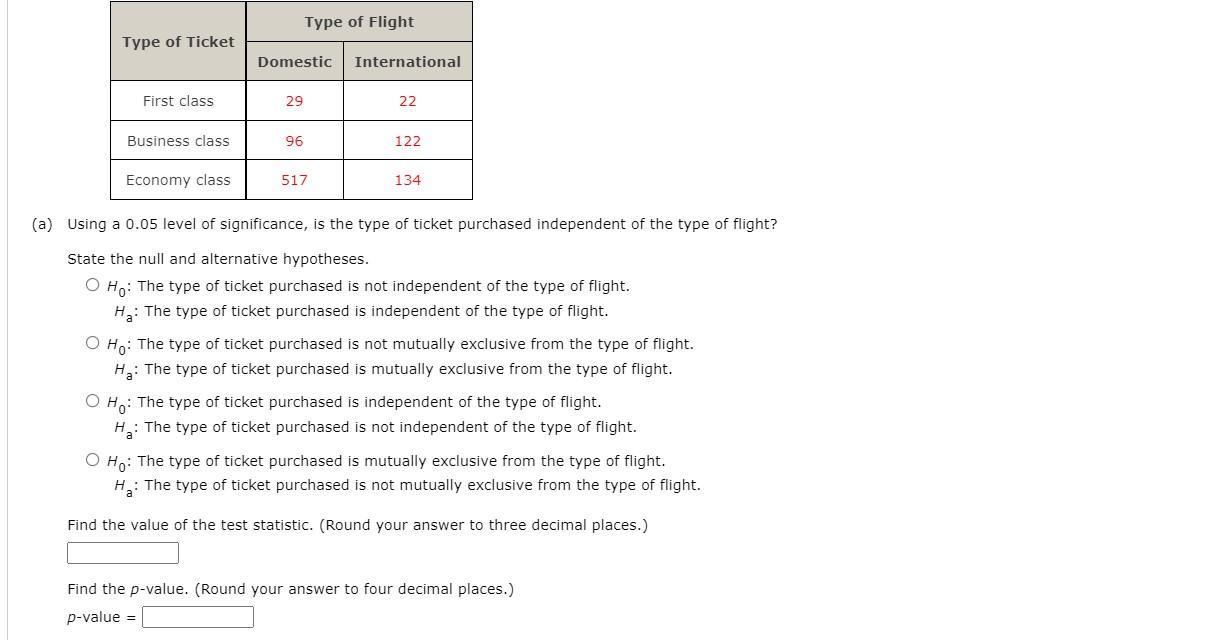
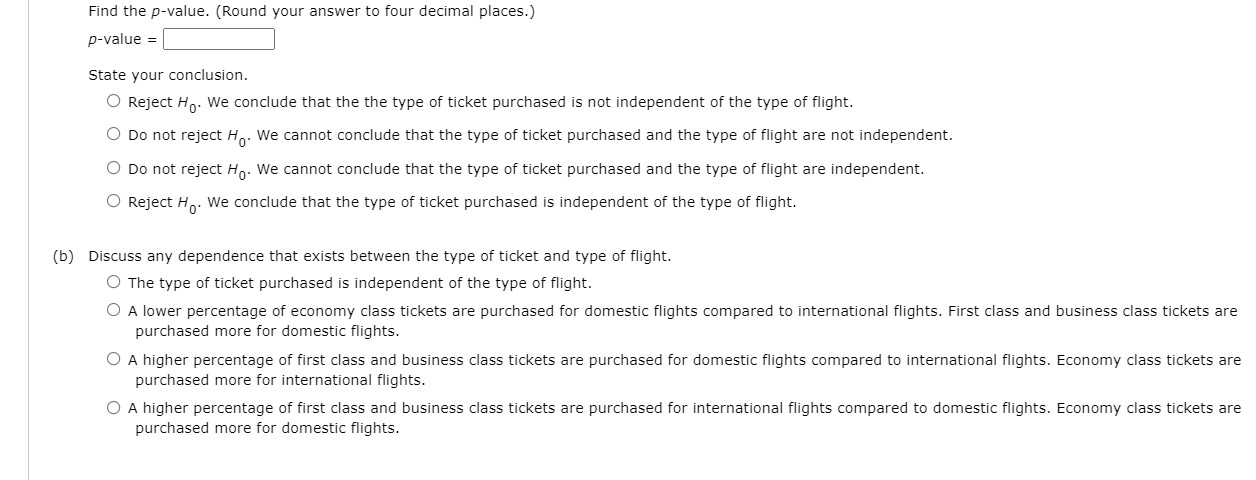
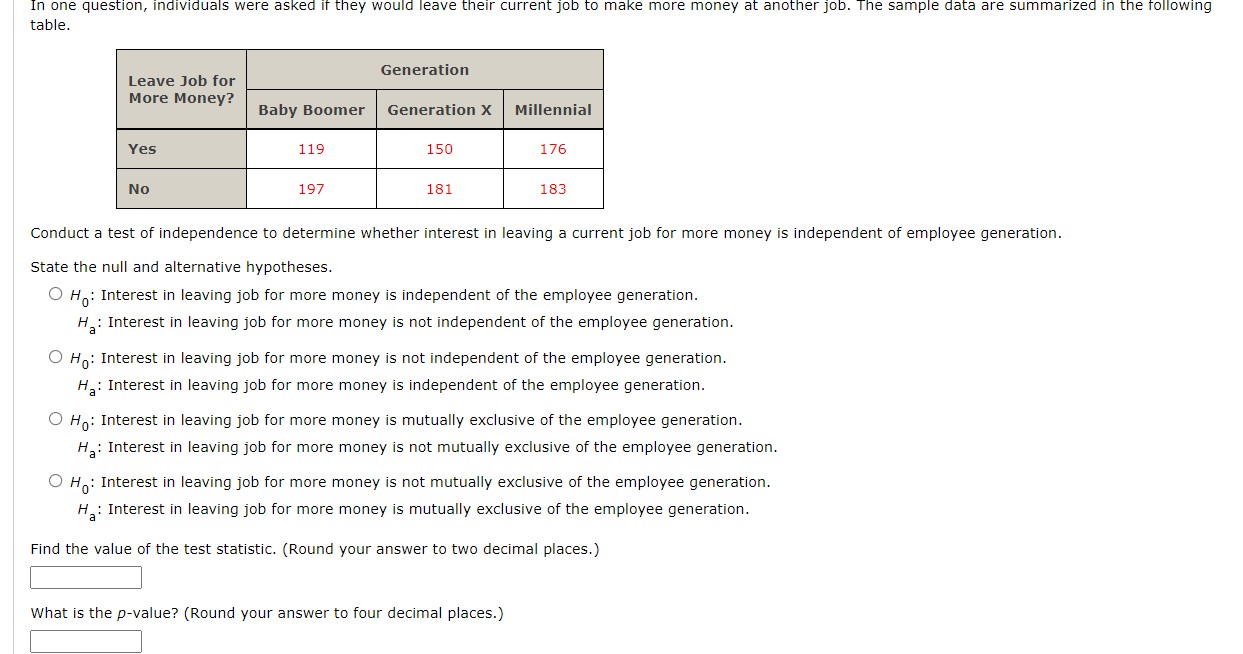

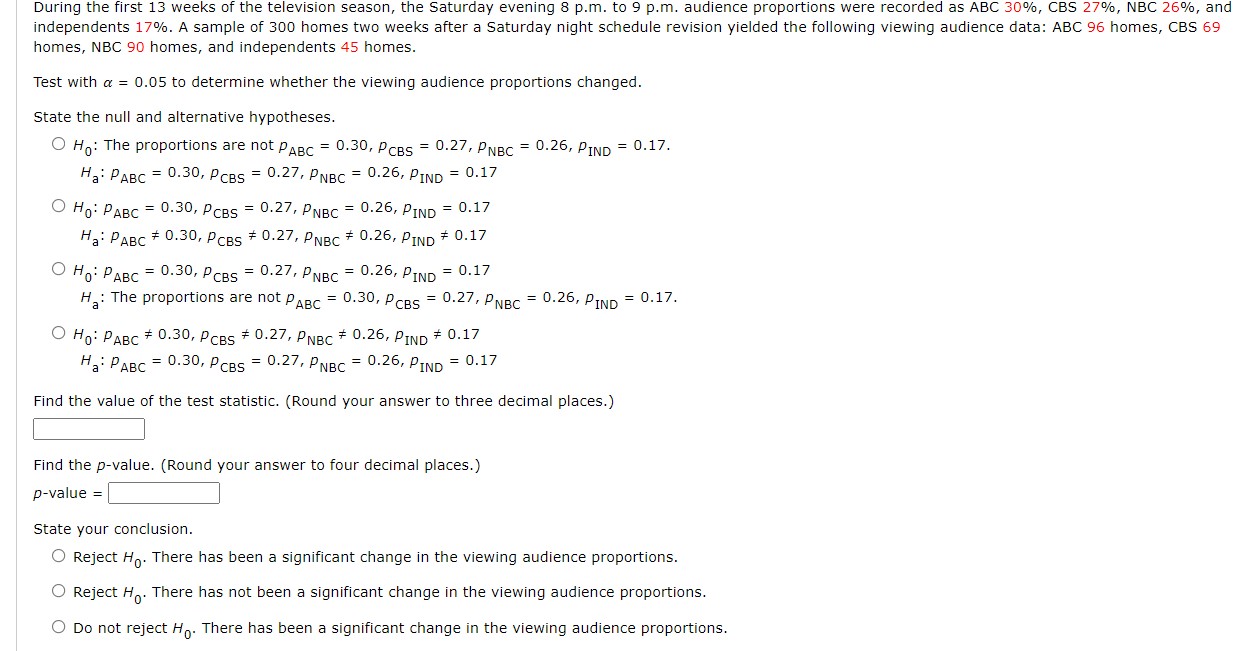
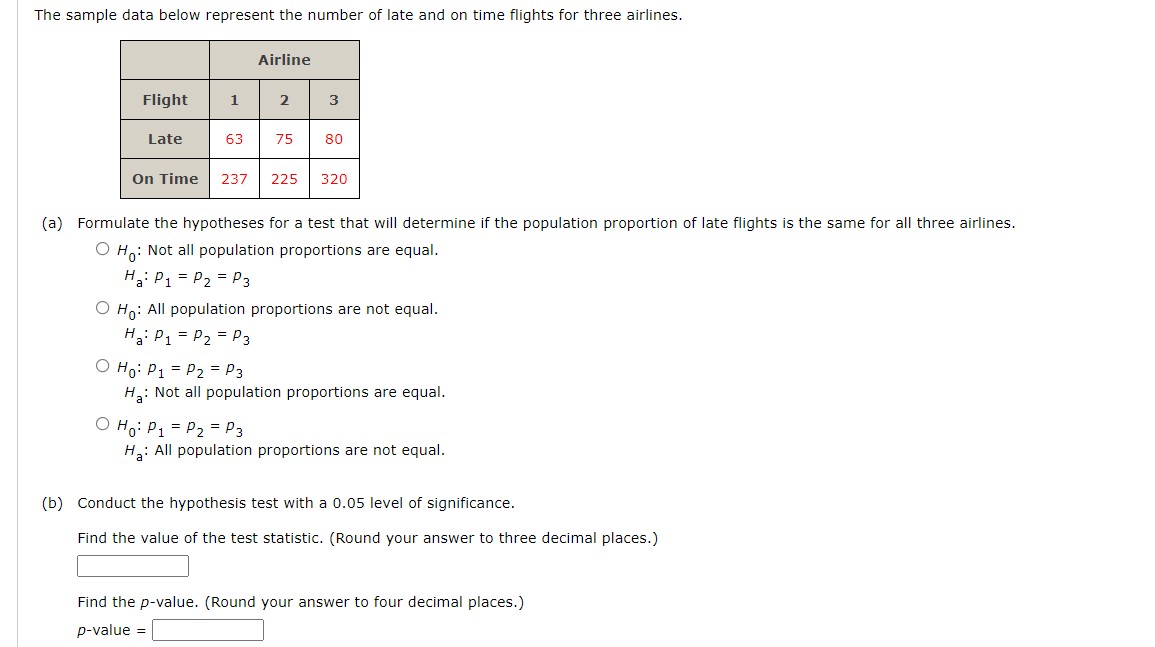
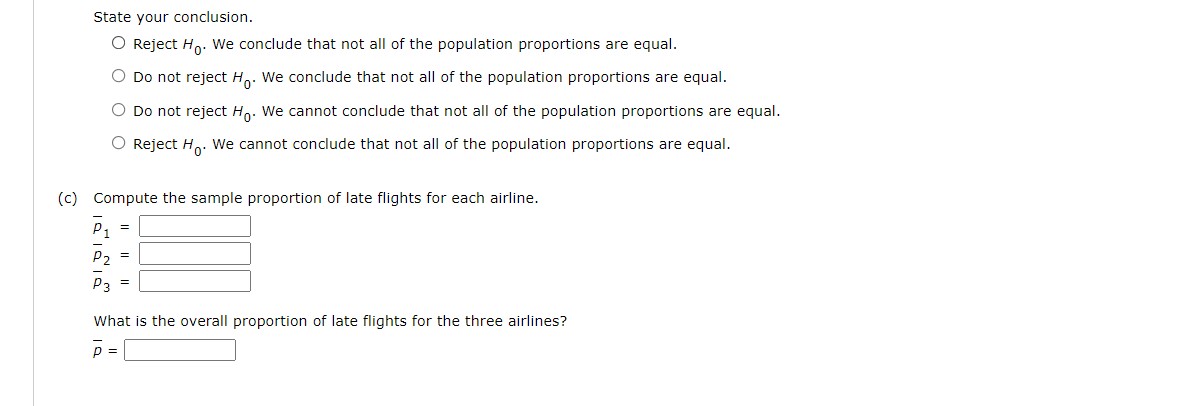
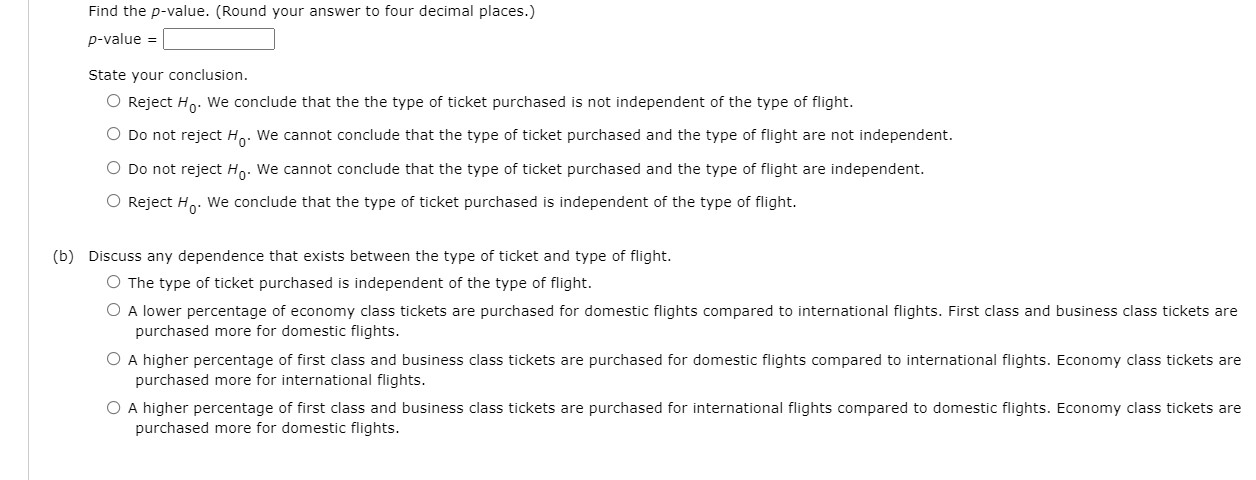
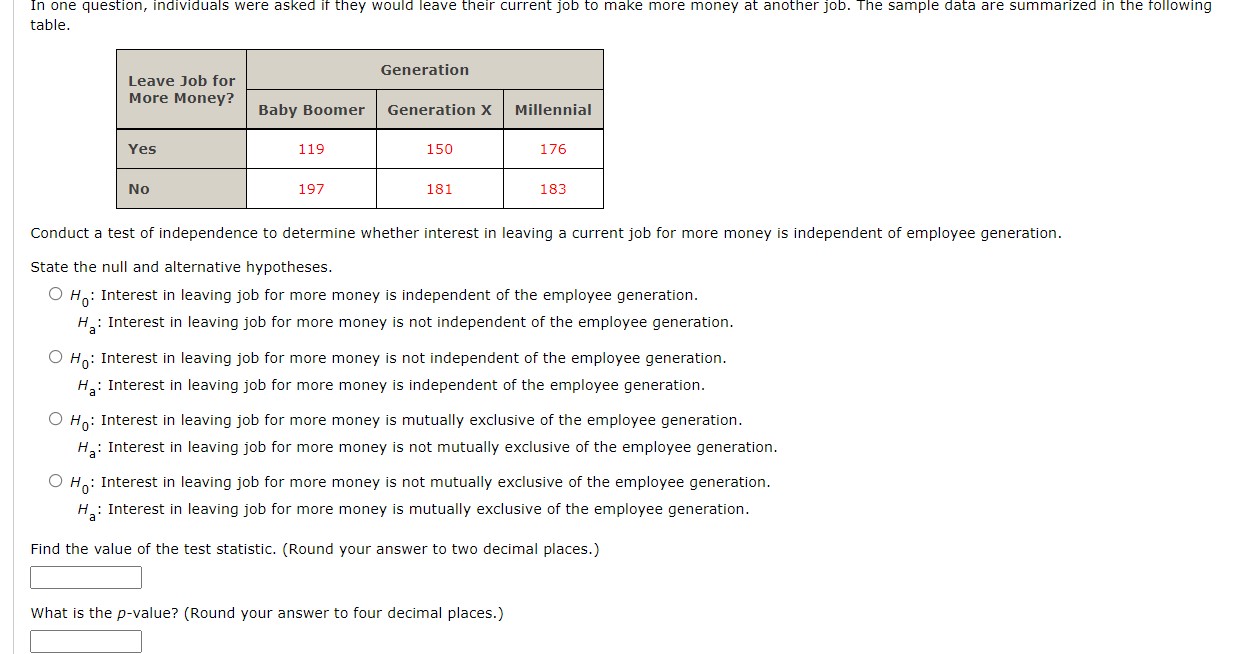
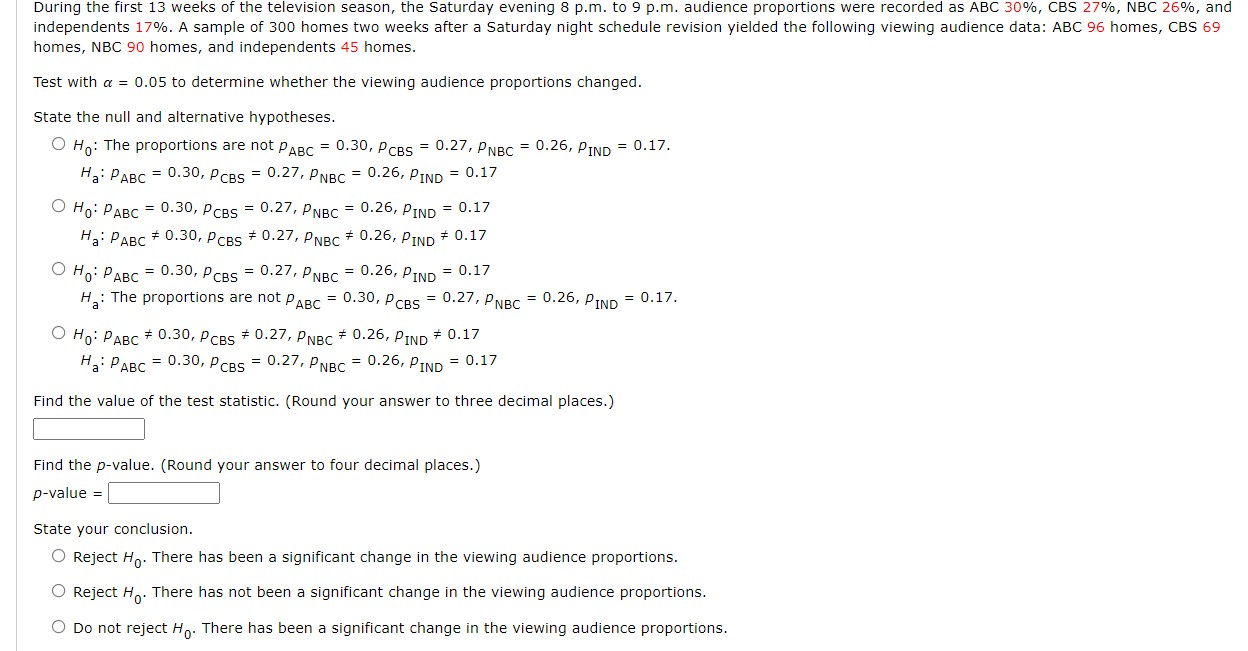
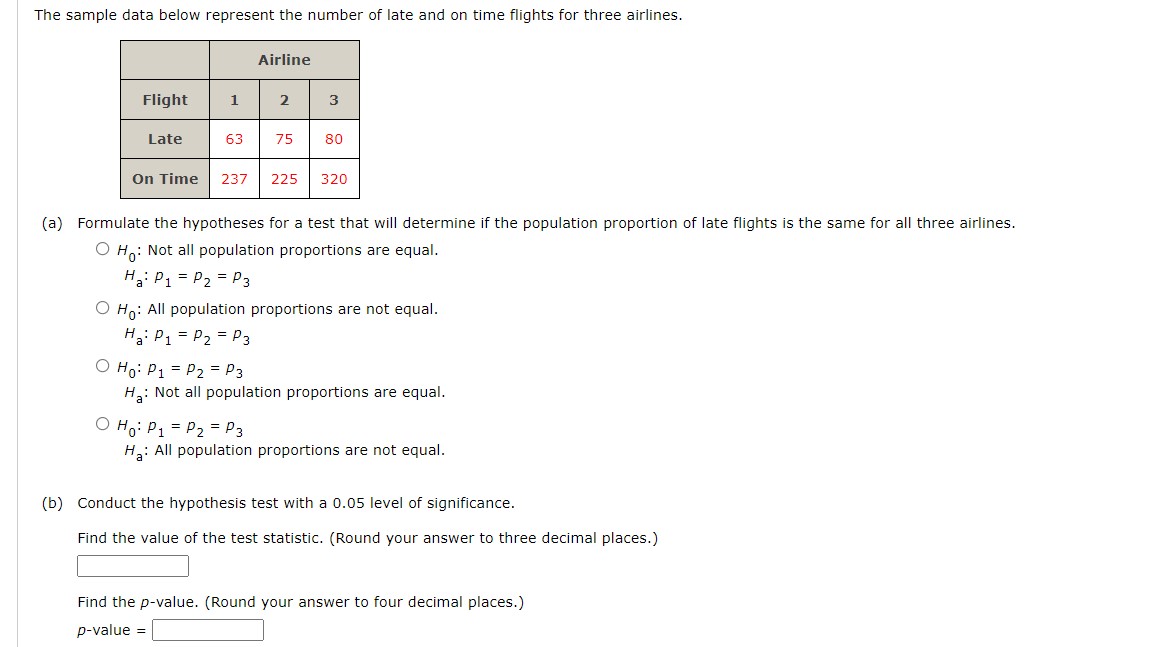
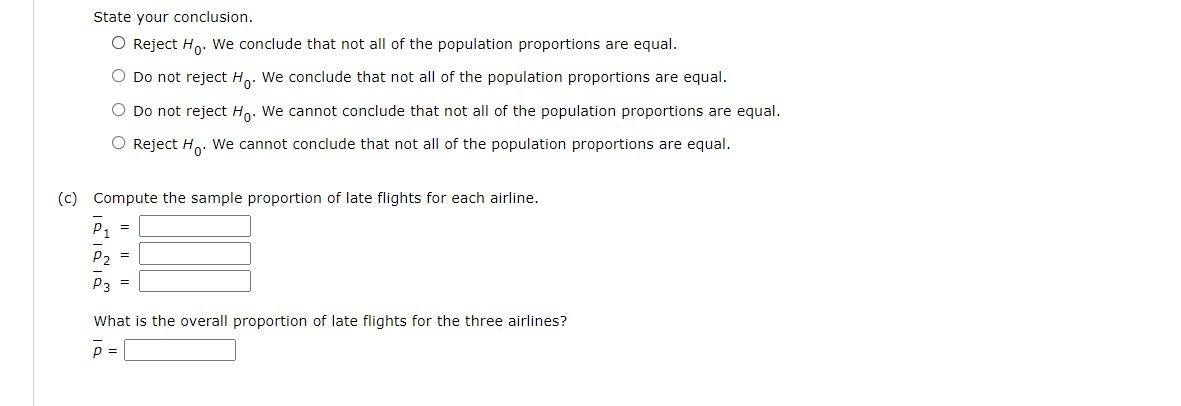
Type of Flight Type of Ticket Domestic International First class 29 22 Business class 96 122 Economy class 517 134 (a) Using a 0.05 level of significance, is the type of ticket purchased independent of the type of flight? State the null and alternative hypotheses. O Ho: The type of ticket purchased is not independent of the type of flight. Ha: The type of ticket purchased is independent of the type of flight. O Ho: The type of ticket purchased is not mutually exclusive from the type of flight. Ha: The type of ticket purchased is mutually exclusive from the type of flight. O H: The type of ticket purchased is independent of the type of flight. He: The type of ticket purchased is not independent of the type of flight. O Ho: The type of ticket purchased is mutually exclusive from the type of flight. H: The type of ticket purchased is not mutually exclusive from the type of flight. Find the value of the test statistic. (Round your answer to three decimal places.) Find the p-value. (Round your answer to four decimal places.) p-value =Find the p-value. (Round your answer to four decimal places.) p-value = State your conclusion. O Reject Ho. We conclude that the the type of ticket purchased is not independent of the type of flight. O Do not reject H . We cannot conclude that the type of ticket purchased and the type of flight are not independent. O Do not reject Ho. We cannot conclude that the type of ticket purchased and the type of flight are independent. O Reject Ho. We conclude that the type of ticket purchased is independent of the type of flight. (b) Discuss any dependence that exists between the type of ticket and type of flight. O The type of ticket purchased is independent of the type of flight. O A lower percentage of economy class tickets are purchased for domestic flights compared to international flights. First class and business class tickets are purchased more for domestic flights. O A higher percentage of first class and business class tickets are purchased for domestic flights compared to international flights. Economy class tickets are purchased more for international flights. O A higher percentage of first class and business class tickets are purchased for international flights compared to domestic flights. Economy class tickets are purchased more for domestic flights.In one question, individuals were asked it they would leave their current job to make more money at another job. The sample data are summarized in the following table. Conduct a test of independence to determine whether interest in leaving a current job for more money is independent of employee generation. State the null and alternative hypotheses. O HO: Interest in leaving job for more money is independent of the employee generation. Ha: Interest in leaving job for more money is not independent of the employee generation. 0 Ho: Interest in leaving job for more money is not independent of the employee generation. Ha: Interest in leaving job for more money is independent of the employee generation. 0 Ho: Interest in leaving job for more money is mutually exclusive of the employee generation. Ha: Interest in leaving job for more money is not mutually exclusive of the employee generation. 0 H0: Interest in leaving job for more money is not mutually exclusive of the employee generation. Ha: Interest in leaving job for more money is mutually exclusive of the employee generation. nd the value of the test statistic. (Round your answer to two decimal places.) |:| What is the pvalue? (Round your answer to four decimal places.) |:| Using a 0.05 level of significance, what is your conclusion? 0 Reject H0. we cannot conclude that interest in leaving a job for more money is independent of the employee generation. 0 Do not reject H0. We cannot conclude that interest in leaving a job for more money is independent of the employee generation. 0 Reject H0. we conclude that interest in leaving a job for more money is not independent of the employee generation. 0 Do not reject H0. We conclude that interest in leaving a job for more money is not independent of the employee generation. During the first 13 weeks of the television season, the Saturday evening 8 p.m. to 9 p.m. audience proportions were recorded as ABC 30%, CBS 27%, NBC 26%, and independents 17%. A sample of 300 homes two weeks after a Saturday night schedule revision yielded the following viewing audience data: ABC 96 homes, CBS 69 homes, NBC 90 homes, and independents 45 homes. Test with a = 0.05 to determine whether the viewing audience proportions changed. State the null and alternative hypotheses. O Ho: The proportions are not PABC = 0.30, PCBS = 0.27, PNBC = 0.26, PIND = 0.17. Hai PABC = 0.30, PCBS = 0.27, PNBC = 0.26, PIND = 0.17 O Ho: PABC = 0.30, PCBS = 0.27, PNBC = 0.26, PIND = 0.17 Ha: PABC # 0.30, PCBS # 0.27, PNBC # 0.26, PIND # 0.17 O Ho: PABC = 0.30, PCBS = 0.27, PNBC = 0.26, PIND = 0.17 H_: The proportions are not PABC = 0.30, PCBS = 0.27, PNBC = 0.26, PIND = 0.17. O Ho: PABC # 0.30, PCBS # 0.27, PNBC # 0.26, PIND # 0.17 Ha: PABC = 0.30, PCBS = 0.27, PNBC = 0.26, PIND = 0.17 Find the value of the test statistic. (Round your answer to three decimal places.) Find the p-value. (Round your answer to four decimal places.) p-value = State your conclusion. O Reject Ho. There has been a significant change in the viewing audience proportions. O Reject H. There has not been a significant change in the viewing audience proportions. O Do not reject Ho. There has been a significant change in the viewing audience proportions.The sample data below represent the number of late and on time flights for three airlines. Airline Flight 1 2 3 Late 63 75 80 On Time 237 225 320 (a) Formulate the hypotheses for a test that will determine if the population proportion of late flights is the same for all three airlines. O H: Not all population proportions are equal. HA: P1 = P2 = P3 O Ho: All population proportions are not equal. HA: P1 = P2 = P3 O Ho: P1 = P2 = P3 Ha: Not all population proportions are equal. OH : P1 = P2 = P3 H: All population proportions are not equal. (b) Conduct the hypothesis test with a 0.05 level of significance. Find the value of the test statistic. (Round your answer to three decimal places.) Find the p-value. (Round your answer to four decimal places.) p-value =State your conclusion. O Reject Ho. We conclude that not all of the population proportions are equal. O Do not reject H . We conclude that not all of the population proportions are equal. O Do not reject Ho. We cannot conclude that not all of the population proportions are equal. O Reject H . We cannot conclude that not all of the population proportions are equal. (c) Compute the sample proportion of late flights for each airline. p. P3 What is the overall proportion of late flights for the three airlines? D =
Step by Step Solution
There are 3 Steps involved in it

Get step-by-step solutions from verified subject matter experts
 Study Help