







Question: Need help with CS325 Analysis of Algorithms homework. Code already created here: https://github.com/MottekeSF/HW4 I just am really dead and done with Algorithms, can someone please
Need help with CS325 Analysis of Algorithms homework.
Code already created here: https://github.com/MottekeSF/HW4
I just am really dead and done with Algorithms, can someone please step by step it for me or just give me the answers and then step by step it, since this is due in 5 hours.
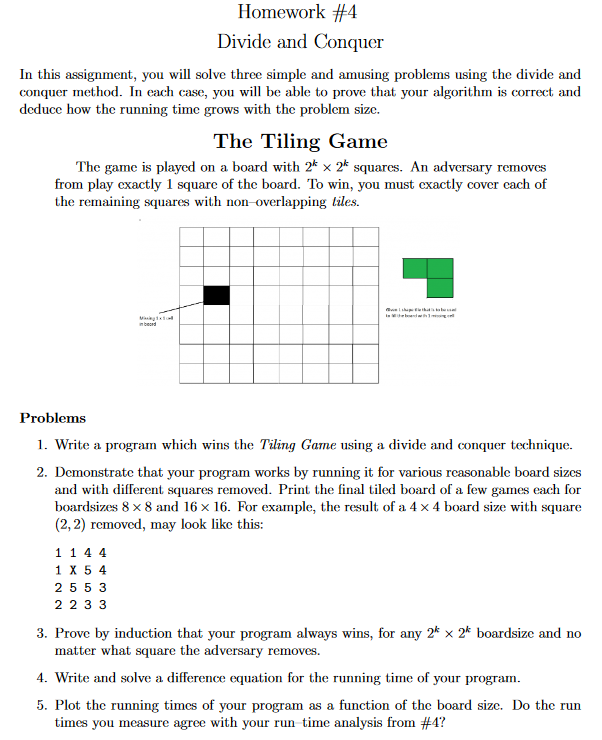
Homework #4 Divide and Conquer In this assignment, you will solve three simple and amusing problems using the divide and conquer method. In each case, you will be able to prove that your algorithm is correct and deduce how the running time grows with the problem sizc. The Tiling Game The game is played on a board with 2k 2k Squares. An adversary removes from play cxactly 1 squarc of the board. To win, you must cxactly cover cach of the remaining squares with non overlapping liles. Problems 1. Write a program which wins the Tiling Game using a divide and conquer technique. 2. Demonstrate that your program works by running it for various rcasonable board sizcs and with different squares removed. Print the final tiled board of a few games each for boardsizes 8 x 8 and 16 x 16. For example, the result of a 4 x 4 board size with square (2,2) removed, may look likc this: 1 14 4 1 X 5 4 2 5 5 3 2 2 3 3 3. Prove by induction that your program always wins, for any 2k 2k boardsize and no matter what square the adversary removes. 4. Write and solve a difference equation for the running time of your program 5. Plot the running times of your progr am as a function of the board size. Do the run times you measure agree with your run time analysis from #4? Homework #4 Divide and Conquer In this assignment, you will solve three simple and amusing problems using the divide and conquer method. In each case, you will be able to prove that your algorithm is correct and deduce how the running time grows with the problem sizc. The Tiling Game The game is played on a board with 2k 2k Squares. An adversary removes from play cxactly 1 squarc of the board. To win, you must cxactly cover cach of the remaining squares with non overlapping liles. Problems 1. Write a program which wins the Tiling Game using a divide and conquer technique. 2. Demonstrate that your program works by running it for various rcasonable board sizcs and with different squares removed. Print the final tiled board of a few games each for boardsizes 8 x 8 and 16 x 16. For example, the result of a 4 x 4 board size with square (2,2) removed, may look likc this: 1 14 4 1 X 5 4 2 5 5 3 2 2 3 3 3. Prove by induction that your program always wins, for any 2k 2k boardsize and no matter what square the adversary removes. 4. Write and solve a difference equation for the running time of your program 5. Plot the running times of your progr am as a function of the board size. Do the run times you measure agree with your run time analysis from #4
Step by Step Solution
There are 3 Steps involved in it

Get step-by-step solutions from verified subject matter experts
 Study Help