







Question: NEED HELP WITH PART A AND B For a first-order reaction, the half-life is constant. It depends only on the rate constant k and not
NEED HELP WITH PART A AND B
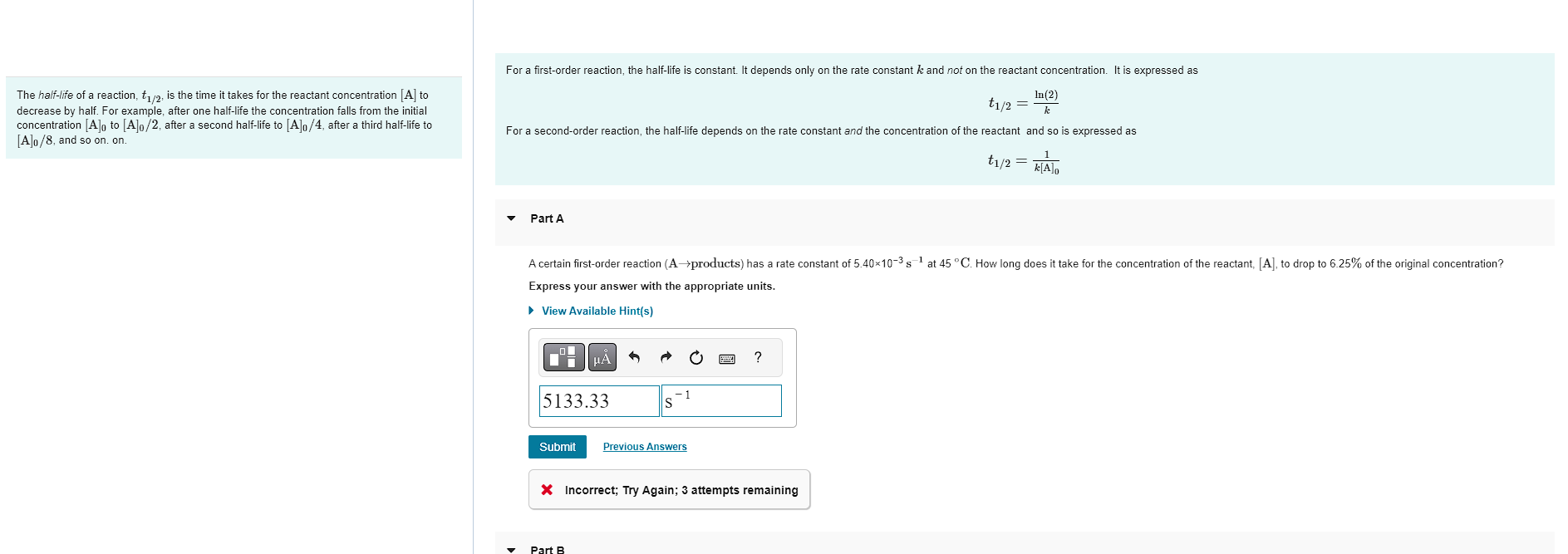
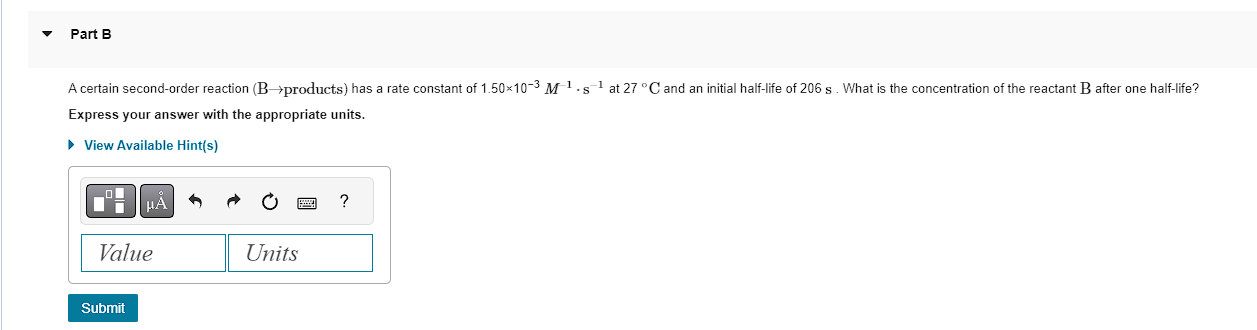
For a first-order reaction, the half-life is constant. It depends only on the rate constant k and not on the reactant concentration. It is expressed as The half-life of a reaction, t1/2, is the time it takes for the reactant concentration [A] to decrease by half. For example, after one half-life the concentration falls from the initial t1/2=kln(2) concentration [A]0 to [A]0/2, after a second half-life to [A]0/4, after a third half-life to For a second-order reaction, the half-life depends on the rate constant and the concentration of the reactant and so is expressed as [A]0/8, and so on. on. t1/2=k[A]]01 PartA A certain first-order reaction (A products) has a rate constant of 5.40103s1 at 45C. How long does it take for the concentration of the reactant, [A], to drop to 6.25% of the original concentration? Express your answer with the appropriate units. X Incorrect; Try Again; 3 attempts remaining A certain second-order reaction ( B products) has a rate constant of 1.50103M1s1 at 27C and an initial half-life of 206s. What is the concentration of the reactant B after one half-life? Express your answer with the appropriate units
Step by Step Solution
There are 3 Steps involved in it

Get step-by-step solutions from verified subject matter experts
 Study Help