







Question: need help with the last two that are highlighted 1. Determining Pay Increases in Job Classification Plans The federal government's General Schedule (GS) is an
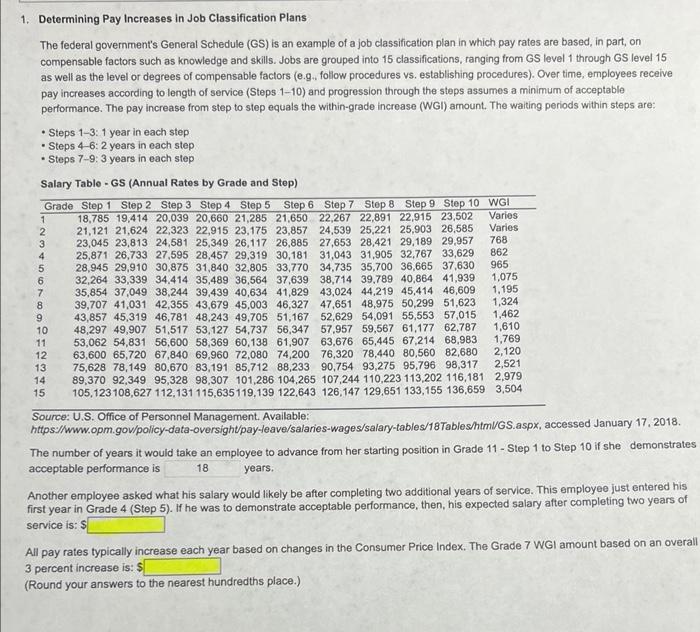
1. Determining Pay Increases in Job Classification Plans The federal government's General Schedule (GS) is an example of a job classification plan in which pay rates are based, in part, on compensable factors such as knowledge and skills. Jobs are grouped into 15 classifications, ranging from GS level 1 through GS level 15 as well as the level or degrees of compensable factors (e.g. follow procedures vs. establishing procedures). Over time, employees receive pay increases according to length of service (Steps 1-10) and progression through the steps assumes a minimum of acceptable performance. The pay increase from step to step equals the within-grade increase (WGI) amount. The waiting periods within steps are: - Steps 1-3: 1 year in each step - Steps 4-6: 2 years in each step - Steps 7-9: 3 years in each step Salary Table - GS (Annual Rates by Grade and Step) Source: U.S. Office of Personnel Management. Available: https://www.opm.gov/policy-data-oversight/pay-leave/salaries-wages/salary-tables/18Tables/htmU/GS. aspx, accessed January 17,2018. The number of years it would take an employee to advance from her starting position in Grade 11 - Step 1 to Step 10 if she demonstrates acceptable performance is years. Another employee asked what his salary would likely be after completing two additional years of service. This employee just entered his first year in Grade 4 (Step 5). If he was to demonstrate acceptable performance, then, his expected salary after completing two years of service is: $ All pay rates typically increase each year based on changes in the Consumer Price Index. The Grade 7 WGI amount based on an overall 3 percent increase is: $ (Round your answers to the nearest hundredths place.)
Step by Step Solution
There are 3 Steps involved in it

Get step-by-step solutions from verified subject matter experts
 Study Help