







Question: Need help with this extra credit assignment!! You'd basically be doing the elements of art and the principles of design which are explained below for
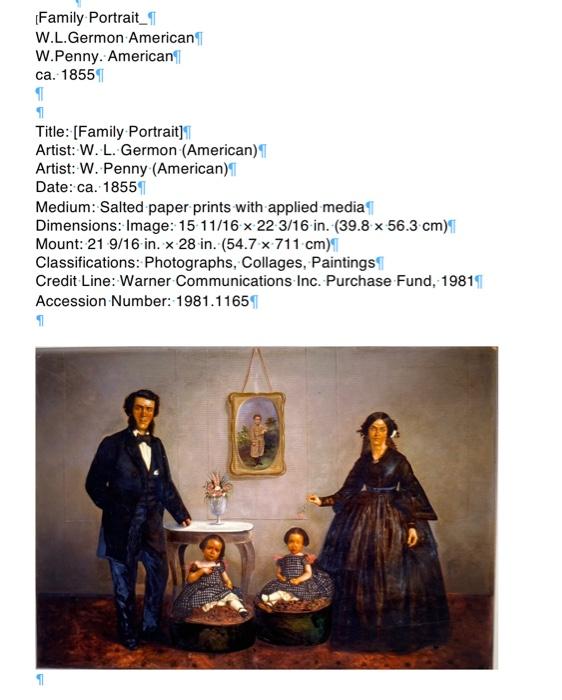
Assignment: Formal Analysis EXTRA CREDIT Format: 2-3 full pages (600-700 words). 12-pt. font, double-spaced, MLA format What is Formal Analysis? Formal analysis presents the challenge of translating the visual (what you observe in the art) into the verbal (what you write). This is not a research paper so dont do it as much andbut rather your own observations and interpretations of the physical qualities of an artwork. You should be able to get all the information you need through close observation. This type of writing is called formal analysis because you are analyzing the form of an artwork, that is how an artist used the elements of art and principles of design to develop the overall composition of an artwork. Writing a Formal Analysis? Step 1: Choose an artworkf The first step is to find an artwork to write about. Choose one painting from the online collection of the Metropoitan Museum of Art that you find visually interesting. Make sure that the artwork you choose is in fact a painting depicted in full color.? Step 2: Spend time with your artworkf When preparing to write a formal analysis, start by spending a good amount of time looking closely at the painting youve chosen. Write detaled notes on how the artist used the elements and principles to create the overall composition. These notes are important, as they will provide the main content for your paper.t Step 3: Organize and write your paper Your formal analysis paper needs an introduction, body. paragraphs, and a conclusion' Part E: Introduction: The first paragraph of your paper should include general information about the painting such as the arlisrs name, the title of the painting. the year it was made, and its current location. Also describe the artwork in a few sentences. How does it look? is it a representation of something? is it an abstraction of something or a non-objective artwork? Tell what the subject is and what aspects are emphasized. This section is not an analysis of the work yet, though some terms used in Part II might be used here.-This section gives the reader a sense of how the artwork looks.? Part H: Formal Analysise The form of every artwork refiects a complex system of choices made by the artist. For this part of your paper, you will describe the elements of art and principles of design and explain how the artist used them to create the composition." This is where those detailed notes you took spring into action." Make sure that you use appropriate art terms when writing about the elements and principles. Part Il should be the longest section of the paper, Part II: Conclusiont This is the part of the paper where you go beyond description and otfer a brief conclusion and your own intormed opinion about the work." How to Write About the Elements of Art and Principles of Design Here are a few example questions to ask about a two-dimensional work of art. This list is by no means exhaustive. You can use your understanding of the elements of art and principles of design to develop other questions. Elements of Art: I I Line: Actual or implied, direction, quality, outline, contour, implied motion? - I Shape: Regular/irregular, geometric/organic? I I Color: Hue, value, intensity, primary, secondary, tertiary, scheme (analogous, complementary) temperature (warm, cool), localcolor? -- I Value: Relative lightness or darkness, modeling of form, chiaroscuro? I I Texture:-Tactile/visual, simulated, abstracted, invented? - I Space: Flatness/depth, positiveegative, overlapping, type of perspective (linear, atmospheric, oblique)? Principles of Design: I I Balance: Visual weight, symmetrical, asymmetrical, radial? I I Rhythm: Repetition or pattern of elements? - I I Proportion/Scale: How do the sizes of objects or figures relate to each other within the composition? Is one thing larger or smaller than the rest? Larger or smaller than expected?? - II Emphasis: Which elements) stands out and why? - I I Unity/Variety: Elements that cohere because of sameness? Contrast because of difference? Pro-Tips: I I Keep your paper concise and use proper terminology, punctuation, and grammar. I I Italicize titles of works of art. I I Allow time to proofread your paper. Read it out loud and see if it makes sense. 7 [Family-Portrait_] W.L.Germon American W.Penny. American? ca. 1855 Title: [Family Portrait]? Artist:W. L. Germon'(American) Artist: W. Penny (American) Date: ca. 1855 Medium: Salted paper prints with applied media Dimensions: Image: 1511/16223/16 in. (39.856.3cm) Mount: 219/16in28in.(54.7711cm) Classifications: Photographs, Collages, Paintings? Credit Line: Warner Communications Inc. Purchase Fund, 1981 Accession Number: 1981.1165
Step by Step Solution
There are 3 Steps involved in it

Get step-by-step solutions from verified subject matter experts
 Study Help