







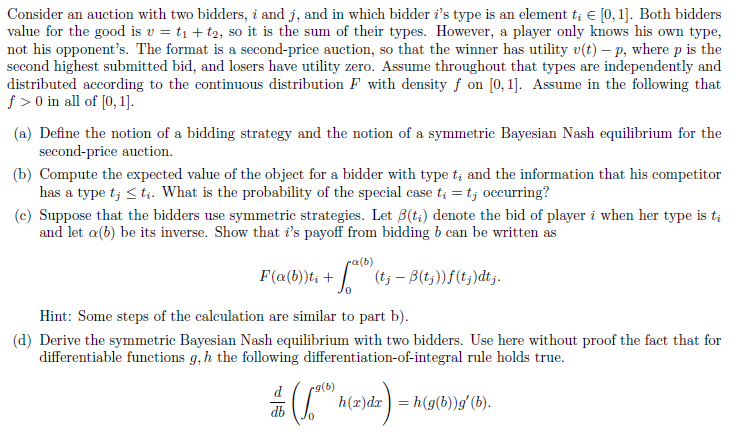
Question: Need help with this game theory question(all information are provided in the question) Consider an auction with two bidders, 1? and j, and in which
Need help with this game theory question(all information are provided in the question)
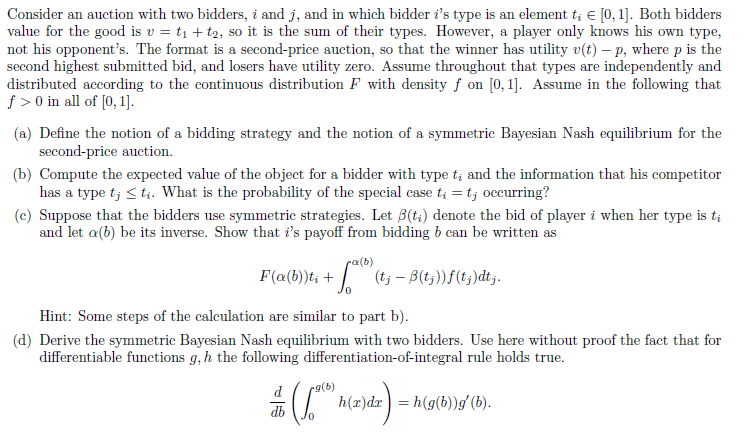
Consider an auction with two bidders, 1? and j, and in which bidder i's type is an element t; E [0, 1]. Both bidders value for the good is if = 1 + 122, so it is the sum of their types. However1 a player only knows his own type, not his opponent's. The format is a second-price auction, so that the winner has utility rMt) p, where p is the second highest submitted bid, and losers have utility zero. Assume throughout that types are independently and distributed according to the continuous distribution F with density f on [I], 1]. Assume in the following that f 2 I] in allof[l],1]l [a] Dene the notion of a bidding strategy and the notion of a symmetric Bayesian Nash equilibrium for the secondprice auction. (b) Compute the expected value of the object for a bidder with type t.- and the information that his competitor has a type t3; 3 ti. What is the probability of the special case t,- = t; occurring? (c) Suppose that the bidders use symmetric strategies. Let Sm) denote the bid of players? when her type is t.- aud let CEUJ} be its inverse. Show that i's payoE from bidding in can be written as o:(b) Foam.- + f to menial-Mt;- Hint: Some steps of the calculation are similar to part b}. (d) Derive the symmetric Bayesian Nash equilibrium with two bidders. Use here without proof the fact that for differentiable functions 9J1. the following dierentiationofintegral rule holds true. nib] % (A new) = homes)
Step by Step Solution
There are 3 Steps involved in it

Get step-by-step solutions from verified subject matter experts
 Study Help